
Top 10 reasons to take or not a bus in Laos
In our trip from Huay Xai to Luang Prabang, we experienced both transportations: slow boat and bus. Therefore we know what we are talking about :-)
Everyone talks about the slow boat and how amazing it is, but only a few mention that there are alternatives. We like out of the box experiences, so we found that alternative. For us, it has been the local bus.
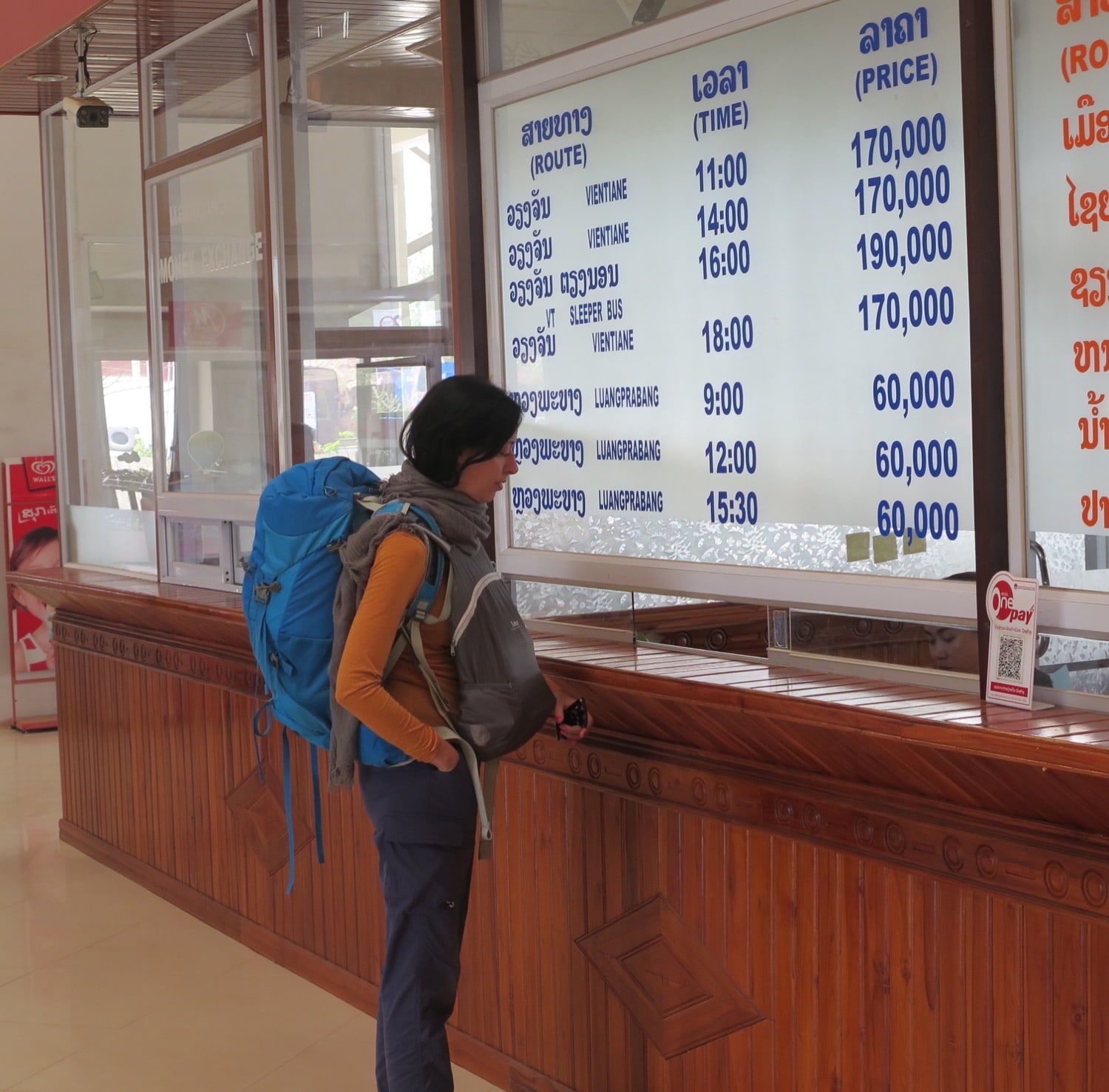
Just a small tip to start: do not book bus transfers via an agency or via your guesthouse. It is easier to buy the tickets directly at the bus station on the same day but you should first check the transfer's cost online. At some bus station, people will try to let you pay much more than due... Only in bigger stations, prices are exposed, so you are sure you will not get scammed.
So, if you are reading this post, I guess you are thinking about taking the bus because you are sick of travelling by slow boat. Or, are you willing to spend other 9 hours on that "thing"? If not, just take the bus!
You should take the bus from Pakbeng to Luang Prabang if...
1 ... you love bus stations... small bus stations
To reach the bus station, it is already an adventure. We have been told that it is far away from the village and that we needed a transfer to go there. Ok, we booked a car via our guesthouse for 40'000 LAK (4.60 $) in total. On that morning, we have been informed that the car was not working, and the only way to go to the station was... by scooter!
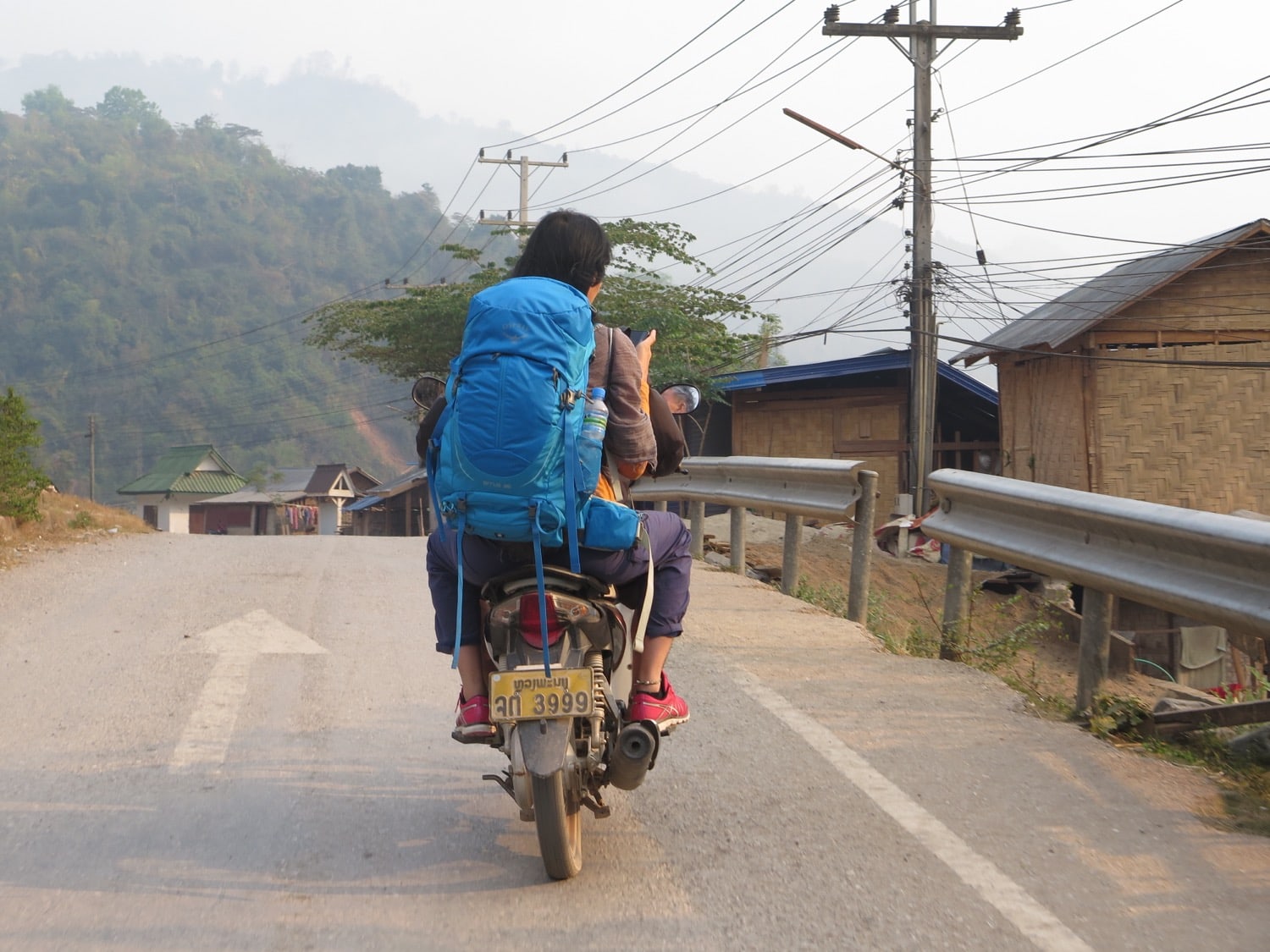
Never mind, as there were no alternatives, we accepted.
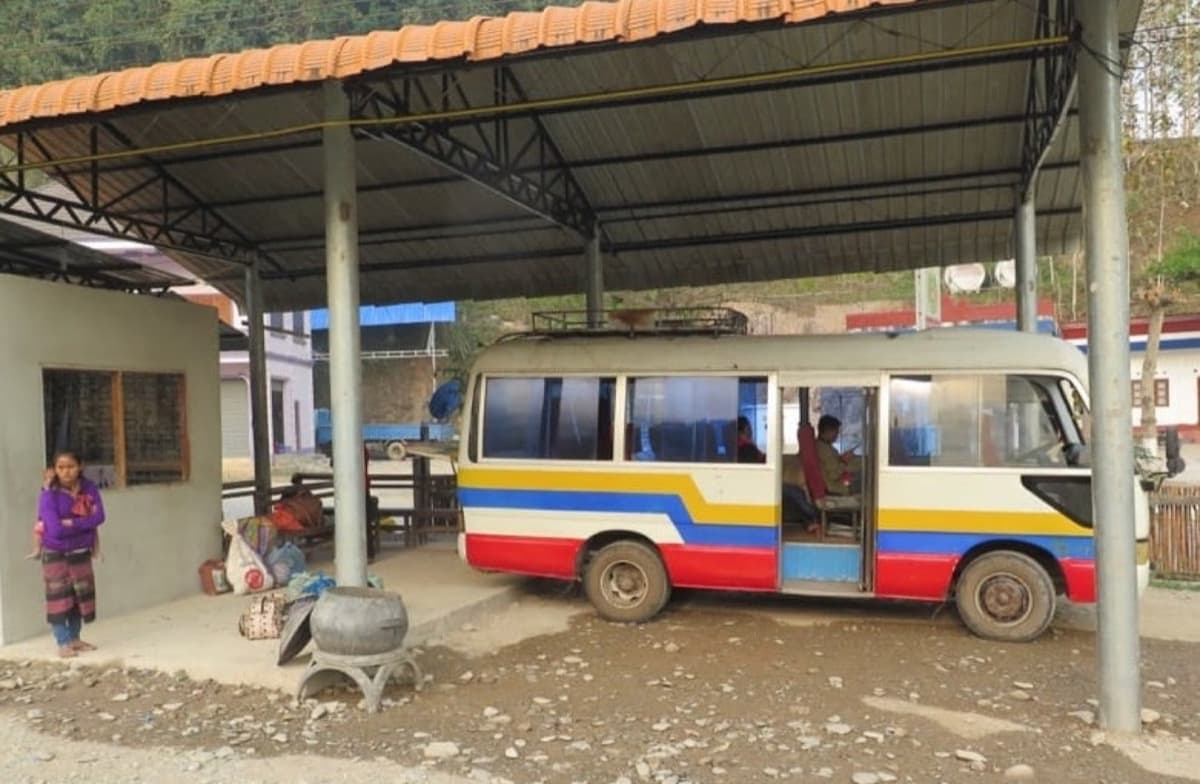
After 15 minutes drive, we arrived at the bus station which was actually a 4 sq office, with 1 bus parked outside.
2 ... you know what to expect by travelling by local bus
The trip should last 3-4 hours, but would the bus work for so long? It was not in really good conditions... and for 40'000 LAK (4.60 $) each, you expect something a bit better. Just to make you guys laugh a bit: before leaving, the driver distributed plastic vomit bags to everyone. Nightmarish, right? We personally didn't need it, but all the kids onboard used it! By the way, we were the only tourists there.
We looked for the best seats (or, better, the least worse...) but, as always, they were too small for us. We couldn't move our legs for hours, and at every bump, I hit my head on the baggage racks.
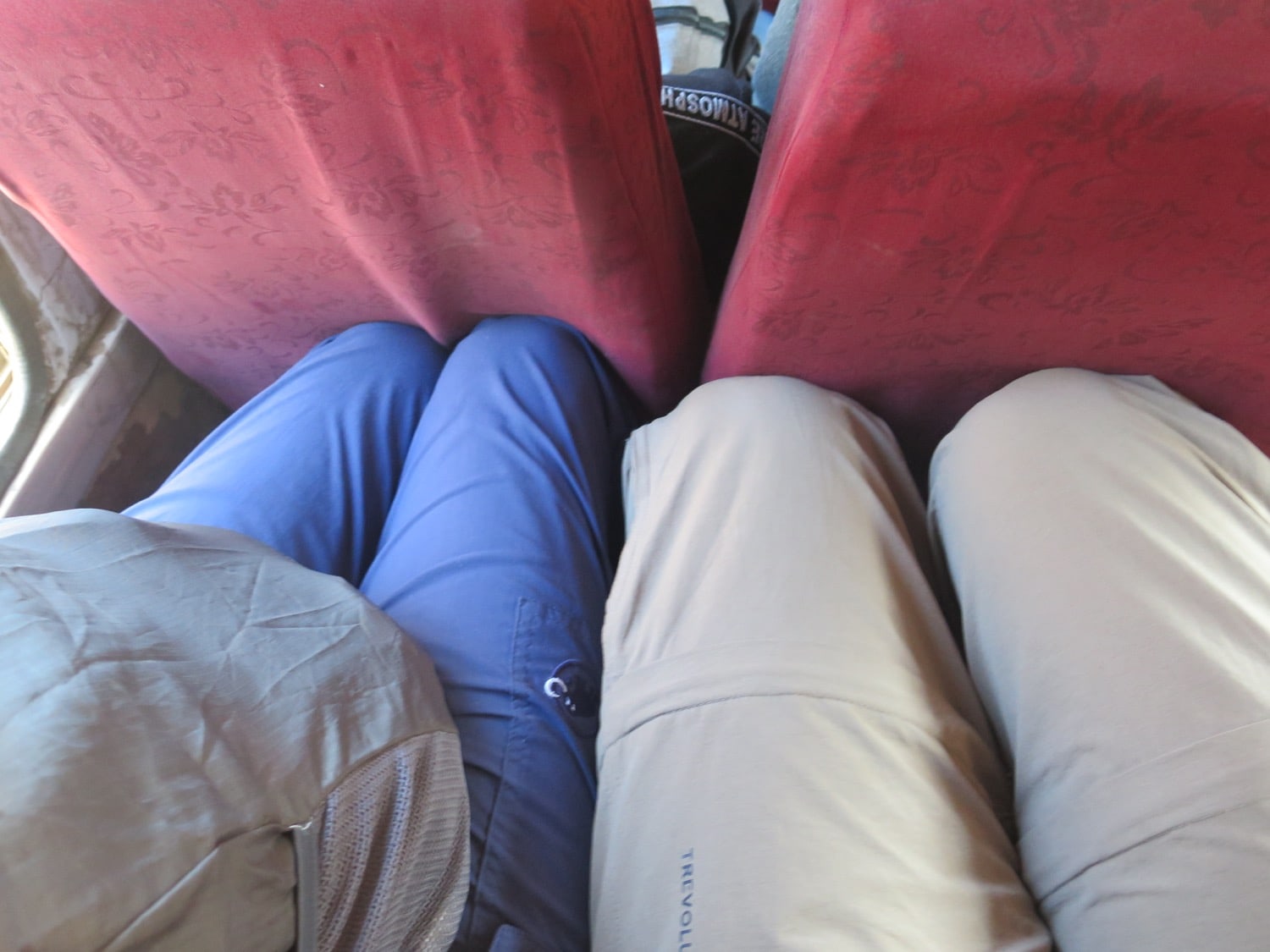
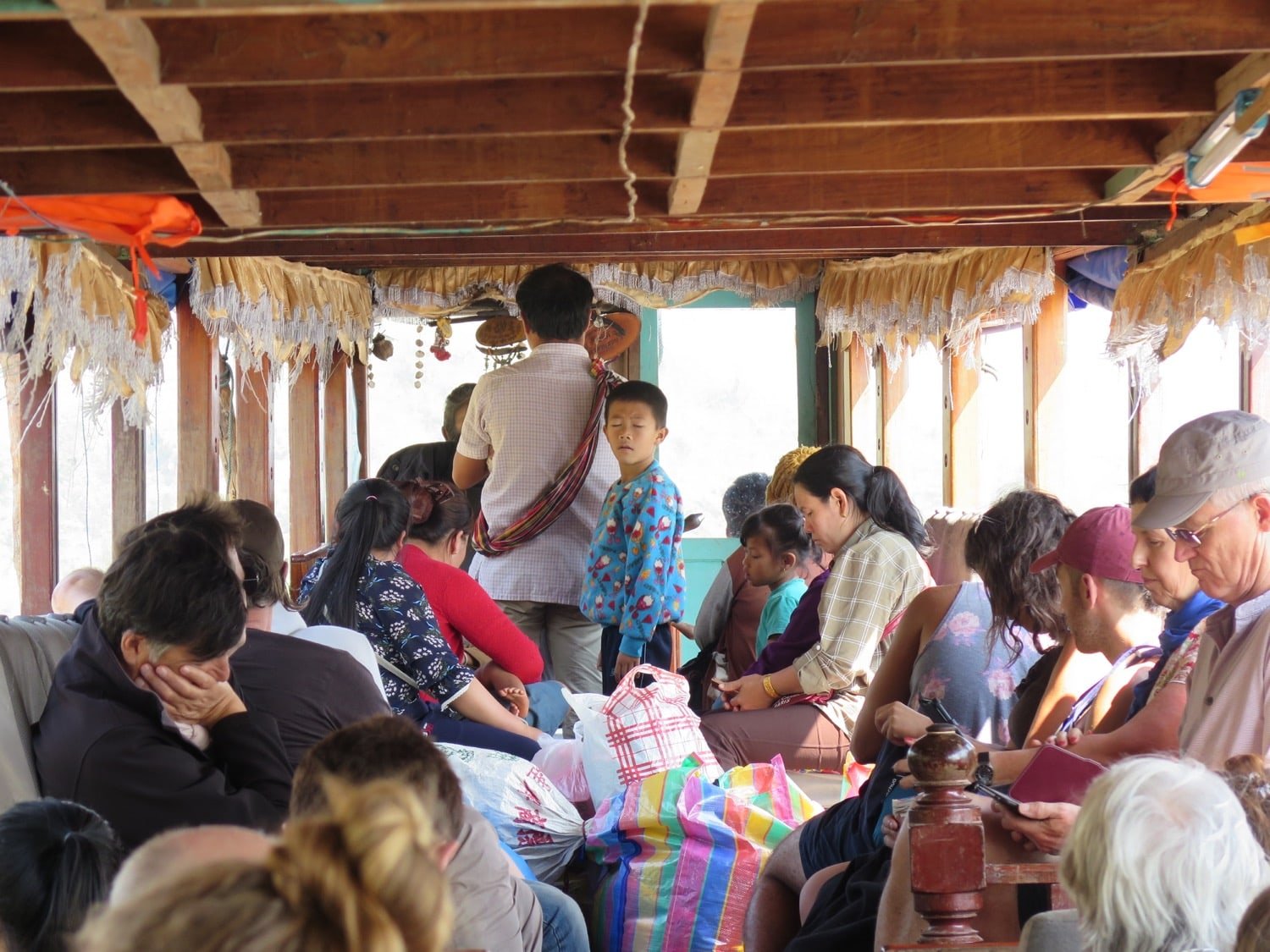
The local bus stops here and there, where there are people waving at it. During our trip, we collected so many people that the bus was super full. When you think that "now it is enough, we are too full", you will find out that a couple of extra people can still fit... The bus had 20 seats, but on board, we were almost 40!
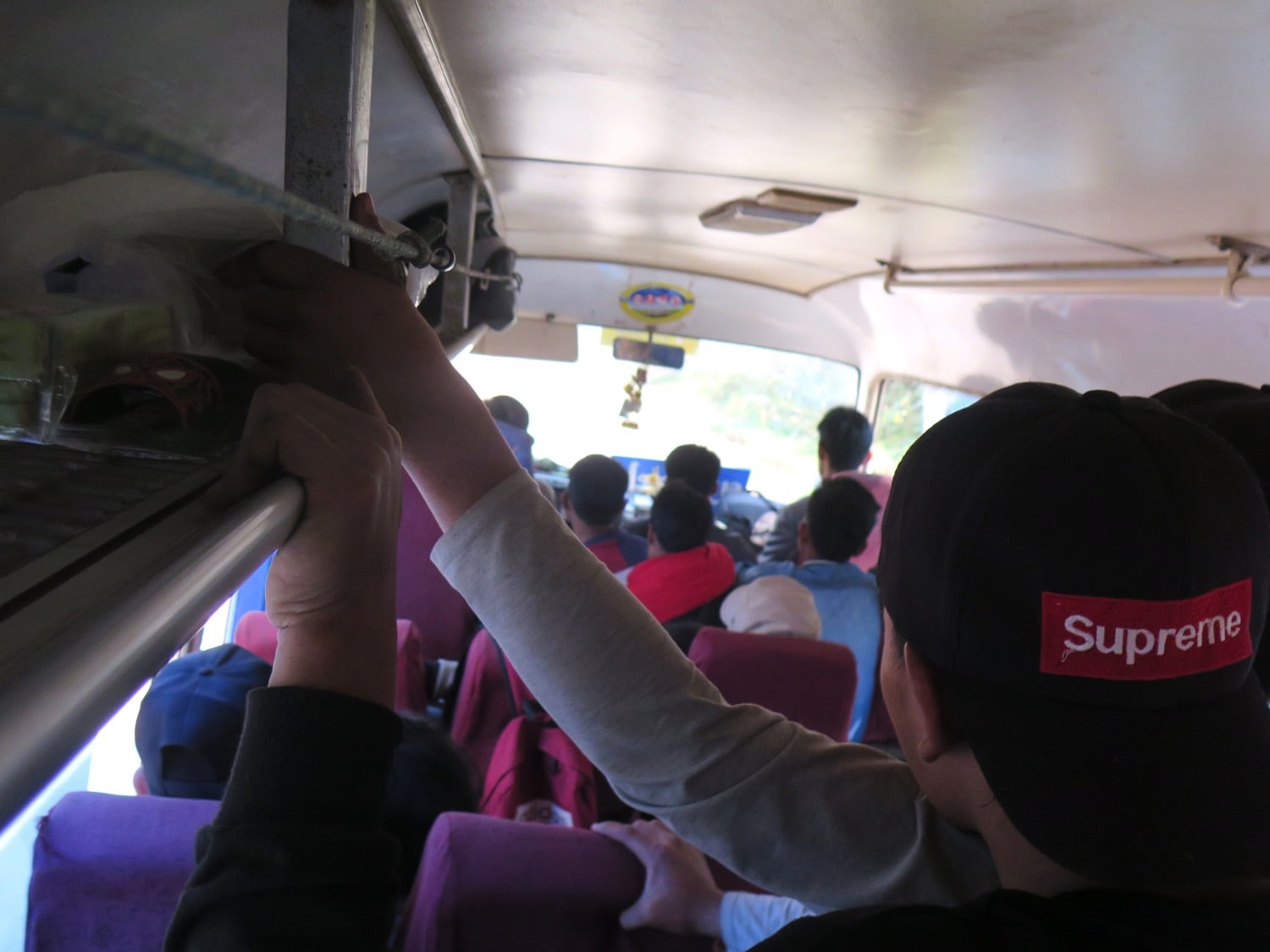
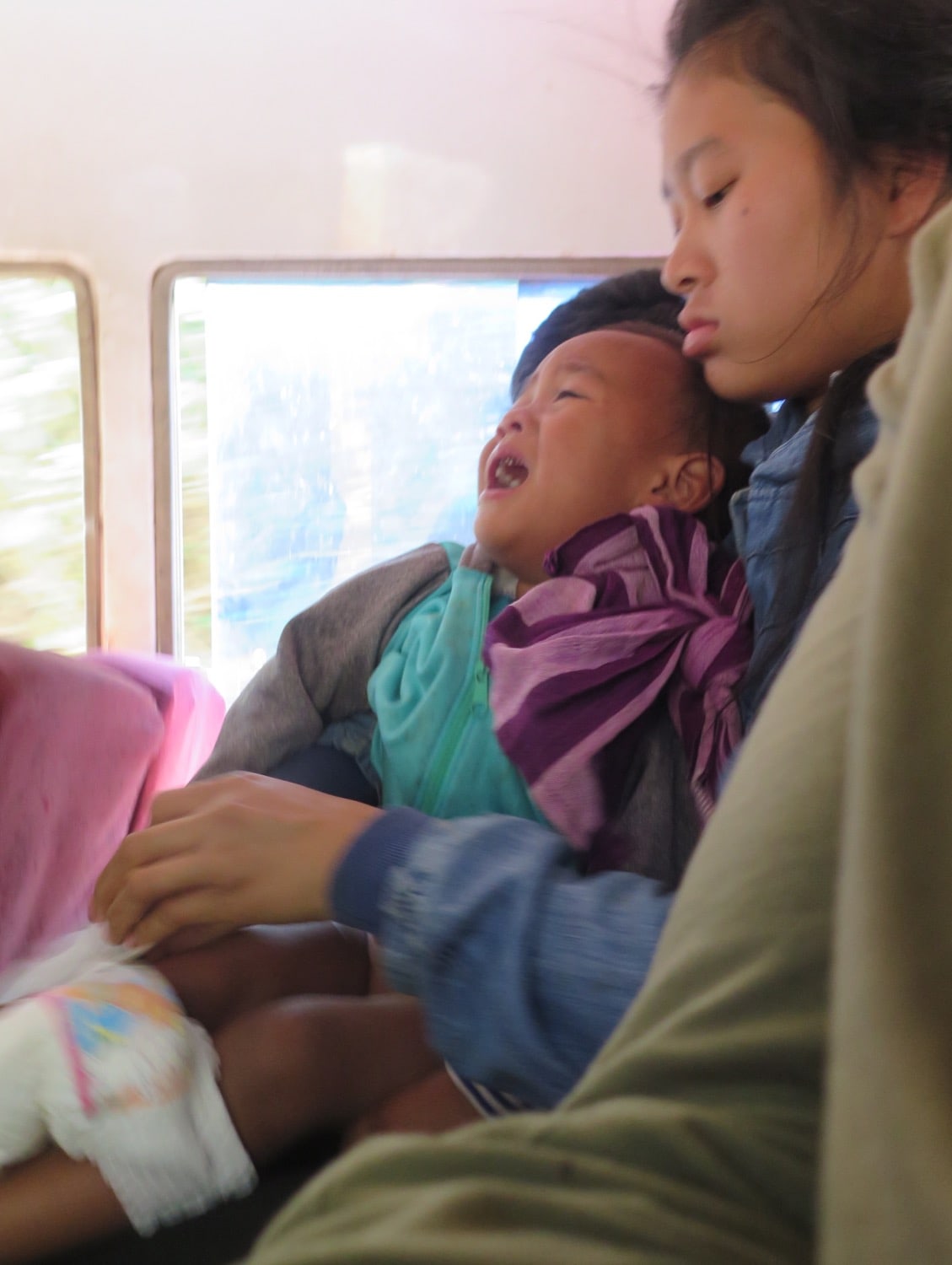
Several guys had to stand in the bus, and slowly kids started to become nervous, to cry and scream. One had even his diaper changed on the go!
3 ... you like sauna
Of course, there was no air conditioning on the bus. We all opened the windows, but it was not really a good idea. Roads are not paved, so outside it is full of dust. Moreover, the bus was so old that the engine started to smell like fuel after 20 minutes of the trip... The positive thing was that thanks to a mix of smells, we didn't notice the vomit one.
4 ... you like risk and adventure
Seat belts were not there. Don't they take care of travellers and their safety? Well, they do. You can find a safety label stuck on the driver's window. Among them, you see that you should wear a helmet!
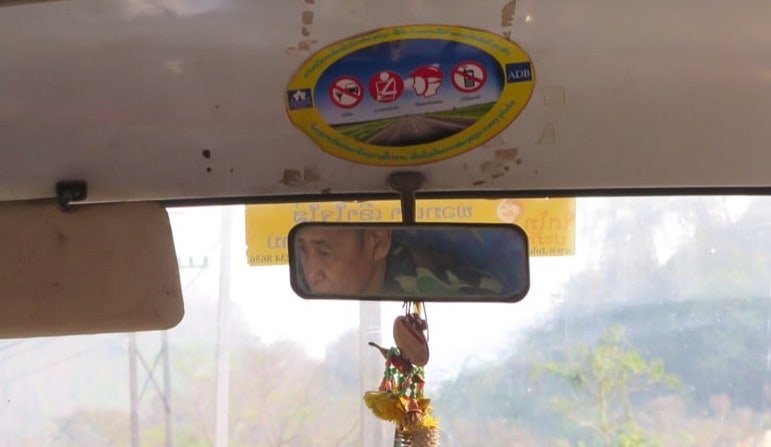
The road is really in bad conditions, and this is the same situation you will find in all the country. At every bump, we hoped that the bus stayed one-piece and wouldn't break. At a certain point, after a huge hole, the driver stopped the bus and went out to check if we lost any piece. Fortunately, everything was "ok", and we could continue our amazing trip.
The driver, who was wearing a US army uniform and flip flops, was a funny and old guy. Like it was no big deal, he started to smoke cigarettes inside the bus while driving... And, when we were almost in Oudamxay, he stopped the bus in the middle of nowhere and went through the bus to collect the tickets' money from everyone. If you don't understand what's going on, it can be a bit weird.
5 ... you like shiatsu massage
As already mentioned, the roads are very bad in Laos. There are no highways from Pakbeng and Luang Prabang, so we drove on the main street which, for us, had the same conditions as a mountain dirt road.
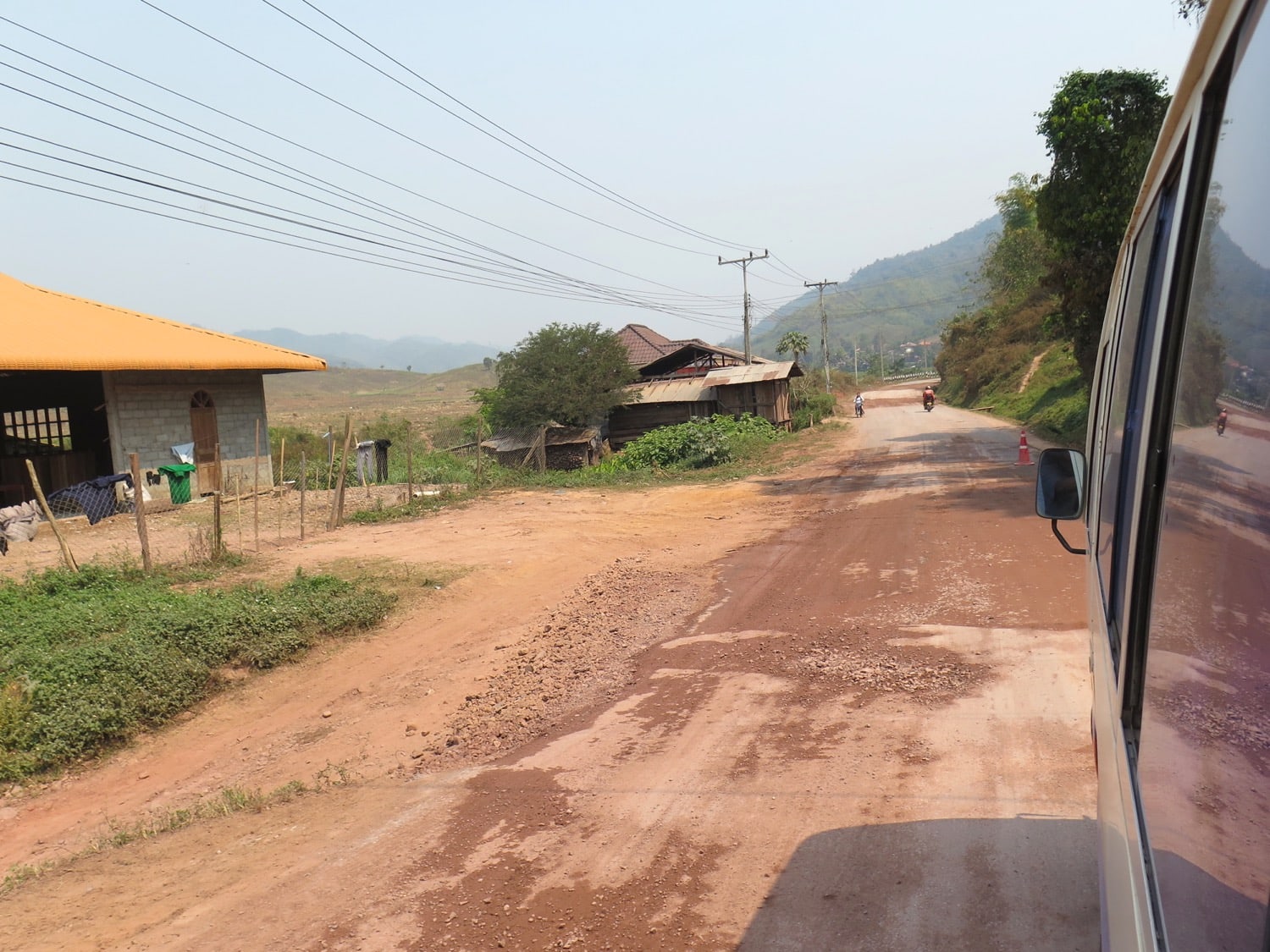
Even if a 3-4 hours massage is maybe too intense...
6 ... you like being watched like an alien
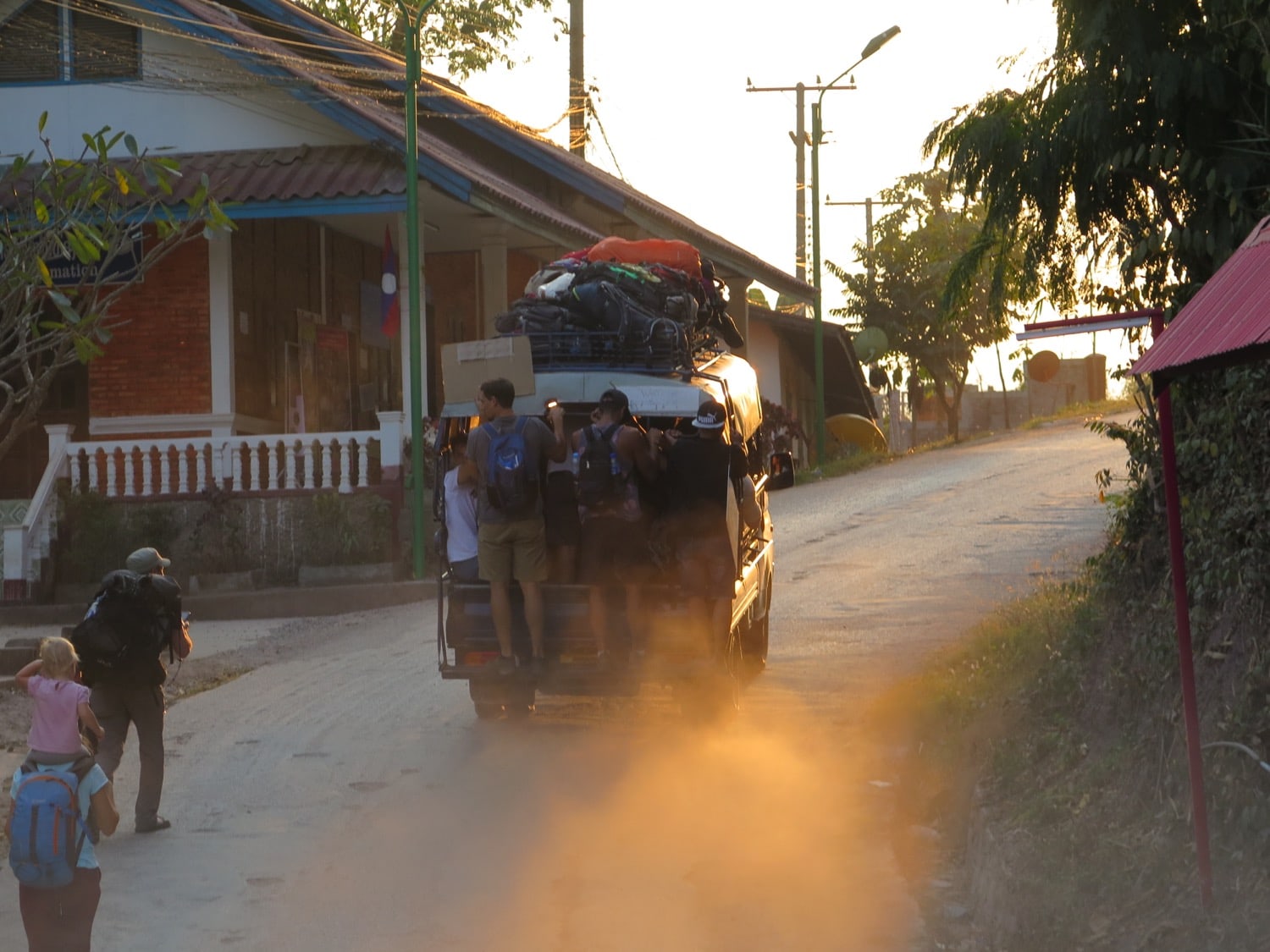
This is not a common touristic way; we were the only 2 tourists there. While passing among villages, we crossed local people' gazes. They intensely looked at us, in a deep way. Partially it was curiosity, and partially it was because of their appearance. They sometimes look angry, but they are simply watching.
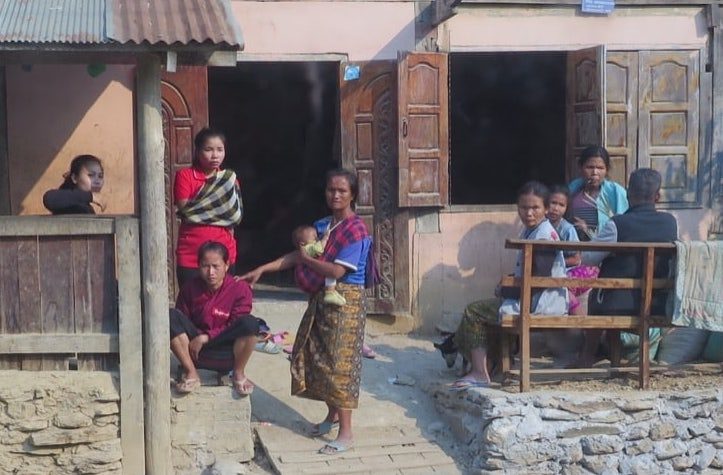
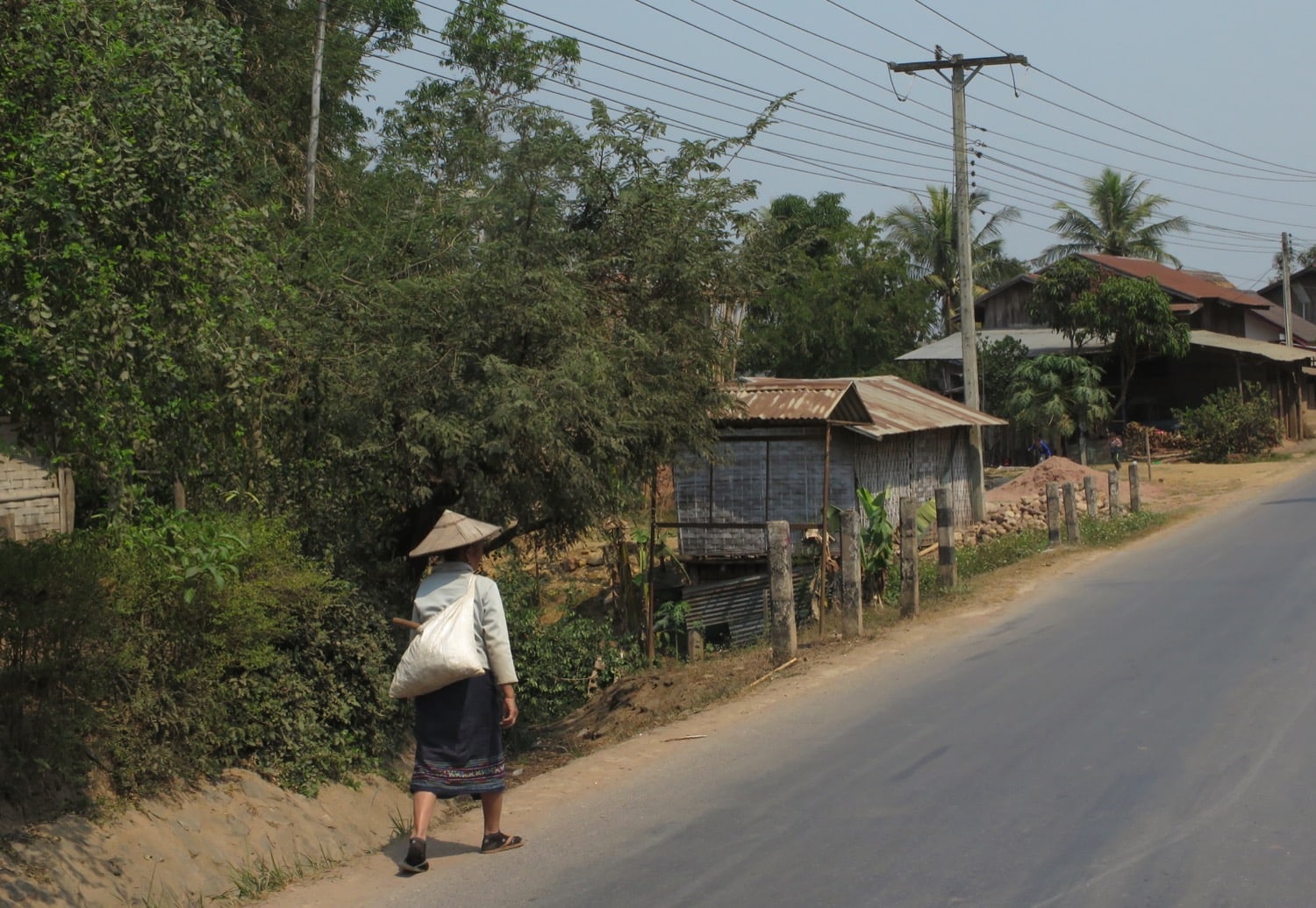
Very often it is shocking to see how much poverty there is outside the main cities. People live in extremely bad conditions, in simple huts on stilts, without running water. Kids play on the road, often naked, animals freely go around, and so on. If you travel by bus you can visualize these realities and keep them in your heart forever. When you complain about some "modern problems", you will think about that.
7 ... you know you will never be on time
Not much to say here, but consider that when they say that the trip lasts 3 hours it will probably last 4 or more. This is due to the bad conditions of roads and buses. The average speed is 30-40 Km/h, and it is full of curves.
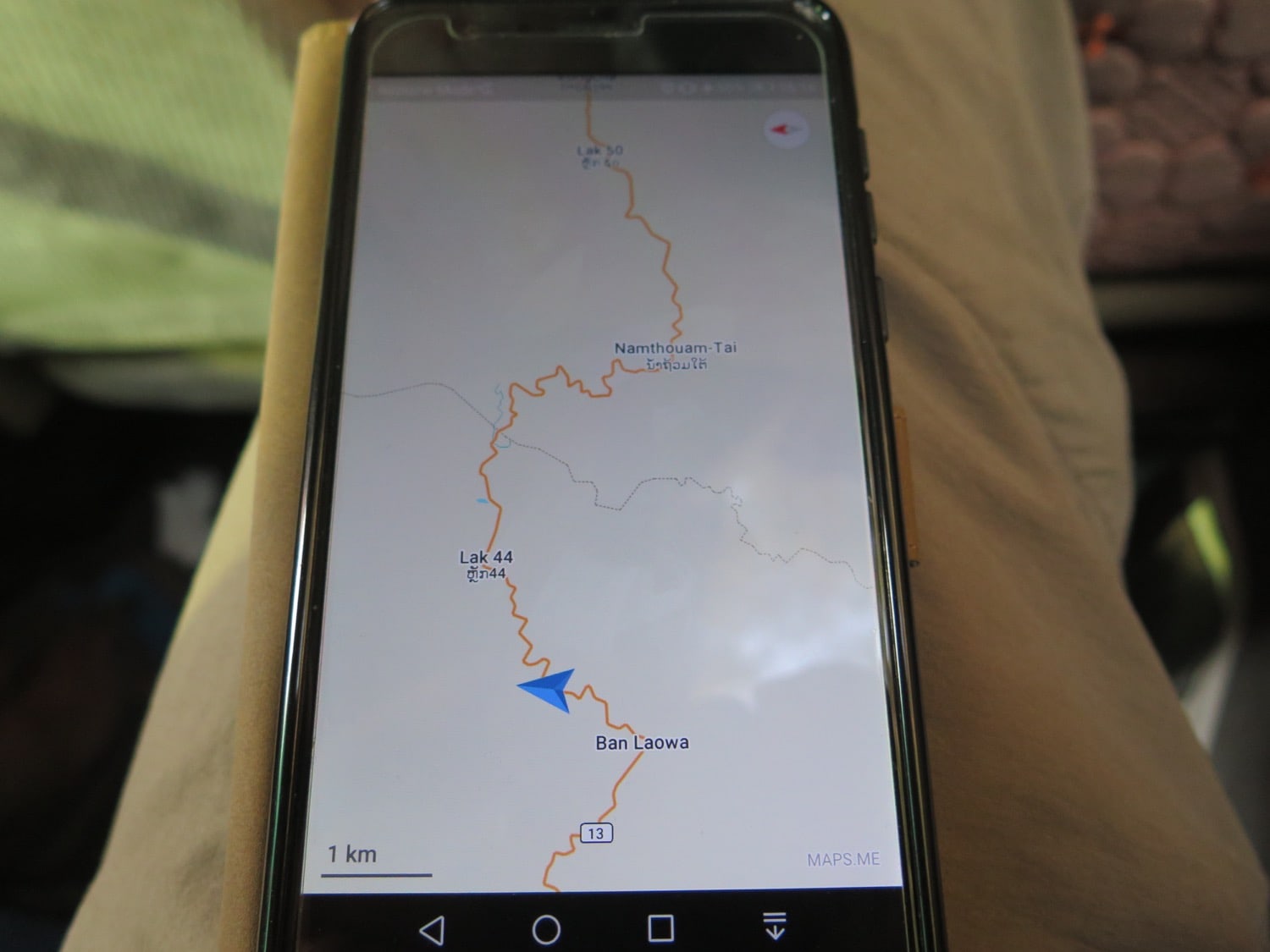
8 ... you like wonderful landscapes
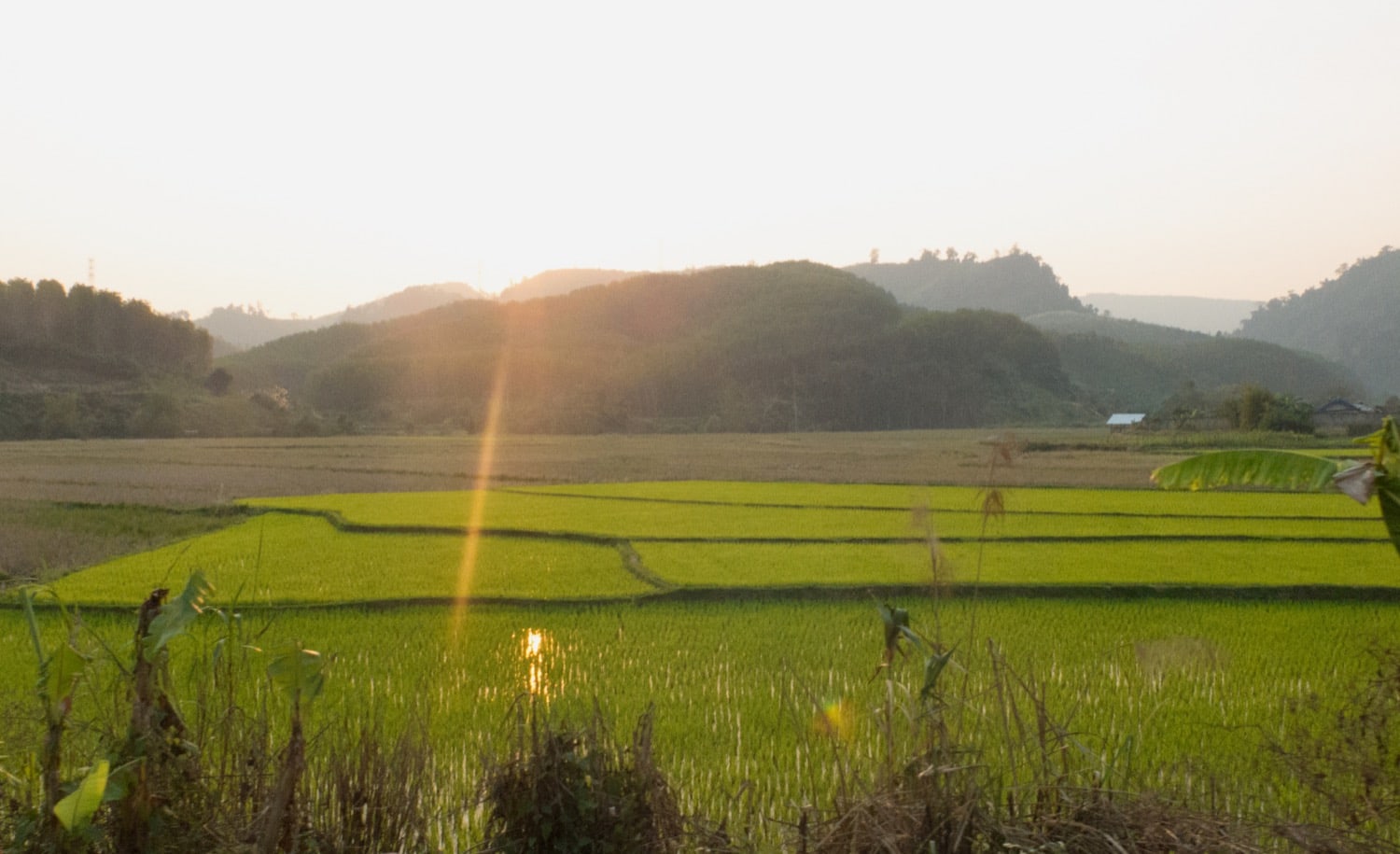
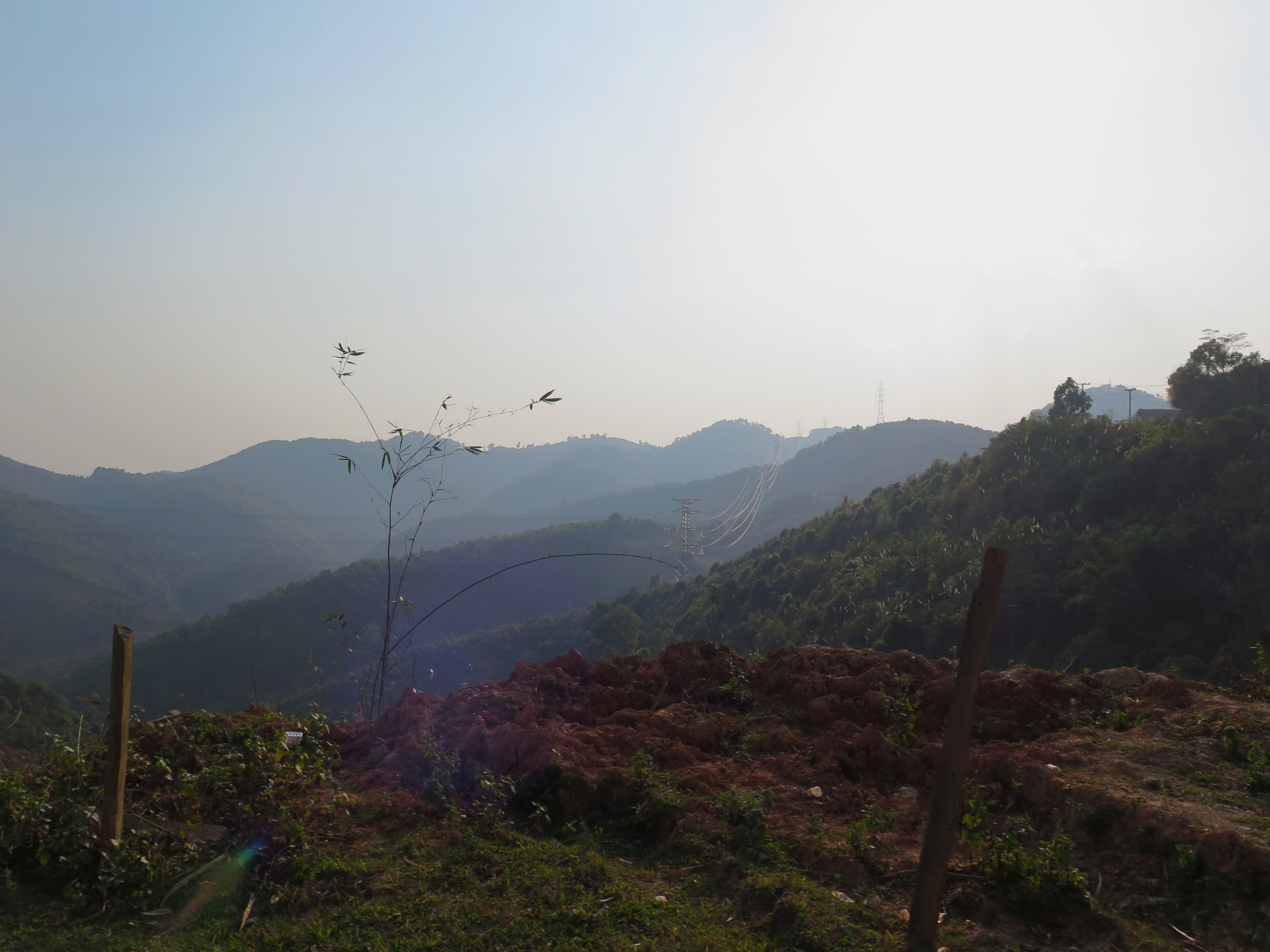
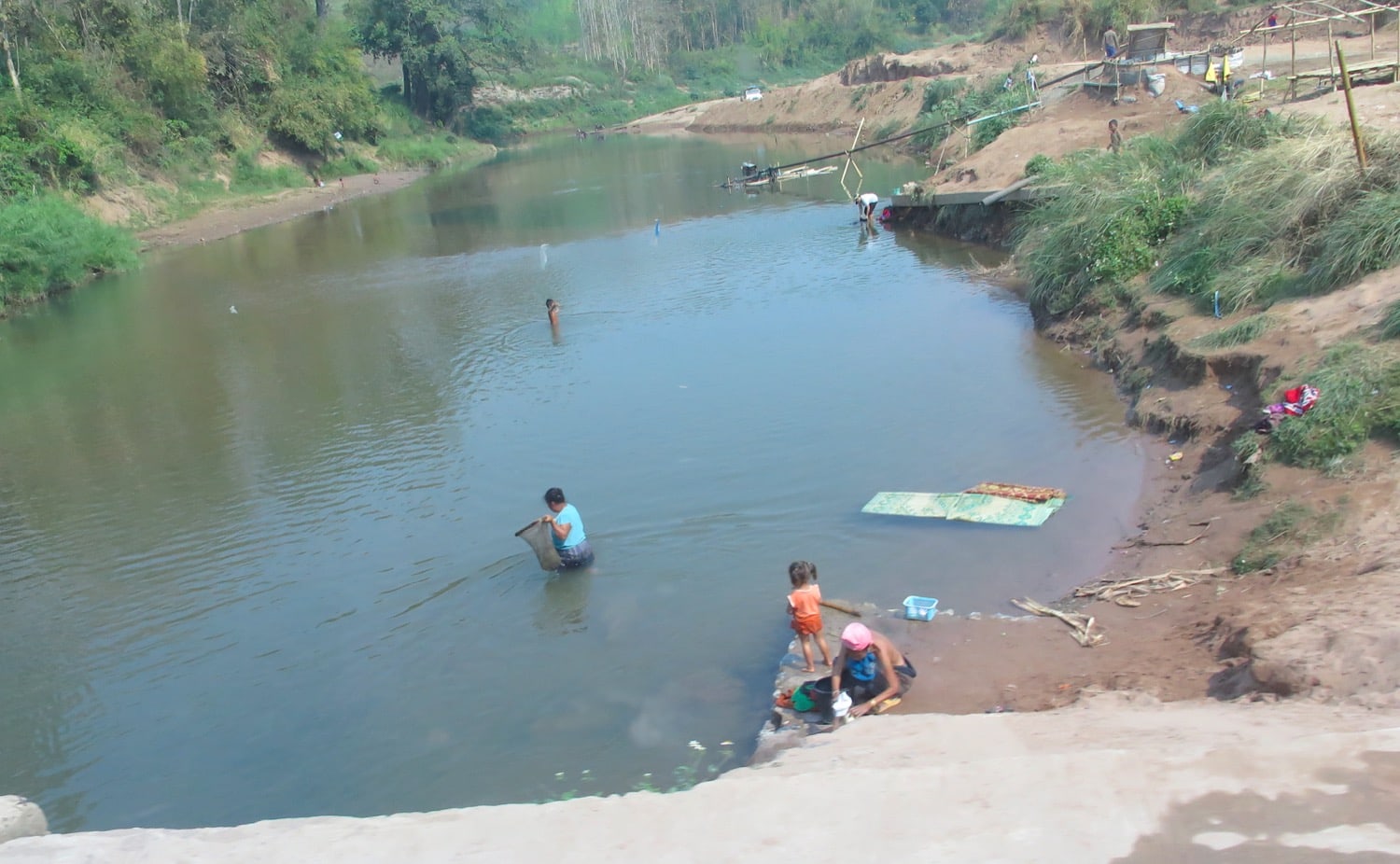
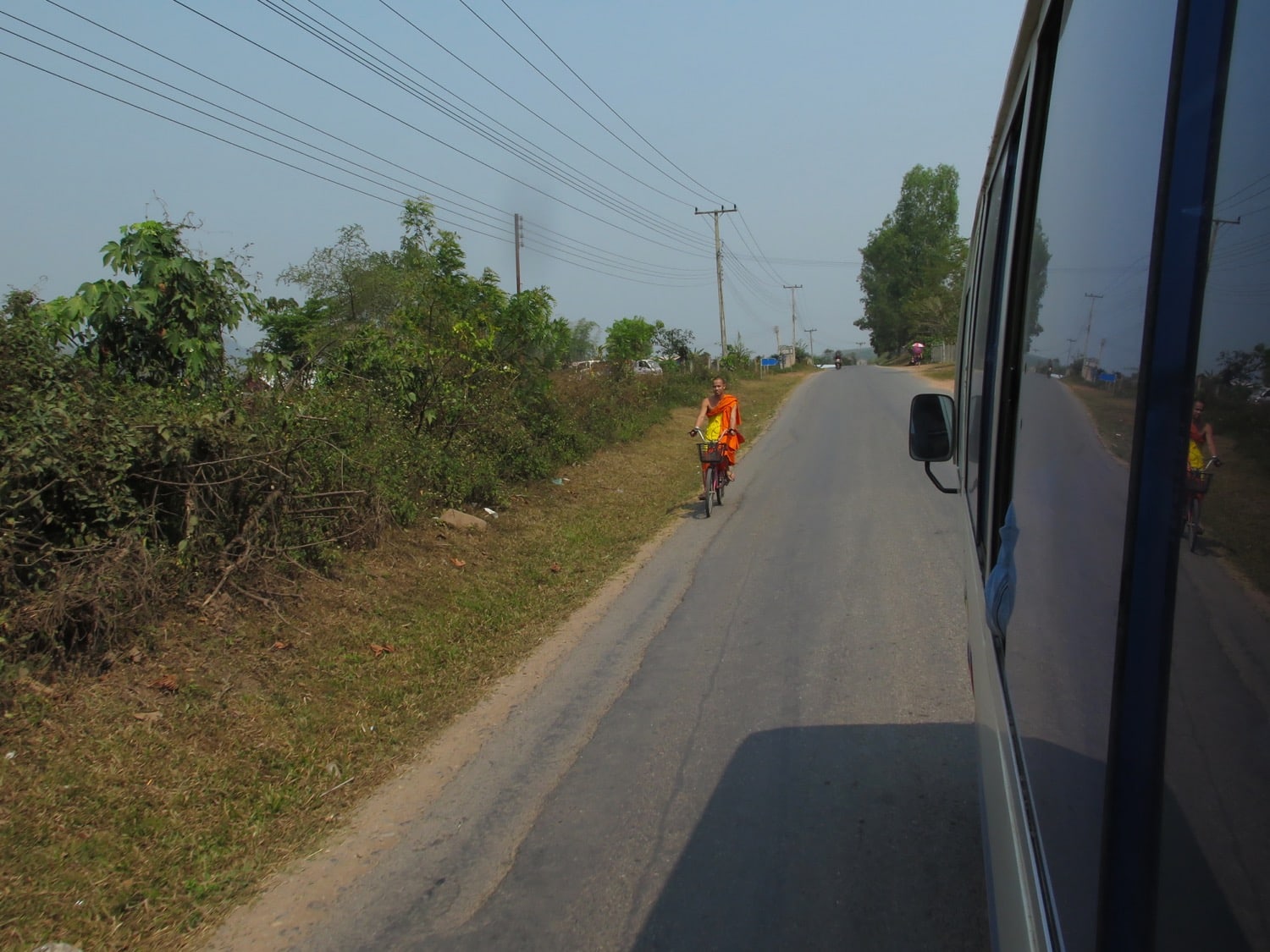
Despite the curvy and bumpy road, the landscape is really breathtaking! You will go through the jungle, villages, small cities, rice fields, green mountains, and so on. From this point of view, it is really worth it to travel by bus.
9 ... you don't mind if your luggage gets lost
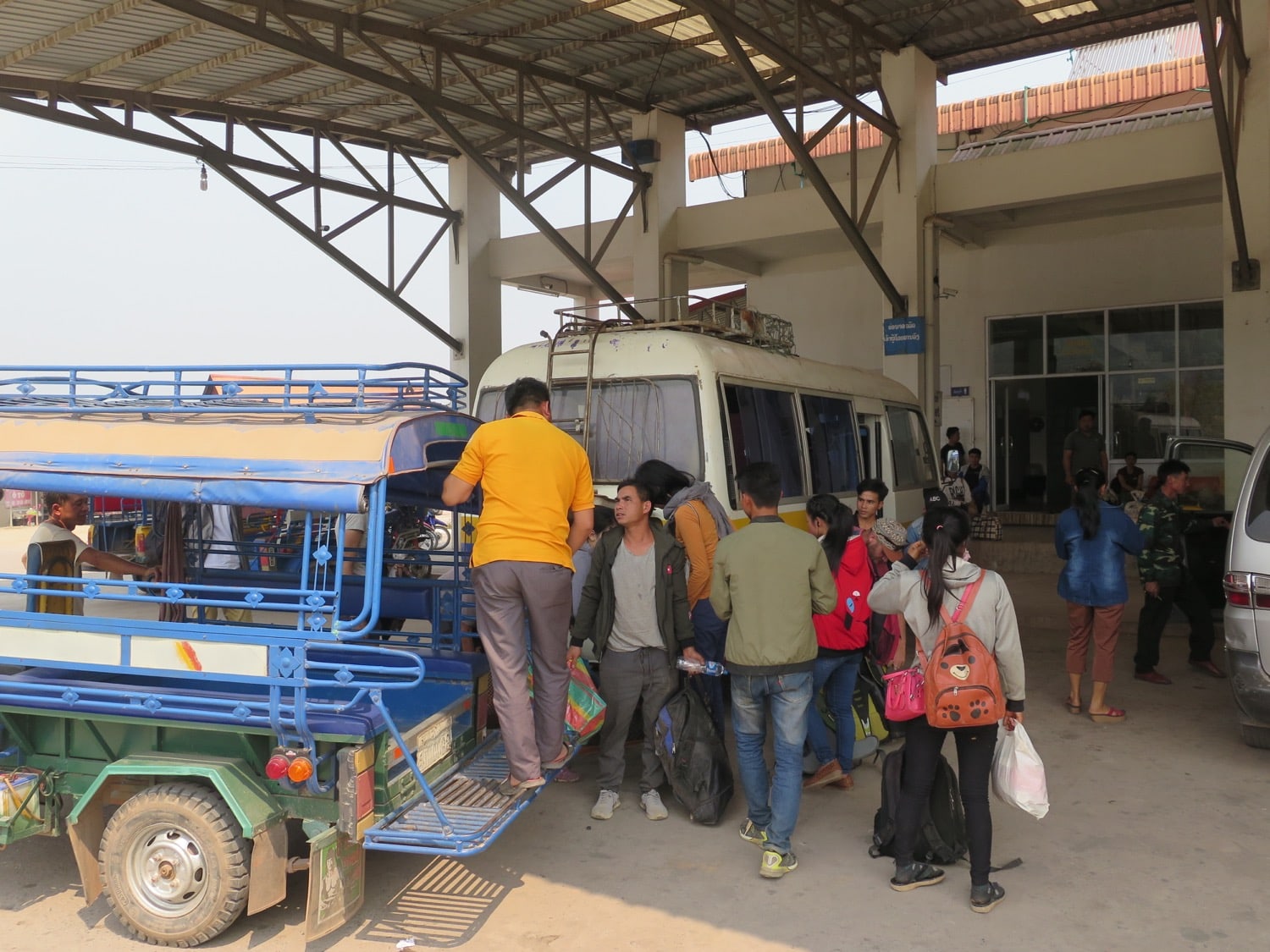
During the trip, there are dozens of travellers going in and out, together with their luggage which is not always a backpack or a suitcase. In our case, many people were travelling to the city because there was the market. Probably they had a booth there, so they transported big bags full of products, food, clothes, etc. to sell.
What if, by mistake, someone took your backpack too? We always have a day backpack with us, containing all the important things. But still, it is a relief when, at the end of the "shiatsu trip", you see your backpack in the trunk!
10 ... you are a dreamer
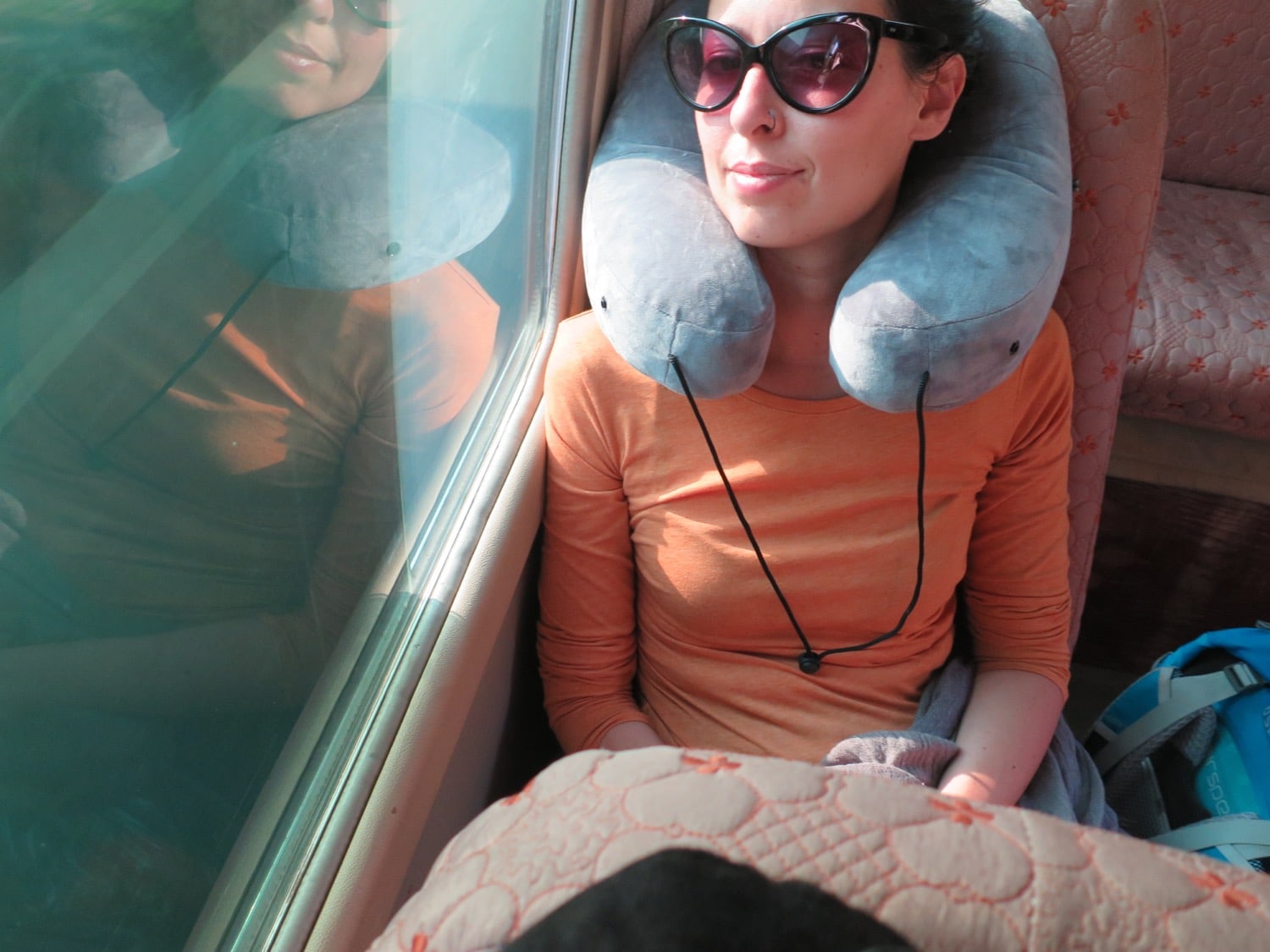
Dreaming about a VIP bus, with all comforts and enough space for everyone... Yeah, that would have been nice, but travelling in local-style is more emotional, it is an experience, you feel part of the community and part of the trip. You have enough time to think about life, experiences, future objectives and much more.
Maybe it isn't the most convenient way to travel, but it is an adventure and we highly recommend to do it once :-)
That's about it at the moment. Talk to you soon!

Huay Xai: what to do [short guide]
Welcome to Laos!
Our first stop in Laos has been in Huay Xai, a village located just after the Thai-Laos border and famous because it is the departure point of the slow boats. If you plan to go to Pakbeng or Luang Prabang by slow boat, you can find some tips about how to organize it in our next post.
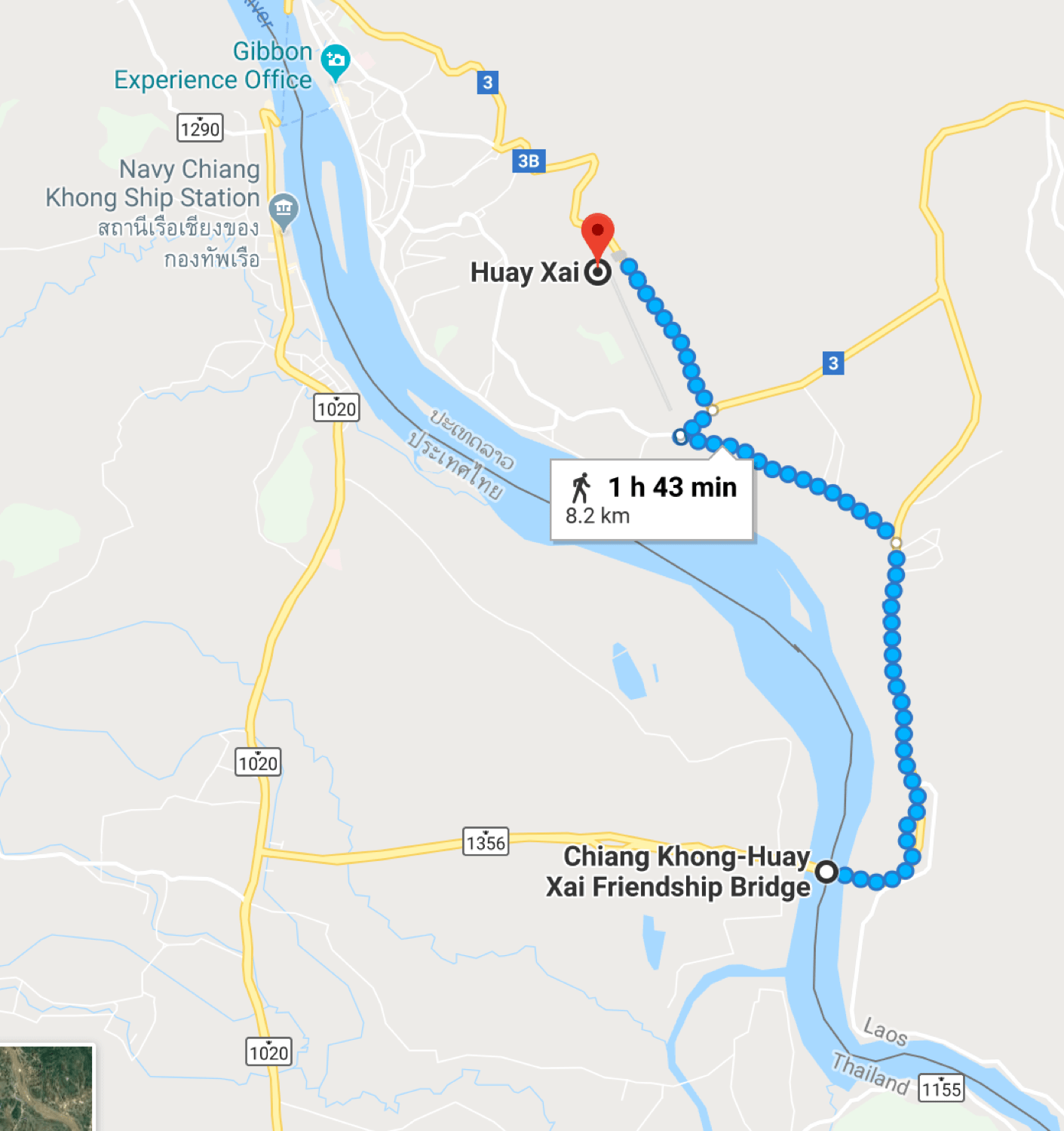
But, what can you do in this little village?
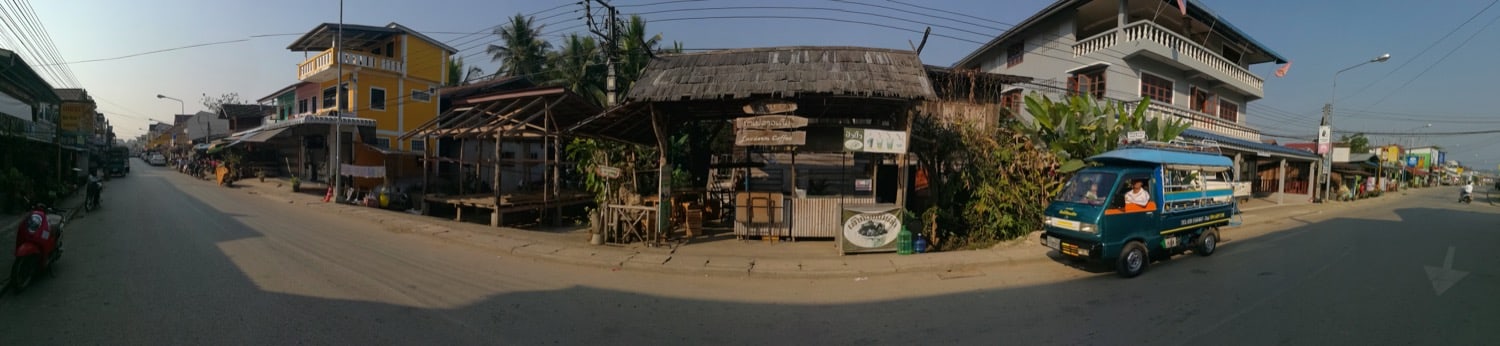
Actually, almost nothing. Oh well, there is a cool activity called “the Gibbon Experience” but it is really expansive. You live 2-3 days in the jungle (national park), in tree-houses and you can reach them only with a zip line. There is no electricity but it must be a very exciting once-in-a-life experience.
Or (less adventurous) you can participate in the “elephant reading” project: you entertain English conversations with monks or kids so that they can practice their language skills. This activity takes places every day from 5.30 pm to 7 pm.
If you need to exchange money and you go to the bank, make sure that your $ notes are clean (no pen or spots) and relatively new (newest series and no rips). Otherwise, they will not accept them. At the exchange desk they are not so strict, but still, they check every note. The exchange rate is similar, but a bit more convenient at the bank (no passport needed).
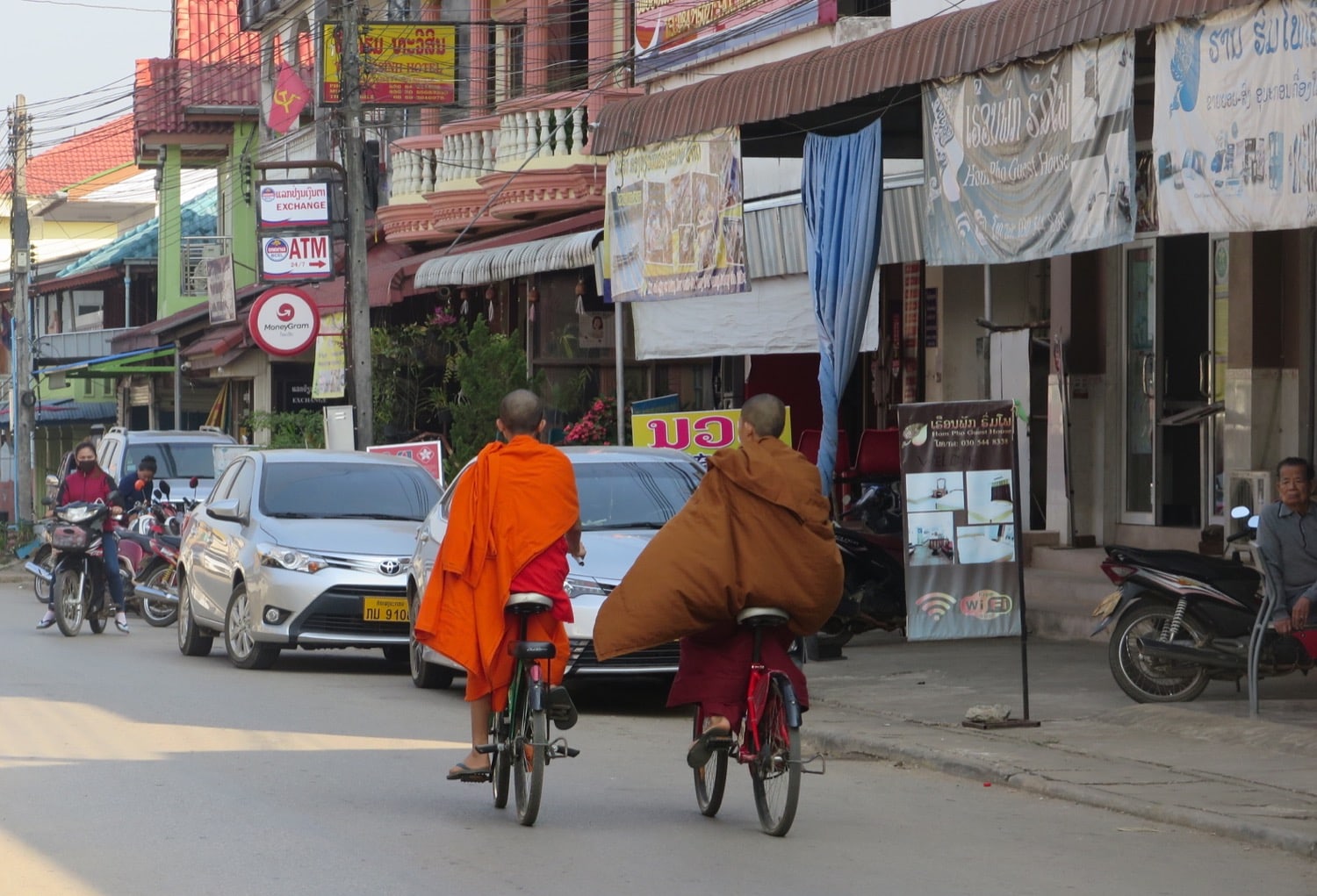
There are few restaurants, but they are a bit overpriced for the quality they deliver. To give you an example: for 2 complete meals with drinks (1 juice each), you can pay the same amount as one night in a hotel! In average, for 1 dish you can consider 15-20’000 LAK (1.50-2 $) and for 1 drink 10-15’000 LAK (1-1.50 $). We understood that probably the land is much cheaper than food, this is why to rent a room is relatively cheaper and the shops have huge surfaces (even if empty).
We found a nice project, a restaurant-accommodation owned by the women from the mountains and their families. It is called Daauw Home. These ladies cook on the wooden fire, using their organic products. We tasted a bowl of vegetables for 18’000 LAK (2$),...
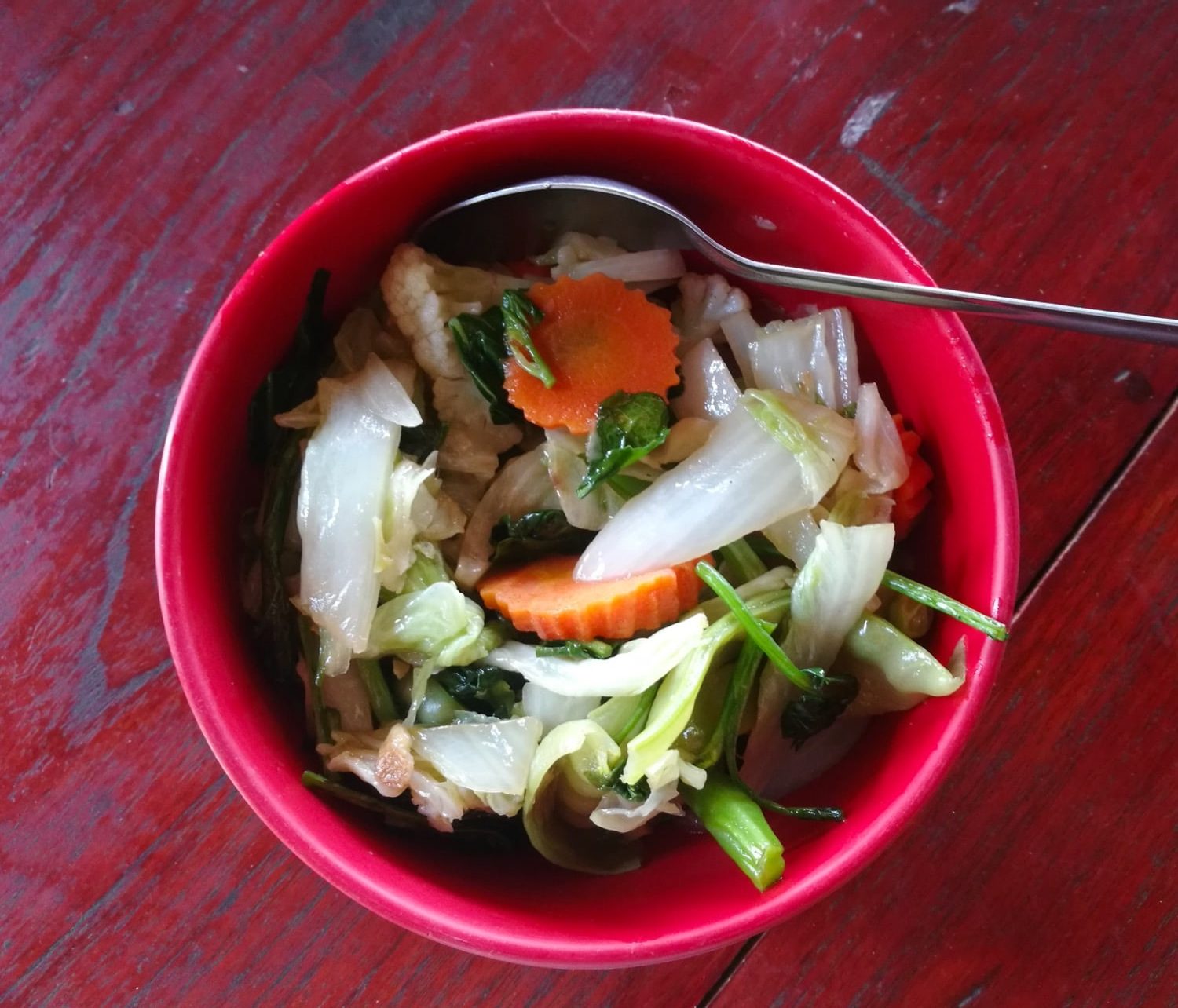
... but their speciality is the pizza from the mountains, cooked in the wooden oven. It is tasty, but quite expansive: 65-70’000 LAK (7.50-8 $).
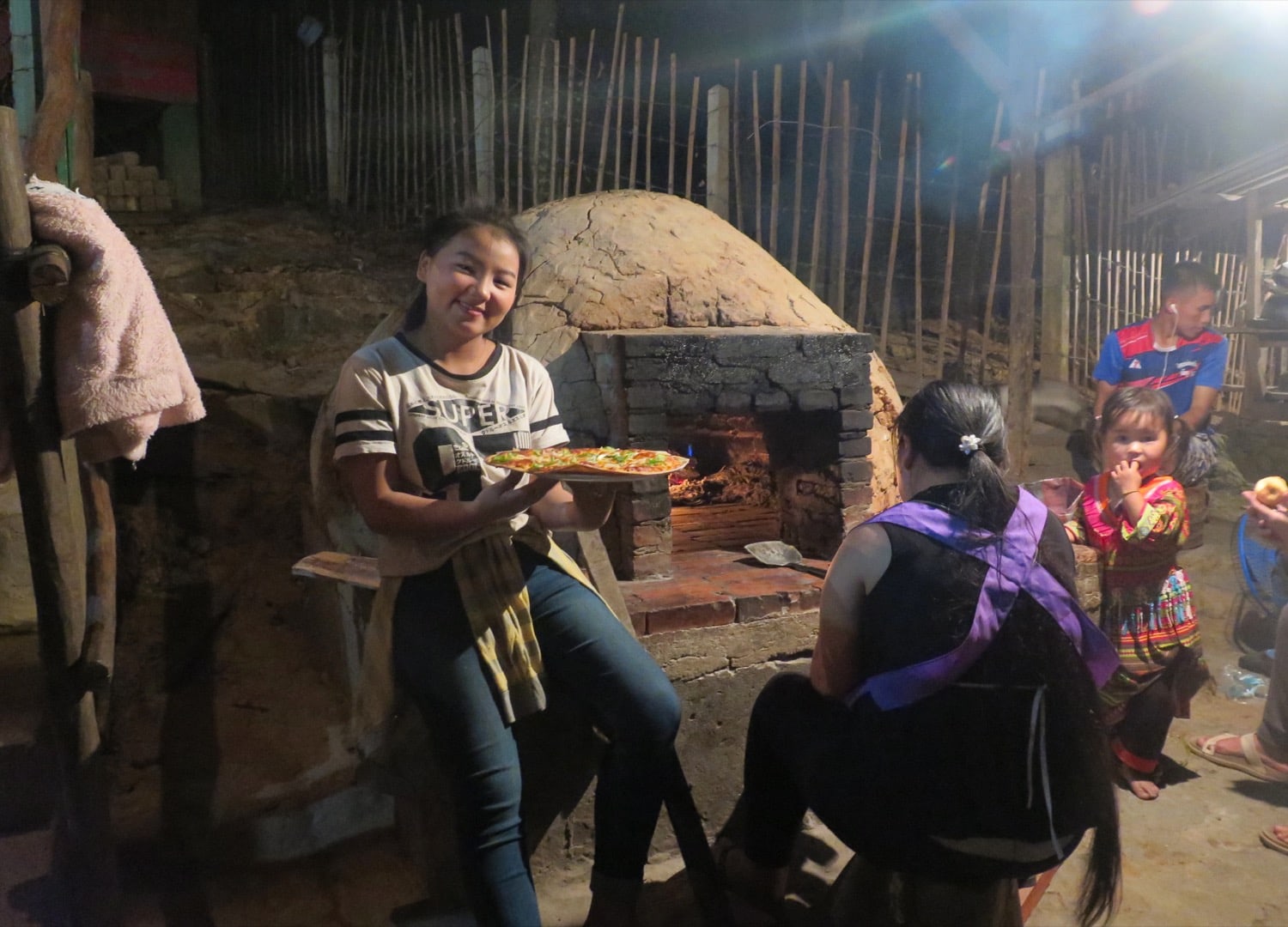
The place is built on a little hill. From there you can see the Mekong and, if you are there between 5-6 pm, also the sunset. There are little cats around, always looking for a cuddle.
Shops in the village sell mainly imported chips, cookies, and drinks. It is shocking to not be able to buy anything healthy, but only junk food or sweets.
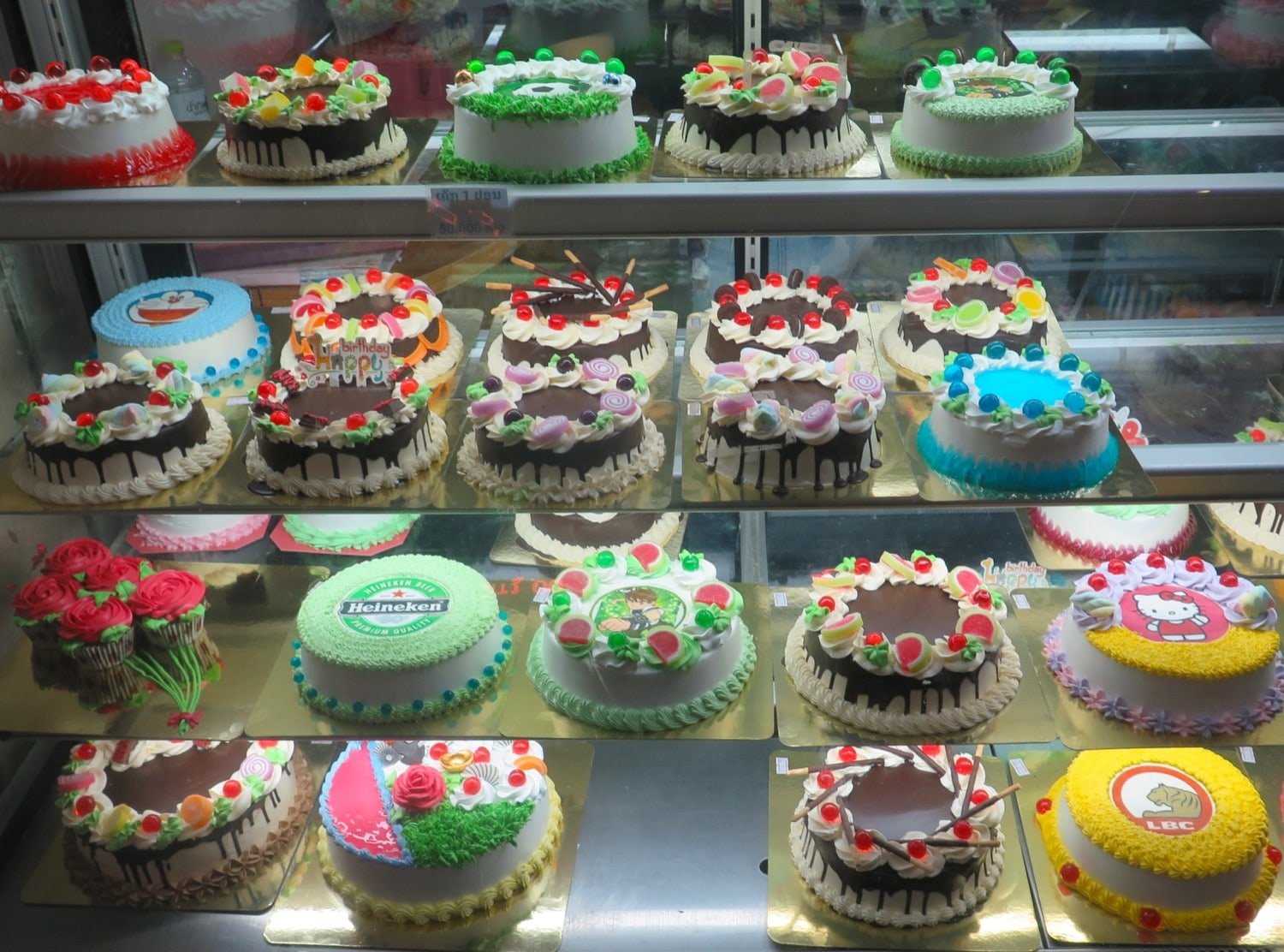
We found only one bar selling bananas and mangos, but nothing more.
WIFI is almost everywhere, but the connection is sometimes poor and not always stable. You can anyway connect your device and wait patiently :-)
Here too, there are travel agencies trying to sell you packages more expansive compared to the real cost of activities. For example, for the slow boat cruise they charge 140’000 LAK (16 $), but if you buy the ticket directly at the pier, you pay 105’000 LAK (12 $). DIY is worth it in this case, too.
If you want to sleep a bit longer in the morning, you are in the wrong place! The village is full of roosters that start to crow at 5.30 am (and do not stop till 9-10 am), and monks ring their gong at 6 am. After that, the village is awake and in full activity. Ladies, in particular, start to mince meat for the most traditional Lao dishes. You can hear "tok tok tok" for hours...
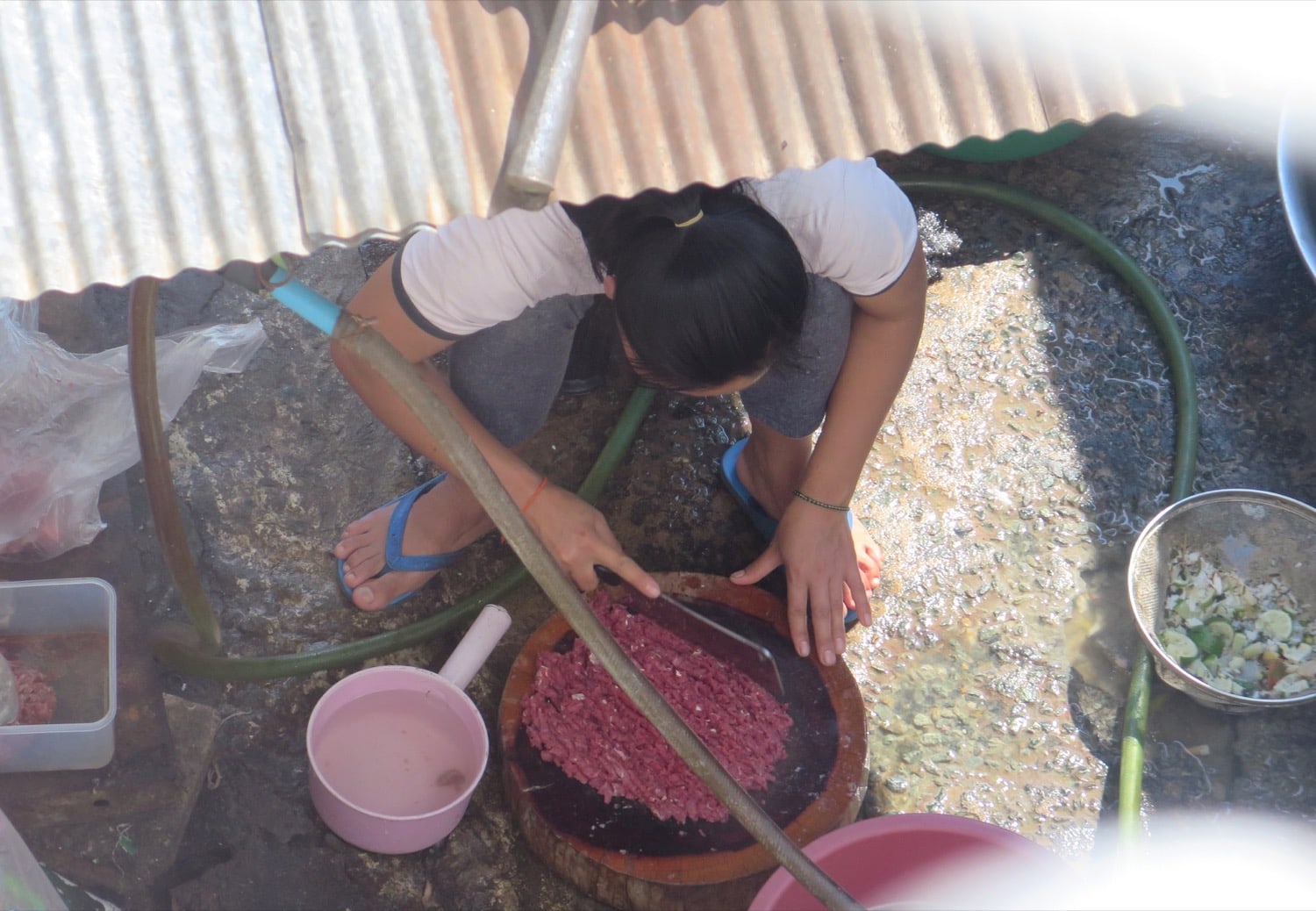
You have two option: go to bed early and wake up together with everyone, or put your earplugs on and enjoy a long sleep!
Enjoy your stay!
Pakbeng: the accommodation business seen differently [real story]
A village that wakes up at 5 pm and falls asleep at 9 am.
(one day with a 15-years old Laotian guy, working in his family's guesthouse)
Sabaidee dear tourists,
I would like to introduce myself to you. My name is Palani and I was born in Pakbeng (Laos) 15 years ago. You may be curious about what I will tell you. I guess you are wondering how a young boy like me is spending his life in such a small village in the middle of nowhere, in Laos. Well, I would love to tell you more about my life. It actually all turns around the moment of the slow boat's arrival, with you guys onboard. This happens every day, at approximately 5 pm.
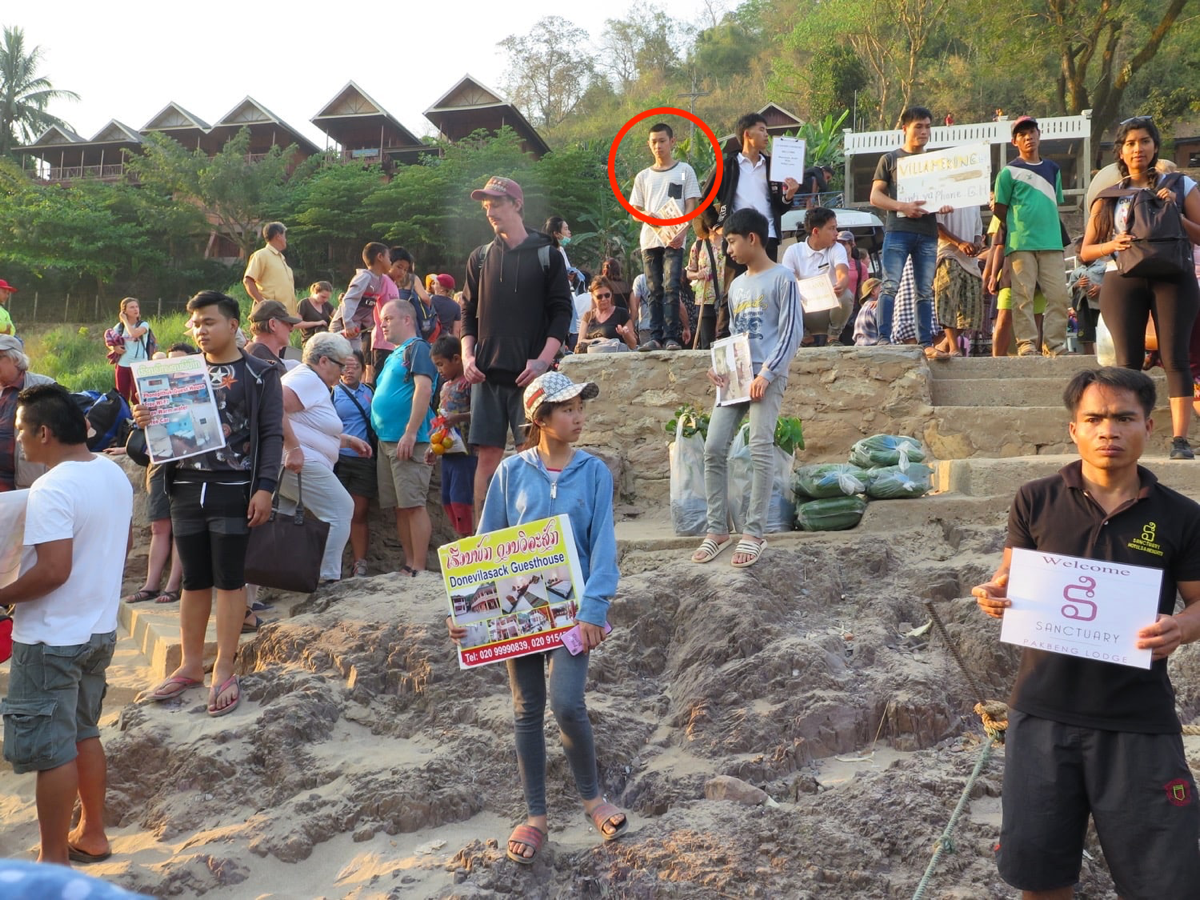
I am in this picture... but you will find out only at the end who I am :-)
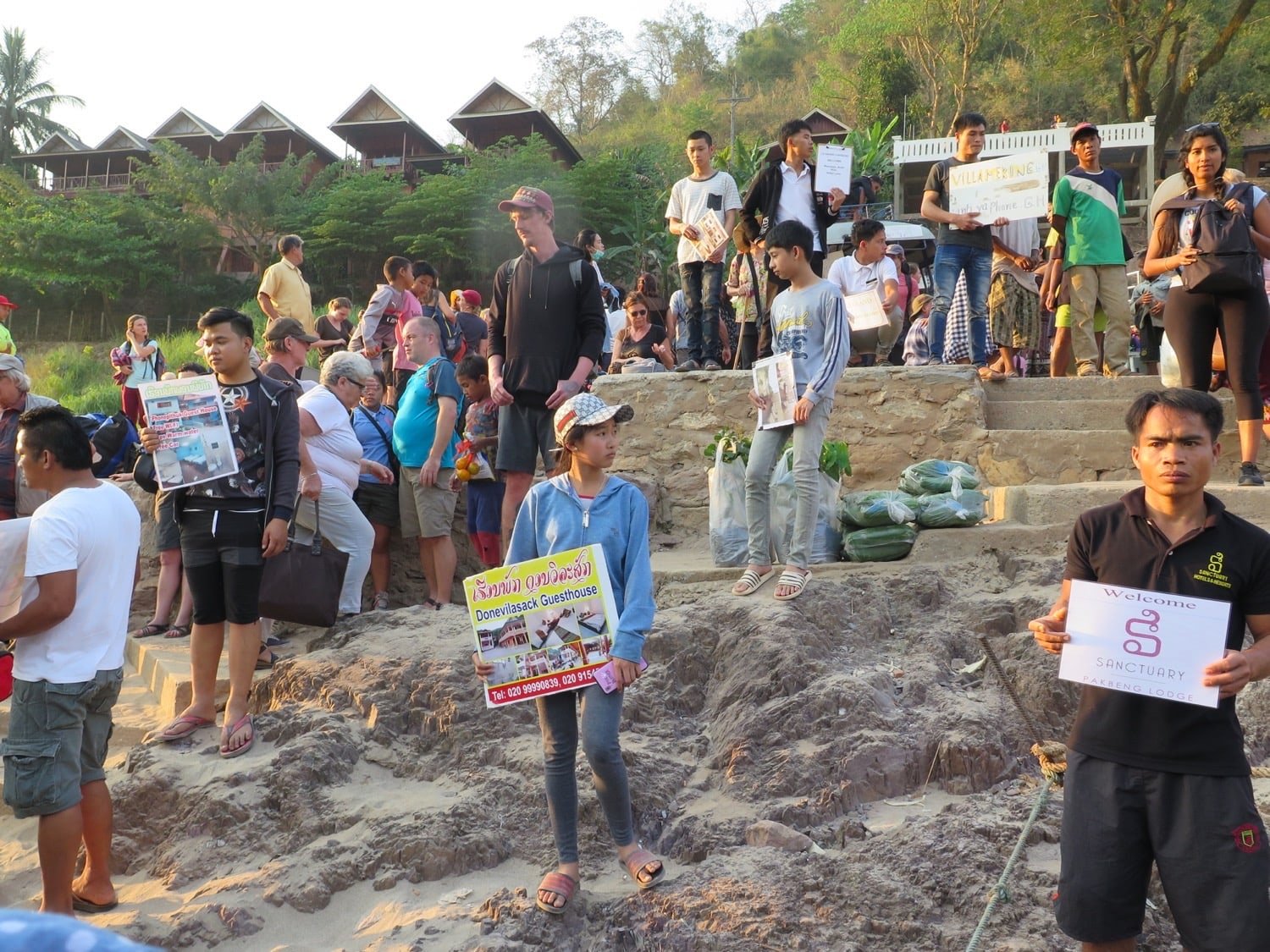
What happens in Pakbeng during the day?
So, practically my village wakes up at 5 pm when you tourists arrive, and falls asleep at 9 am when everyone leaves. But what happens in the meantime?
Let's start from the beginning. I live with my parents and my 2 younger brothers. We own a guesthouse in Pakbeng.
My day starts very early, each morning I get up at 5.30 am when the rooster crows. In a few minutes, I am dressed up and ready for my breakfast: I usually eat a bowl of noodle soup to have enough energies to start my routine.
My father immediately takes care of "men works". Our guesthouse is not so new anymore, as it was my grandfather's. But we like to improve both the building and our services so that our guests are happy and spread a good word about us. He is currently working on creating a beautiful garden. I can already imagine our guests enjoying some fresh air among green palm trees.
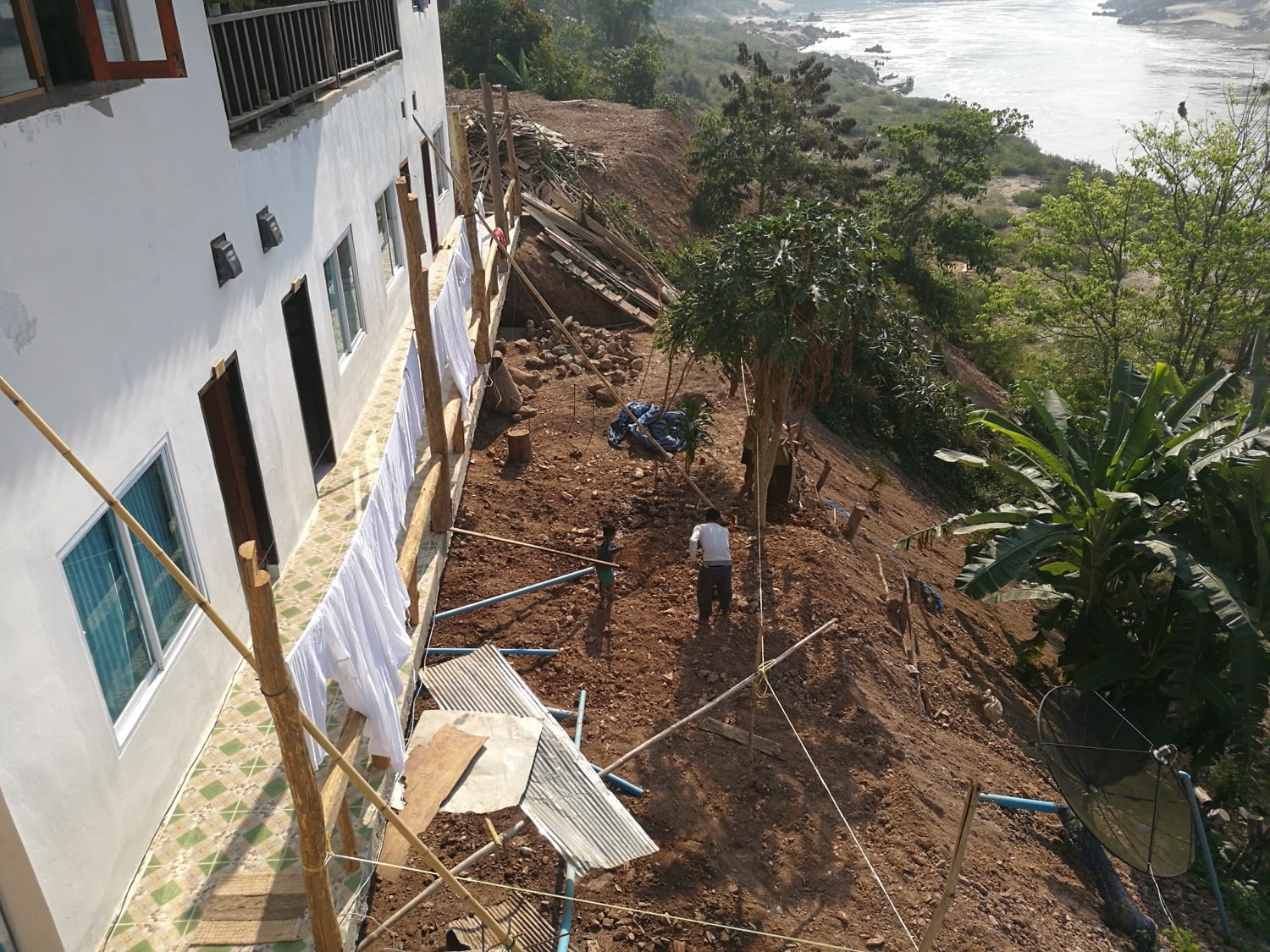
He has to work in the early morning because during the day is really too hot: between 10 am and 4 pm it is actually hard to stay outside...
In the meanwhile, my mum and I are preparing breakfast and taking care of our guests. They have to be ready at 8 am because we need to bring them to the pier on time for the slow boat's departure. My uncle has a truck, and we use it as a minivan.
At 9.30 am, after the slow boat leaves, everything becomes quiet and silent. There is no one around anymore.
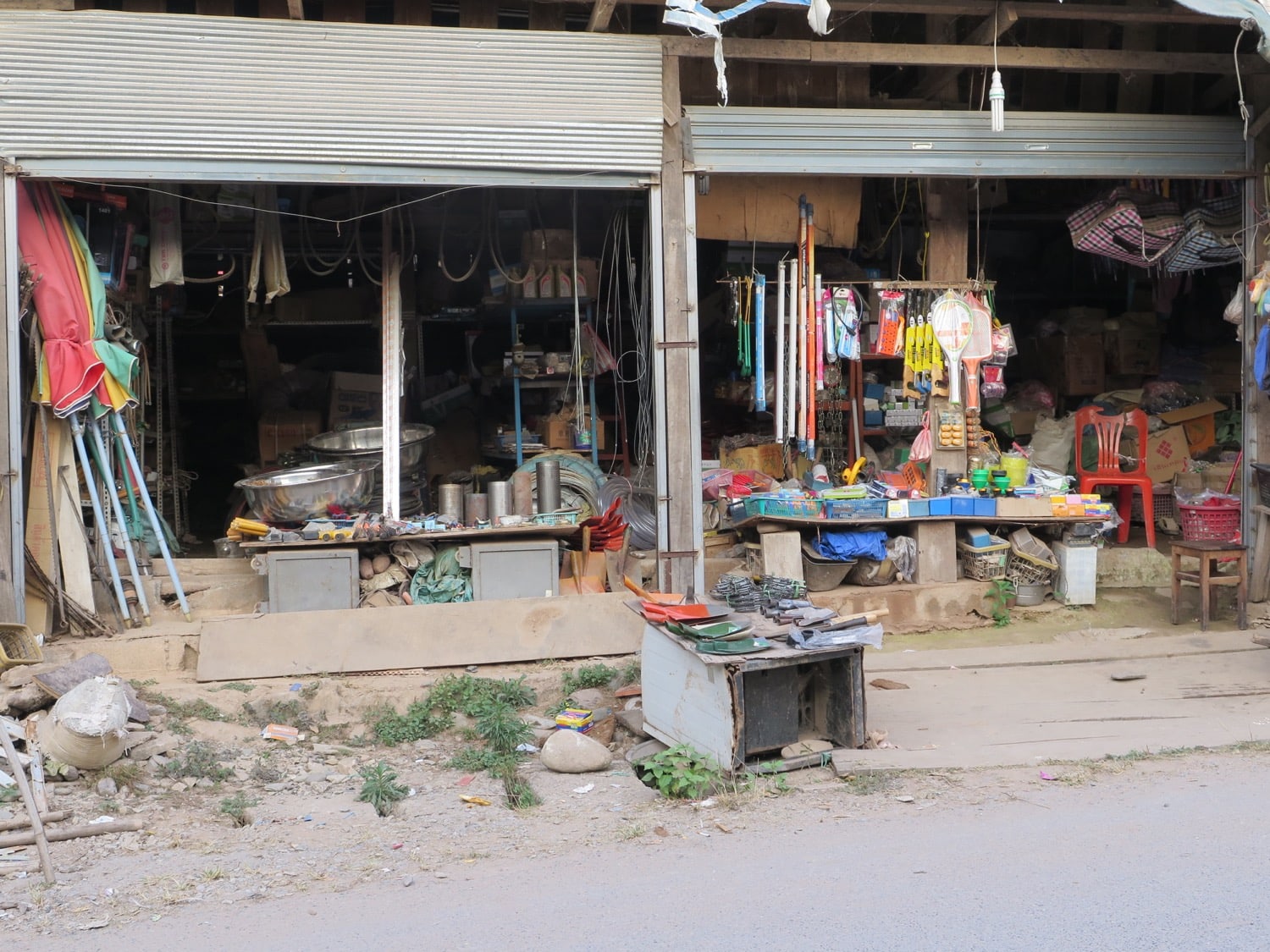
In Pakbeng you can find several shops, even a hardware store and those store selling everything you may need,...
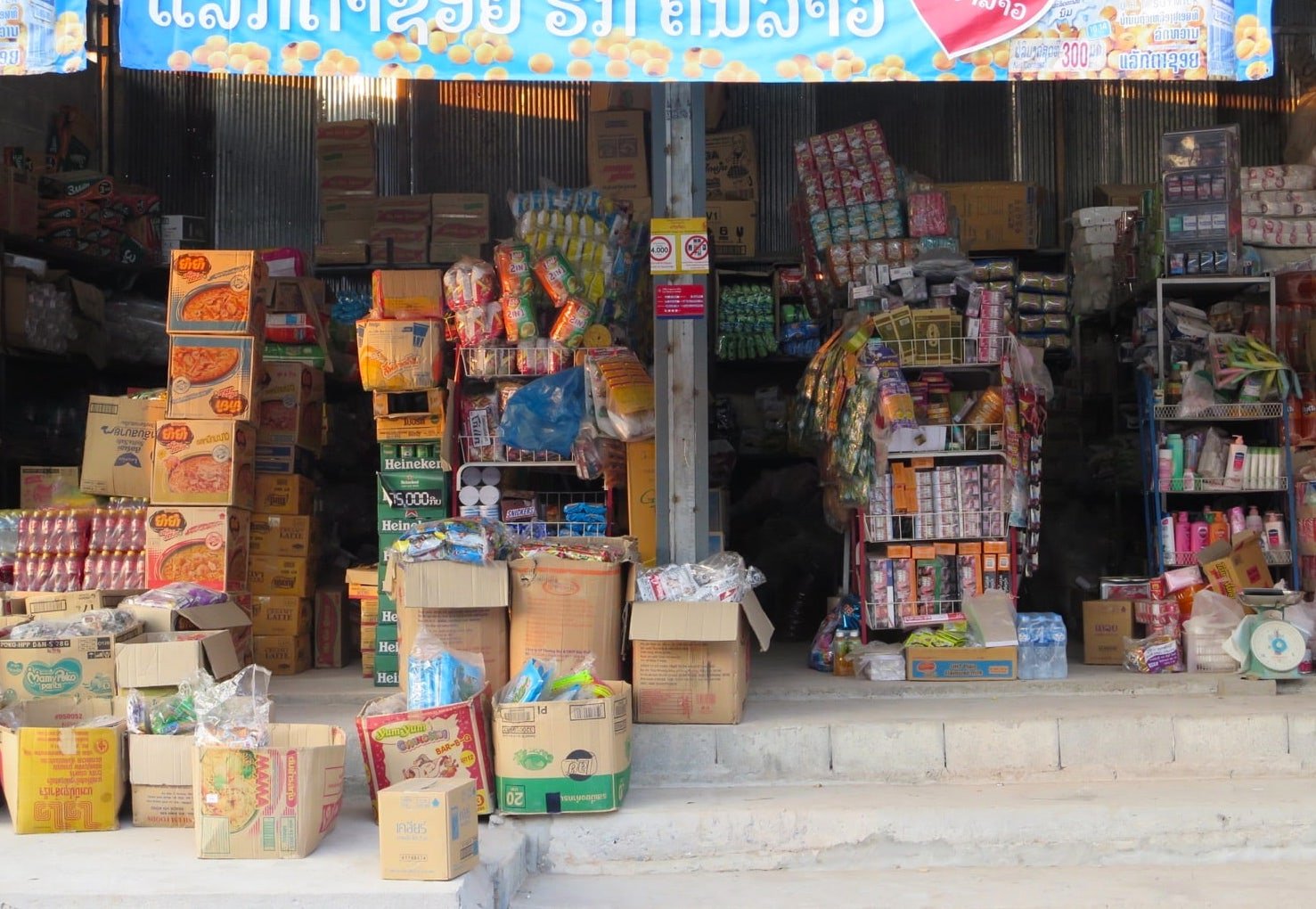
... or, you find grocery stores.
I know that many of you may look for money exchange because you are probably arriving directly from Thailand. Unfortunately, we have neither banks nor exchange desks in the village, we only have 2 ATMs where you can withdraw some local currency. Take what you need for your short stay, and then exchange the rest when you reach Luang Prabang. I heard that many tourists handle it this way.
Globalization
Pakbeng is a small village in the middle of nowhere, disconnected from all the main roads. It is reachable from Oudamxay by road, or from Huay Xai by river. Globalization arrived here too together with the slow boats' business.
Every slow boat stops in Pakbeng for the night, so a few years ago we had to develop our village, to transform it into a tourists' village and to "adjust" it according to the global trend.
Eventually, the civilized world arrived, but luckily it didn't completely take over our culture. Unfortunately, so far, only the "worse" side of globalization invaded our country. Our little and local stores are full of American products. They are so bright, colourful and inviting. Don't you think so? When I see those candies packages, I just want to eat them all! It's amazing...
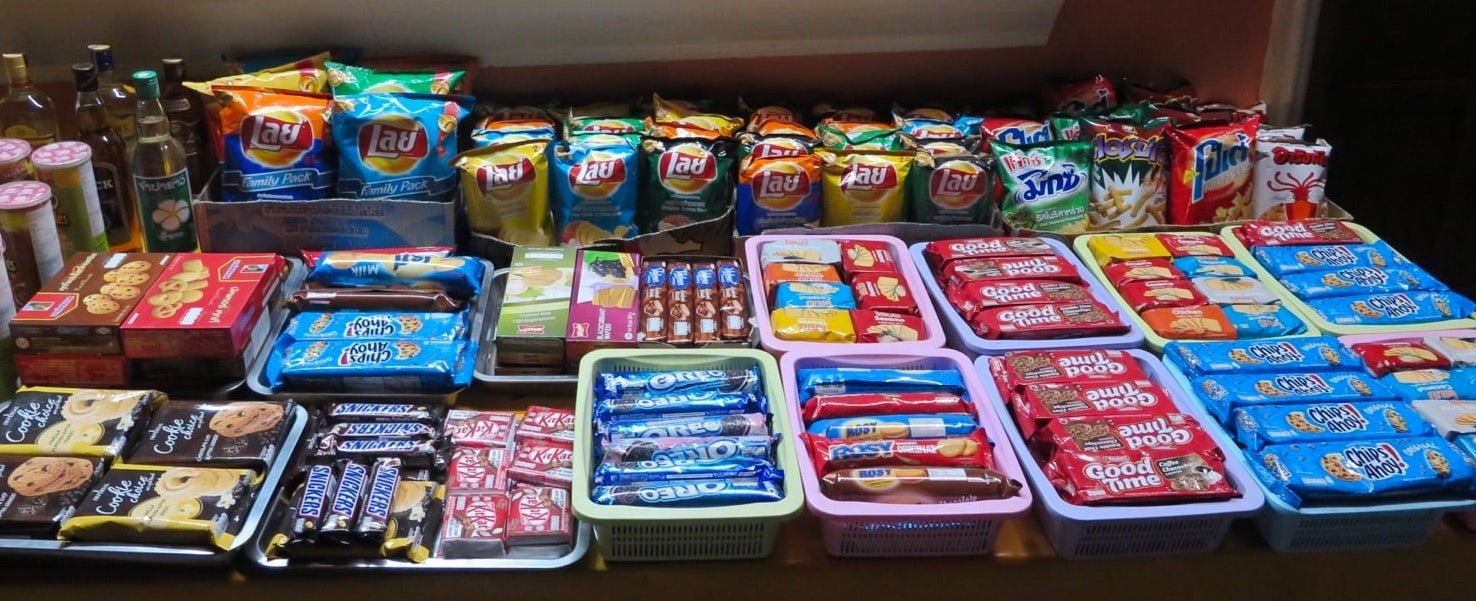
And... did you see our bakeries selling huge French croissants? They are expensive and quite big for us who are not used to eat risen products. But I understand that for western people, this is kind of a breakfast item. I had a croissant once, it is tasty but I still prefer my noodle soup :-)
If I think about my childhood, I remember that candy bars were not existing at all here. I haven't seen one until I was 10-11 years old. All the food we ate was local food, not imported and with natural ingredients. We had only a few homemade sweets because our culinary tradition doesn't include refined sugar.
The future
It's scary to think that, in a few years, everything has changed. And I don't want to think about what will happen in the feature... Today's young people are used to sugar, as they are growing up seeing cookies, candies and chocolate.
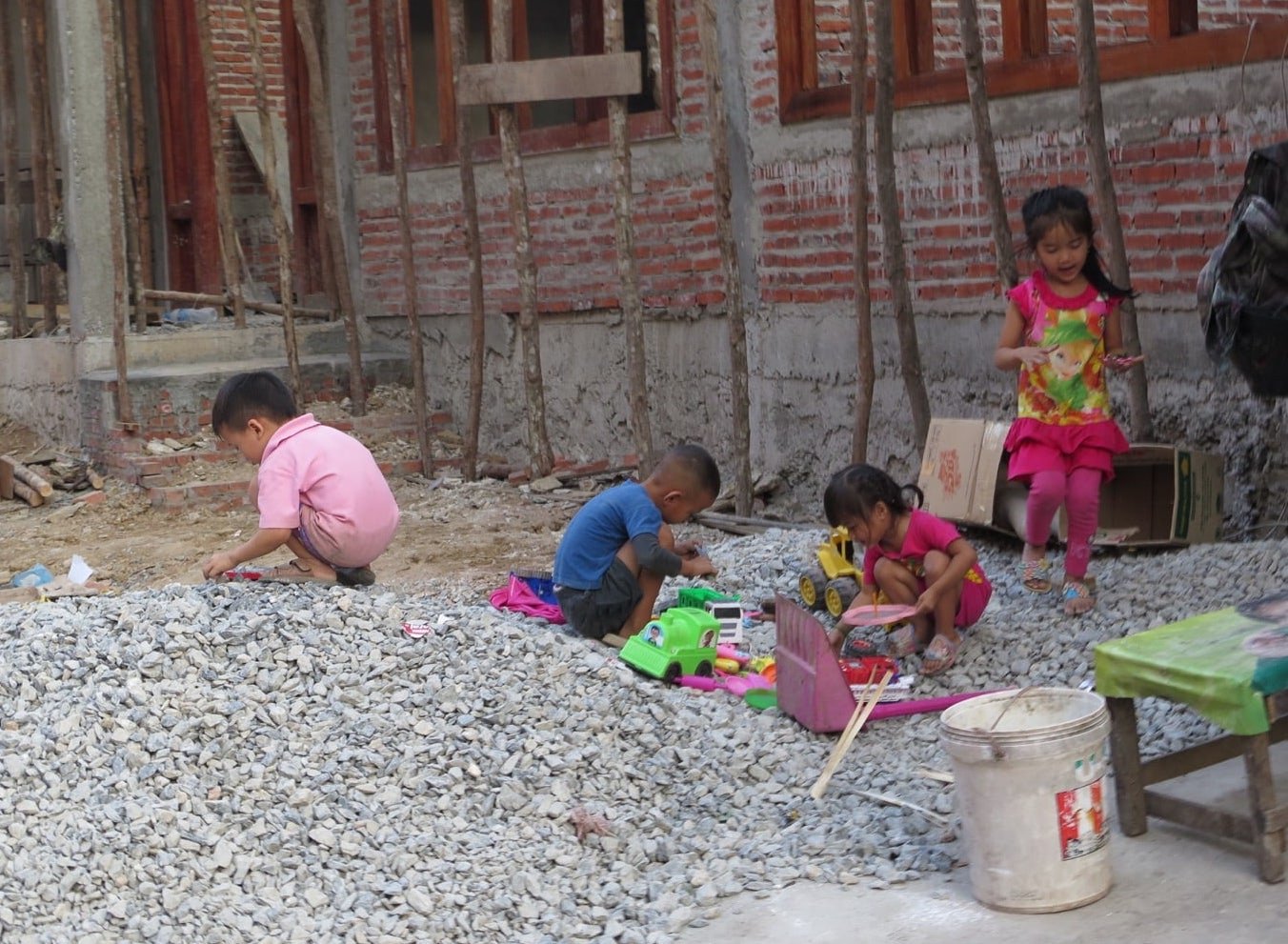
We all eat "junk food" sometimes, not too much as it is still quite expensive and we cannot always afford it. I prefer to save my little money for my family.
The environment
We are also living in an environment where we don't make any difference between garbage and nature. If you look on the ground, you will see food packages, plastic bags and other waste, together with chickens and other animals. I don't accept this condition, but I am one of the few against an entire population... I really would like to make the difference and safeguard the environment, but habits here are too strong. Anyway, I am a fighter, and I will not surrender so easily :-)
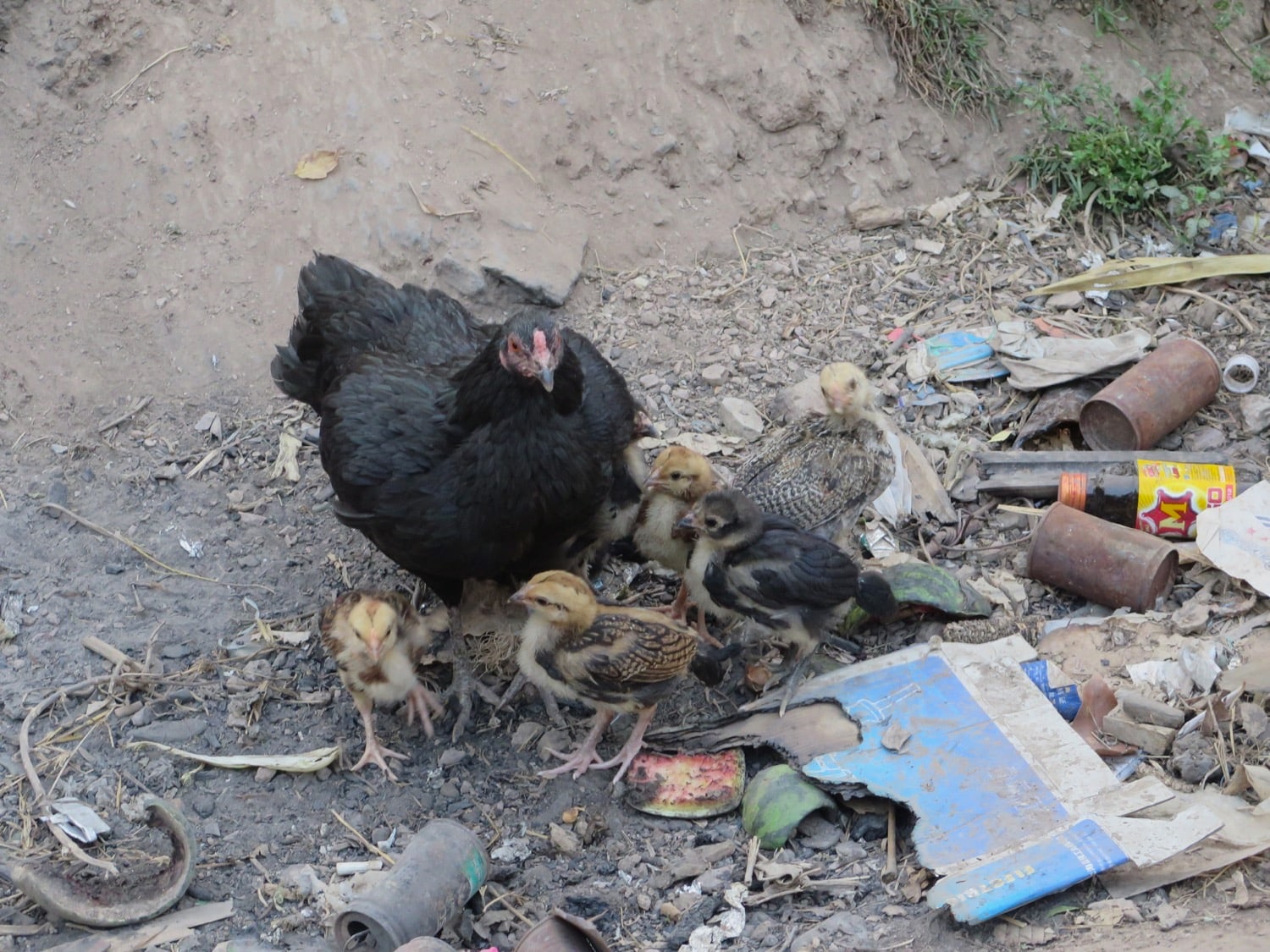
What is even sadder, is that several dishes of our tradition are based on chicken. This means that when we eat chicken, we eat garbage... It sounds disgusting, but it is kind of true.
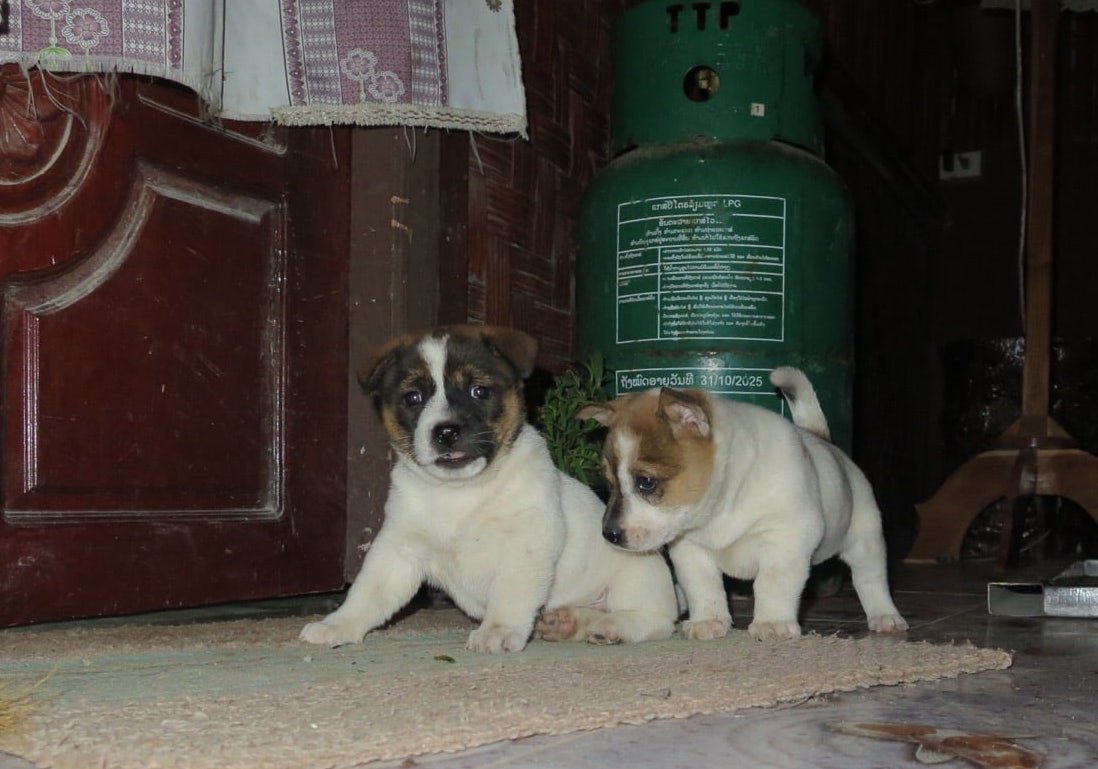
Oh sorry, I forgot to introduce you to my 2 little dogs! They are cute, aren't they? When they grow up they will be our guesthouse's guardians. For now, they only eat, sleep and play...
Daily life
But let's go back to my day. We were talking about that, right?
Around 1.30 pm I have lunch with my family. We usually eat in the patio, as it is cooler. Today we had fried noodles, one of my mum's best dishes!
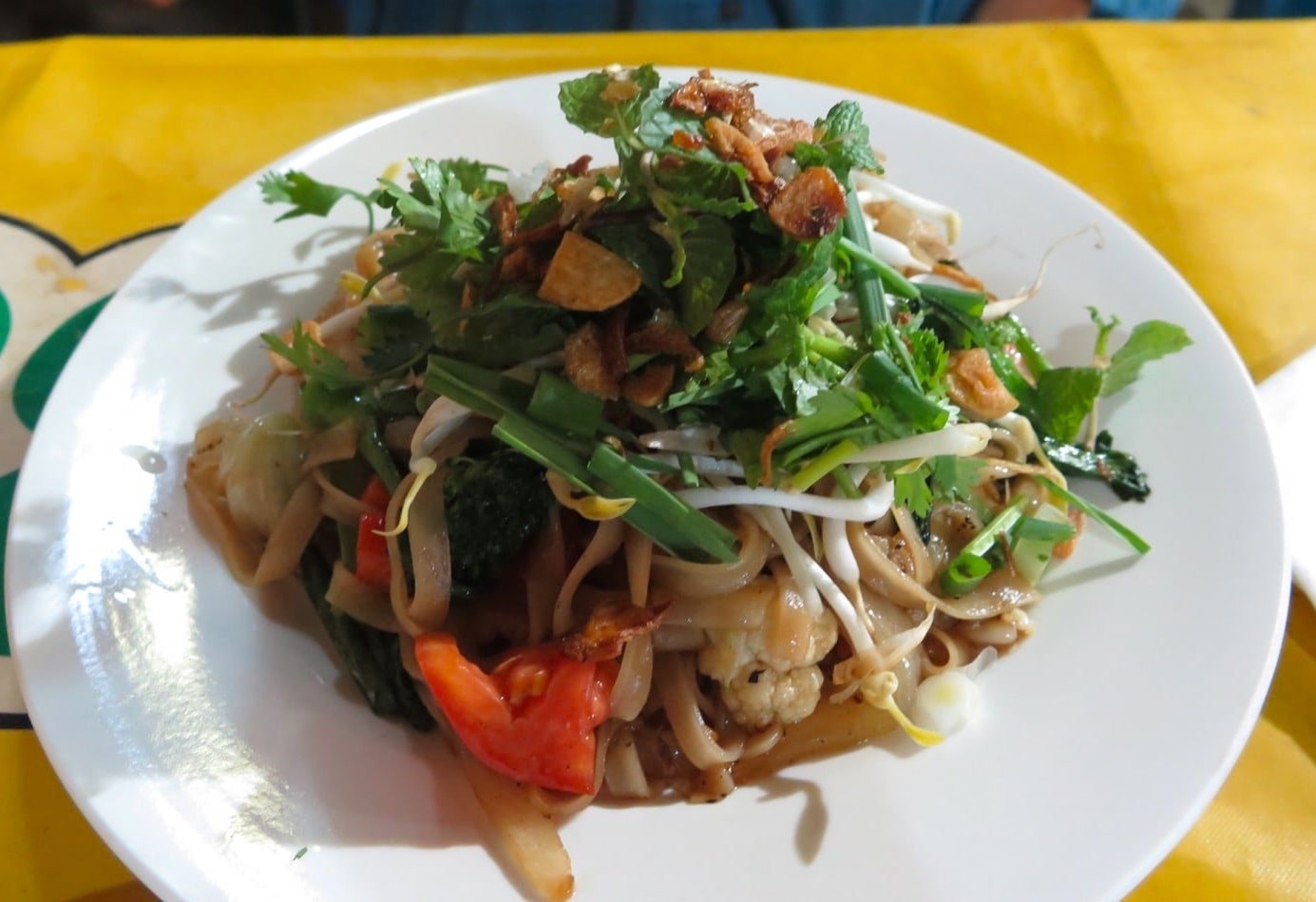
After lunch, we, all together, prepare the rooms for the guests who already booked online. In addition to that, we always keep a few other rooms ready to use in case I convince some extra tourists at the pier.
Today it was a special day. Instead of working for the guesthouse all day, I took a few moments for myself. At 3 pm I realized it was getting too late, so I put a t-shirt on and run to my cousin who owns this barber shop.
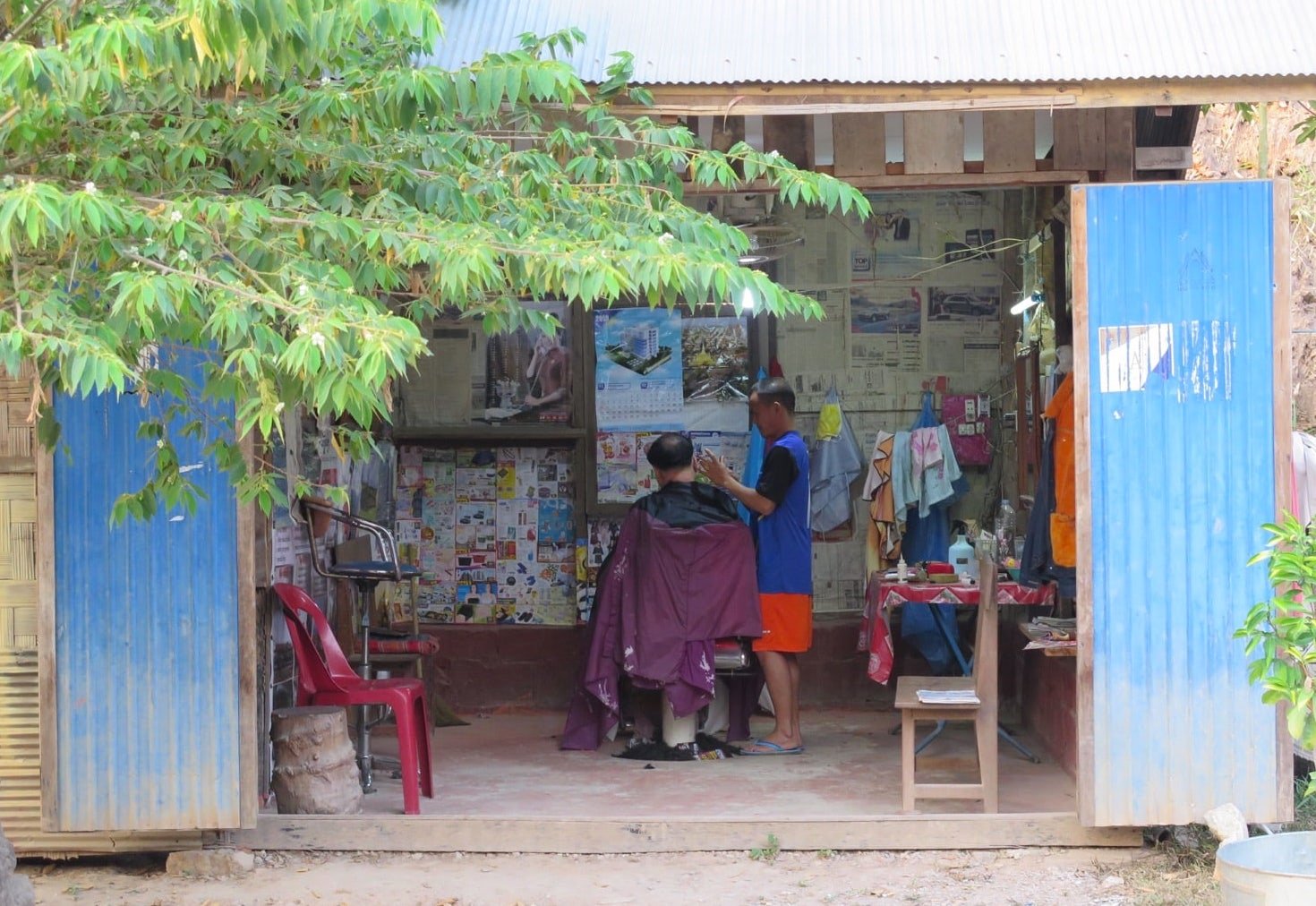
The barber always knows stories about other guesthouses, or about tourists. I often go there just to hear that and collect good ideas... or funny tales.
Generally, in the afternoon I always find something to do at the guesthouse, something to fix or to improve. It's our little treasure so we dedicate a lot of time to it :-)
At 4 pm it's bath time. Unfortunately, we don't have a real shower, like the one we offer to our guests. We bath in big buckets with cold water and soap.
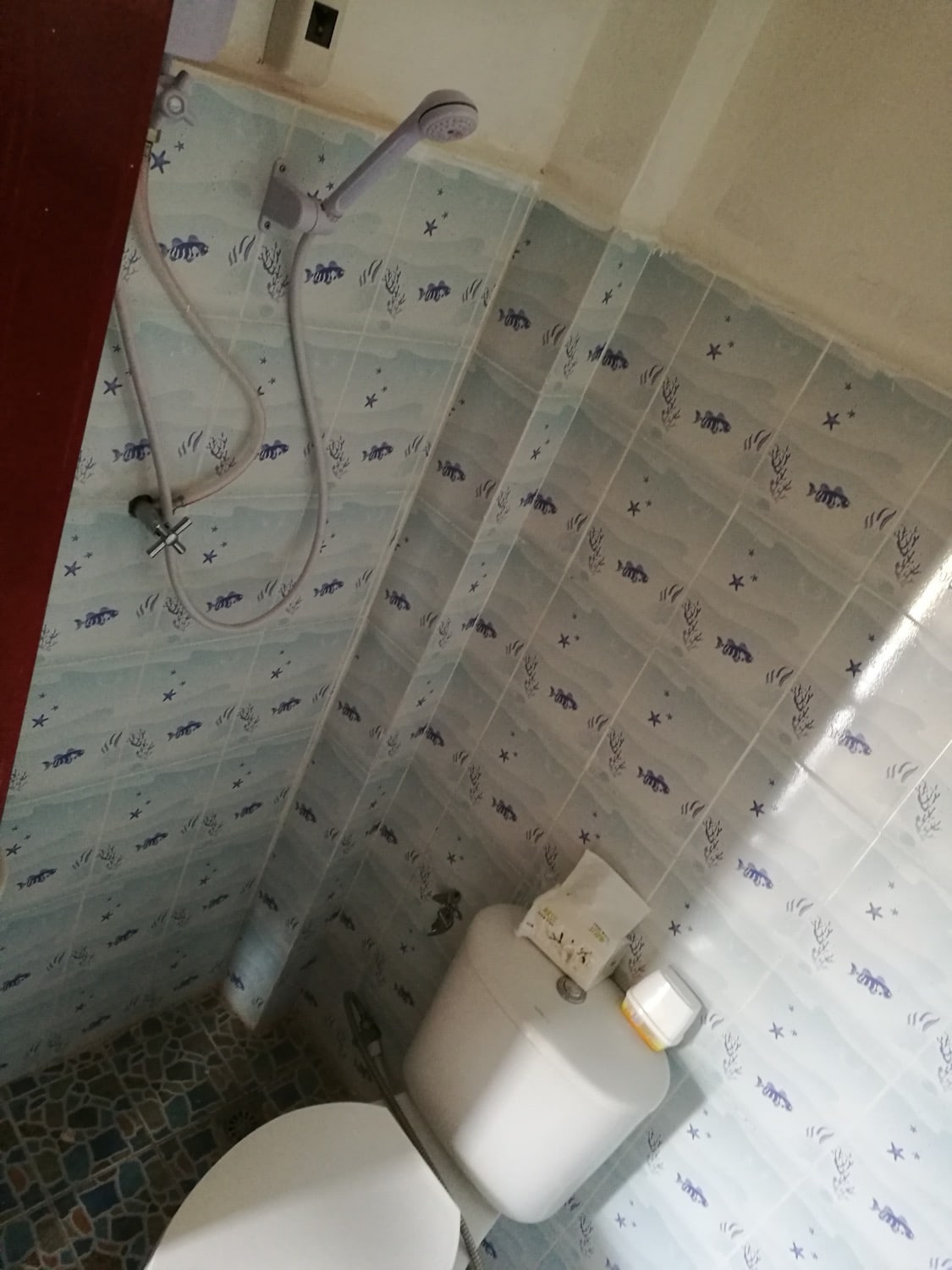
After a working day, I want to be decent and scented to welcome you, my dear guests!
I take my guesthouse's board, start the scooter and run down to the pier. I see the boat arriving, perfectly on time. While waiting, I always try to guess how many new guests I can convince this time and with which strategy.
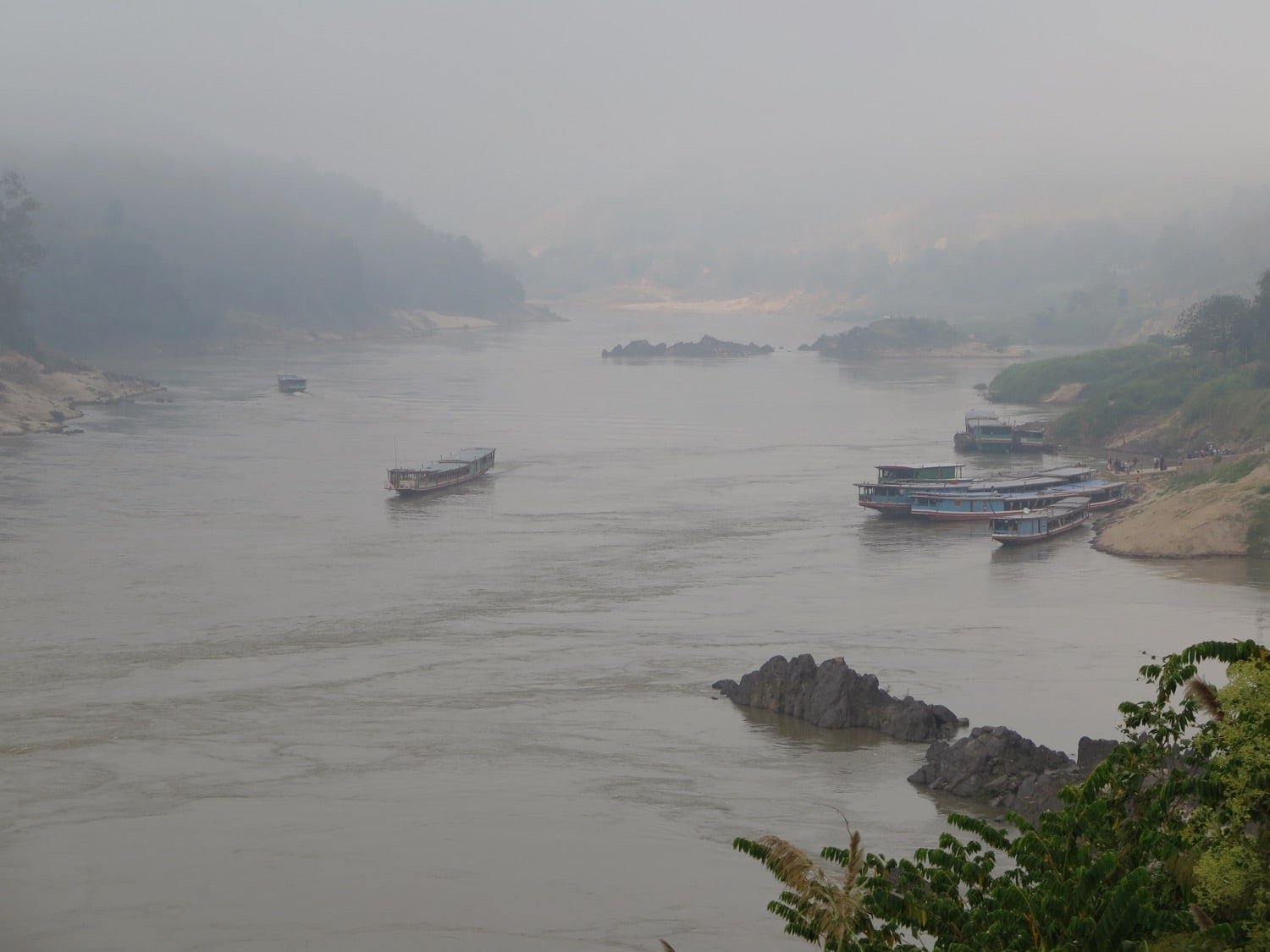
The competition is very high. There are dozens of guesthouses in Pakbeng, and they are almost never fully booked.
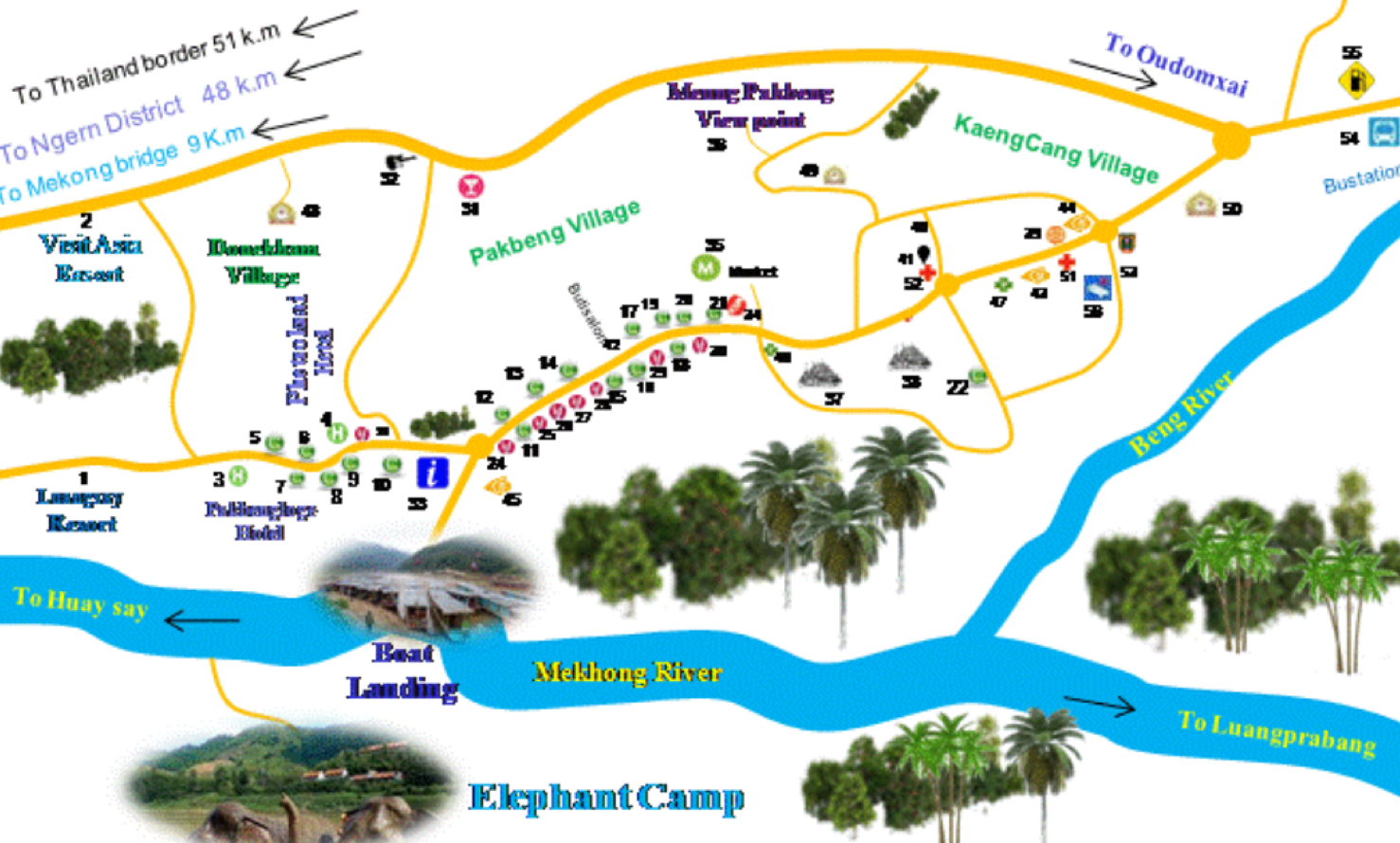
There are actually more empty rooms than tourists. But it is a great business for us... because it is our own house, and it is our main source of income.
If I may give you a suggestion, I would like to advise you not to stay in a guesthouse right at the pier. That's the busiest and more expensive part of the village. If you walk a few hundreds of meters further, you can find friendly hosts offering cheap rooms with a nice 180° view on the Mekong.
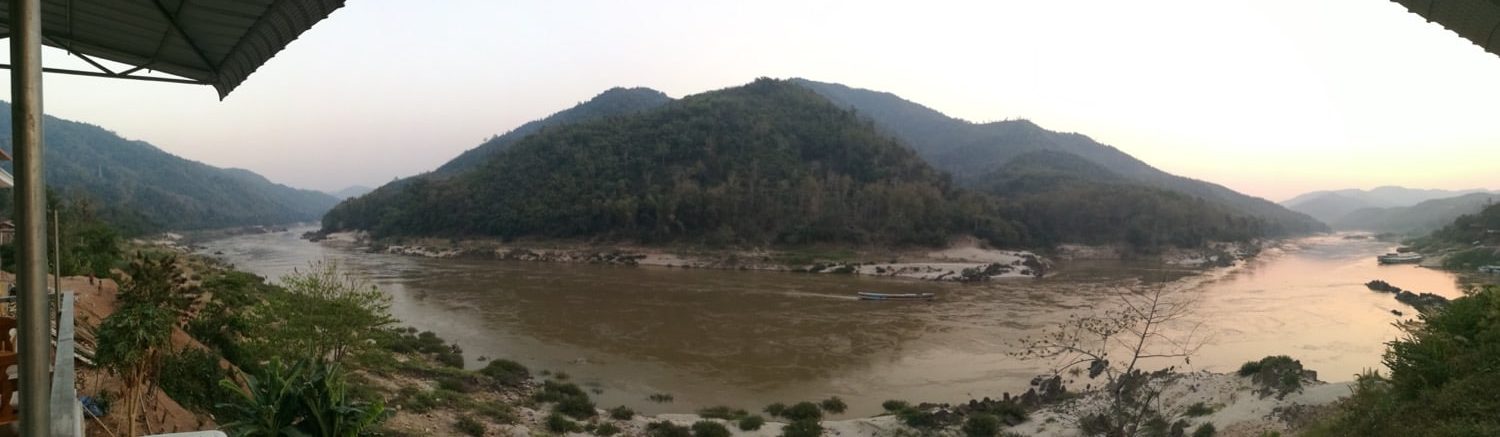
Don't you want to enjoy this sunset from your balcony? I love to do it!
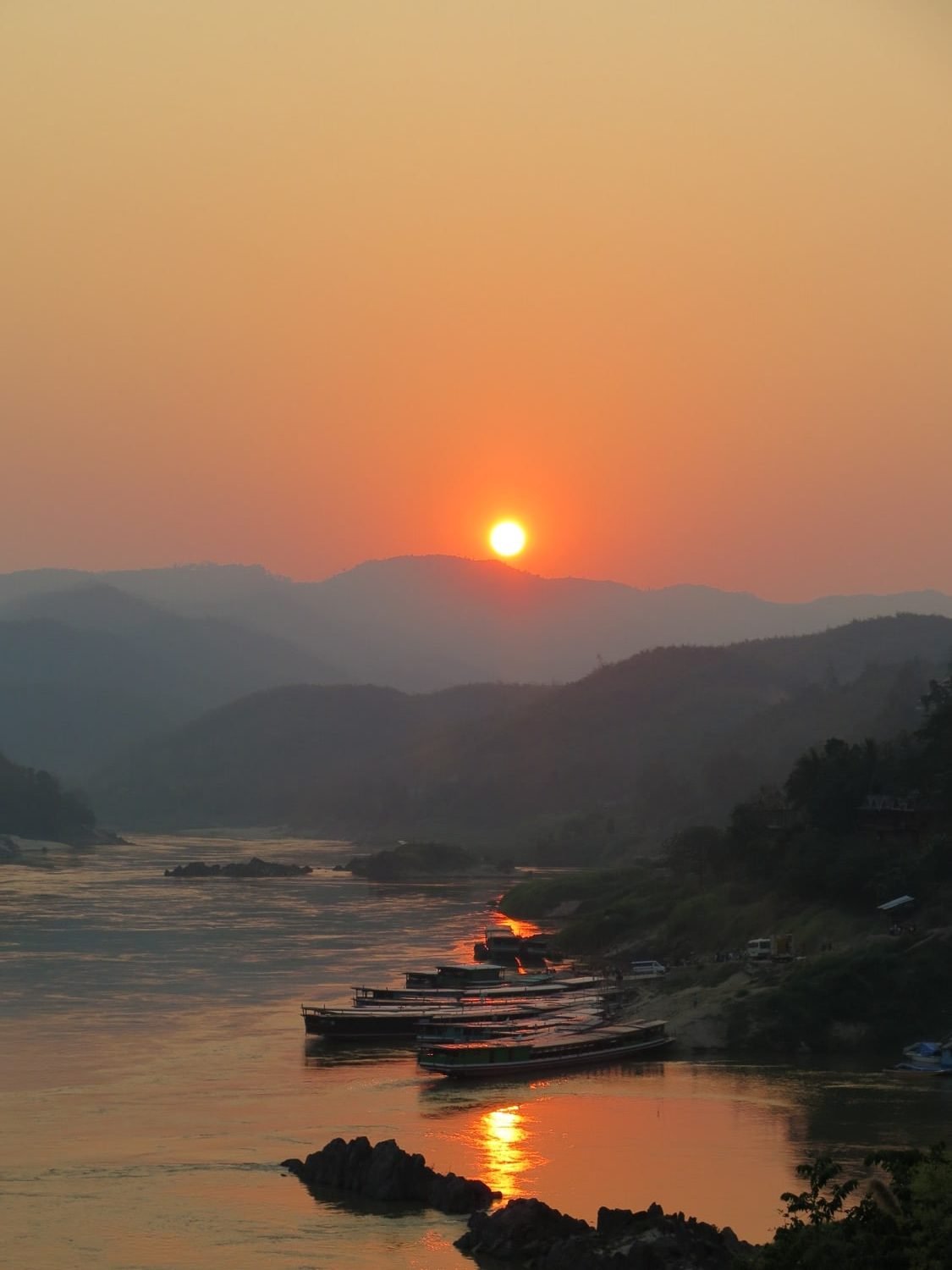
Well, it's 5.30 pm. Today, other 2 slow boats arrived with dozen of tourists. We "fought" to get new guests without reservation, and I successfully convinced 4. I am proud of my job!
For all the other tourists, I wish you a safe trip to your hotels or guesthouses and I hope you will enjoy these few hours in our little village.
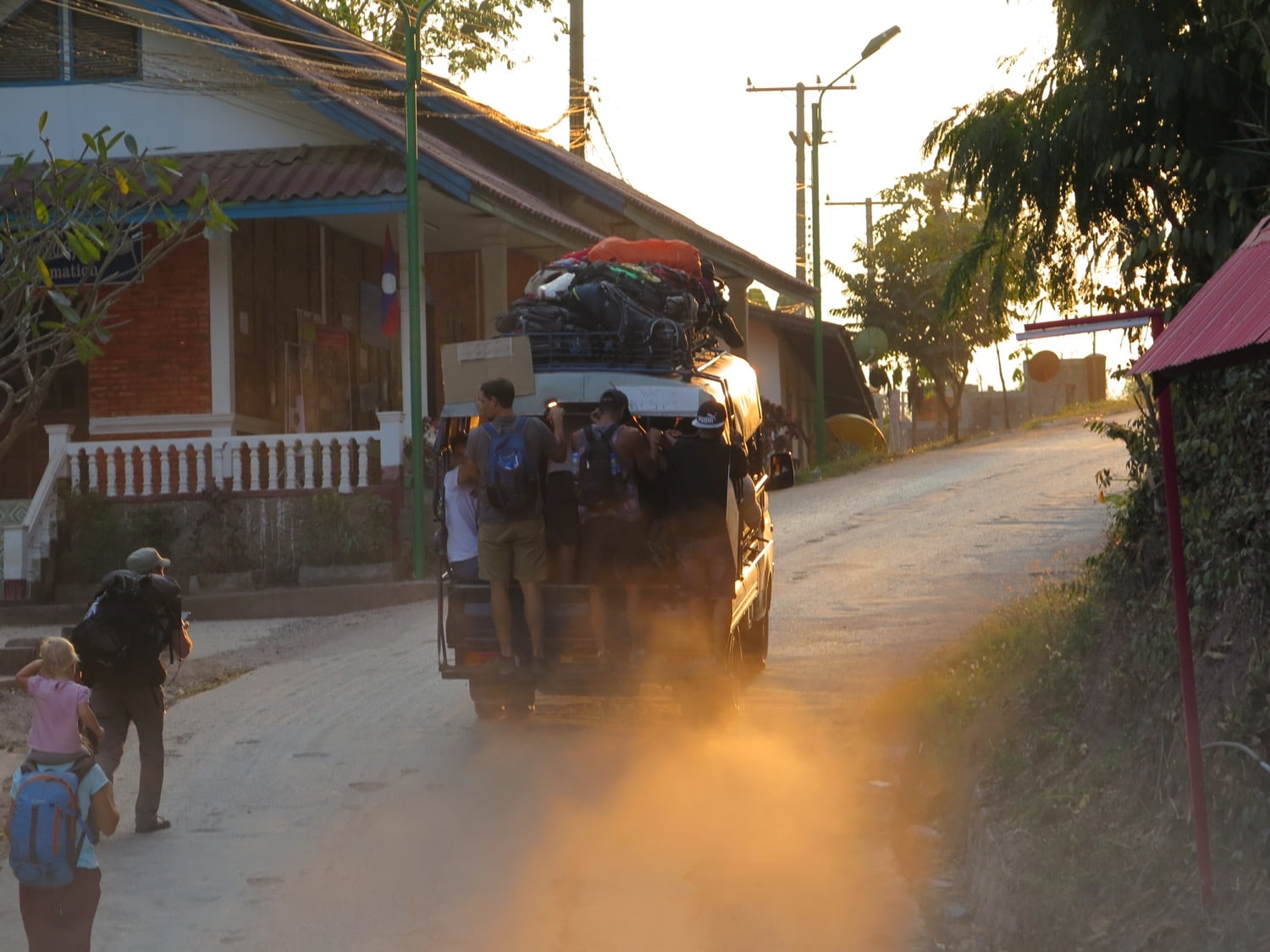
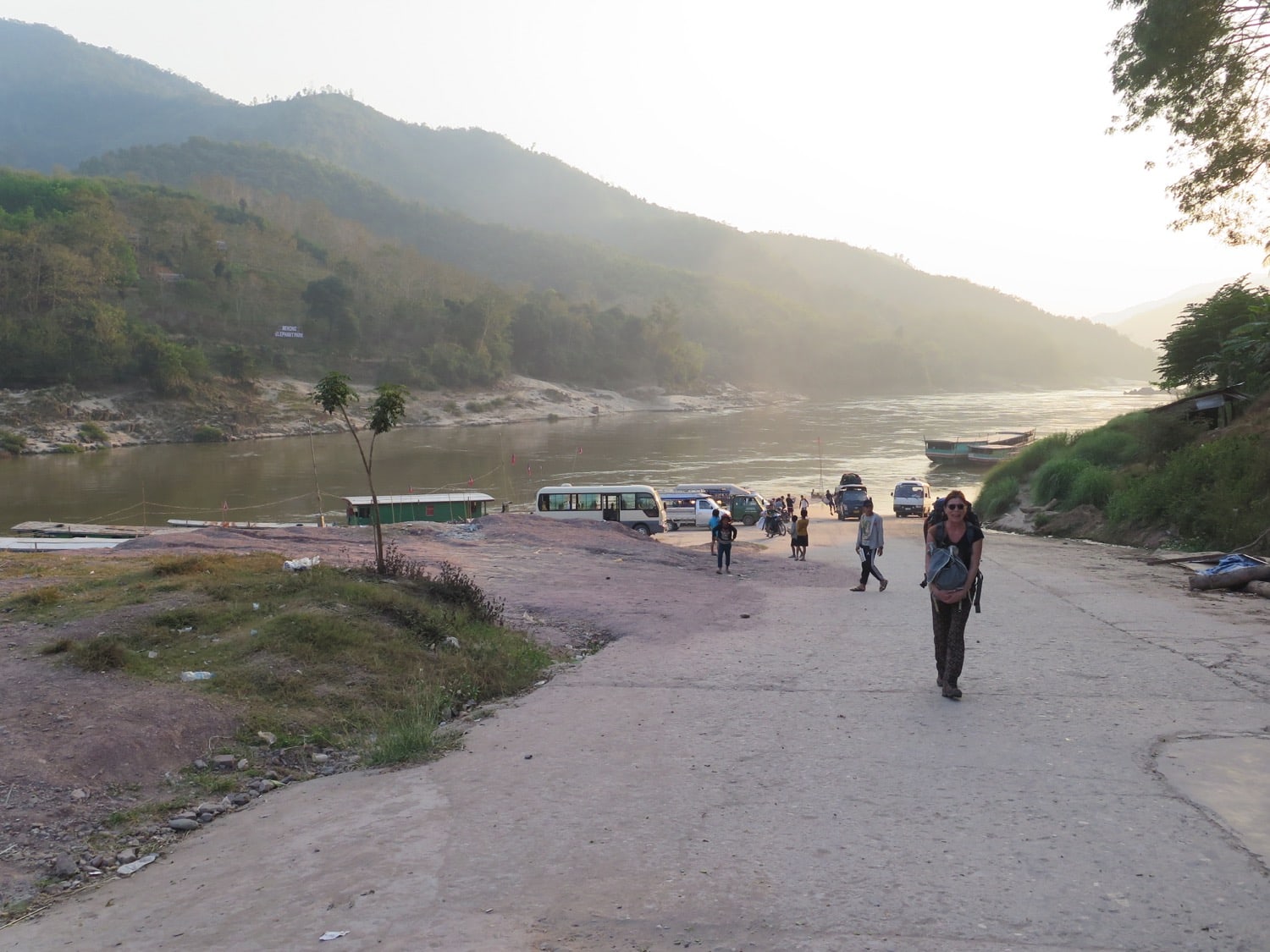
From now till tomorrow morning at 9 am, Pakbeng will be a busy and lively village. Restaurants are full of beautiful people who now decided to visit our country instead of others.
Thank you, dear tourists, for your visit, and hope to see you again in the future.
Oh, by the way... this is me :-)
PS: this is a real story, we met this wonderful guy who told us about his daily life in Pakbeng, about his emotions and about the impact of tourism.
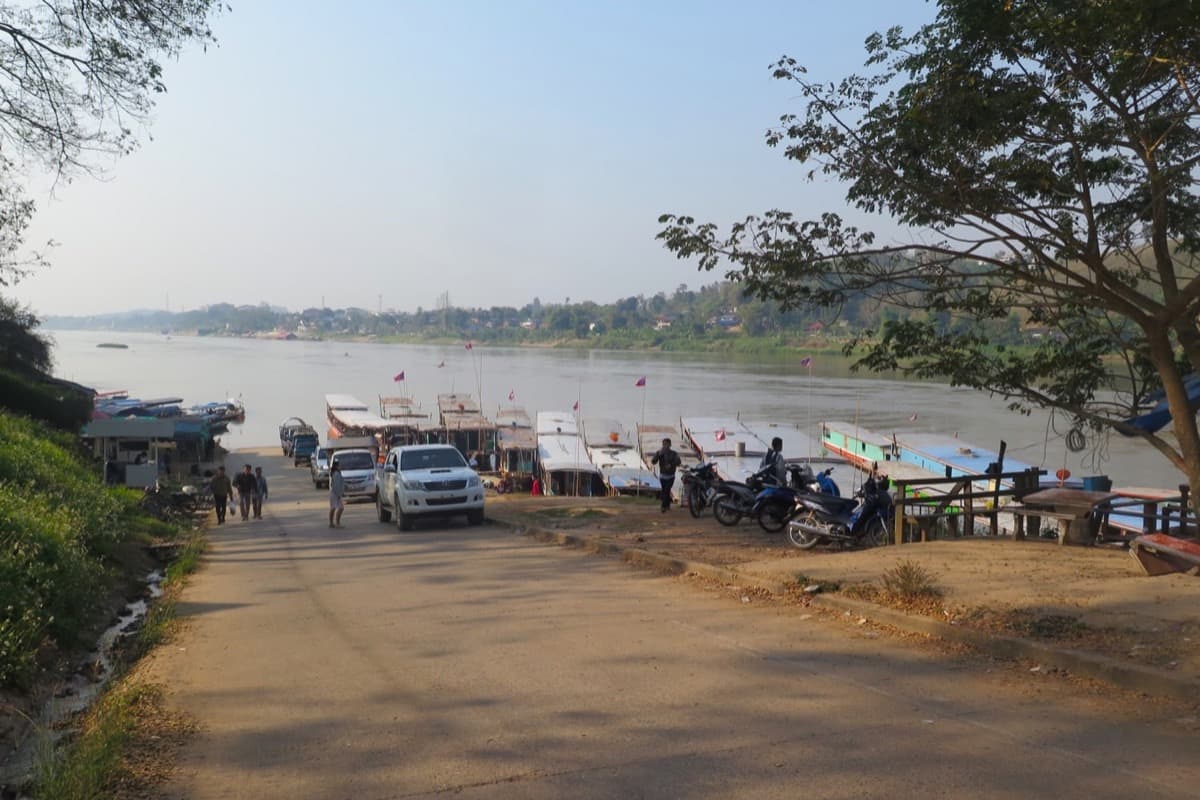
From Huay Xai to Pakbeng by slow boat: 8 practical advices
After reading hundreds of blogs about this wonderful experience, we decided to travel from Huay Xai to Pakbeng by slow boat. From Pakbeng to Luang Prabang, we travelled in an alternative but still very adventurous way (you will find out more in one of our next posts!).
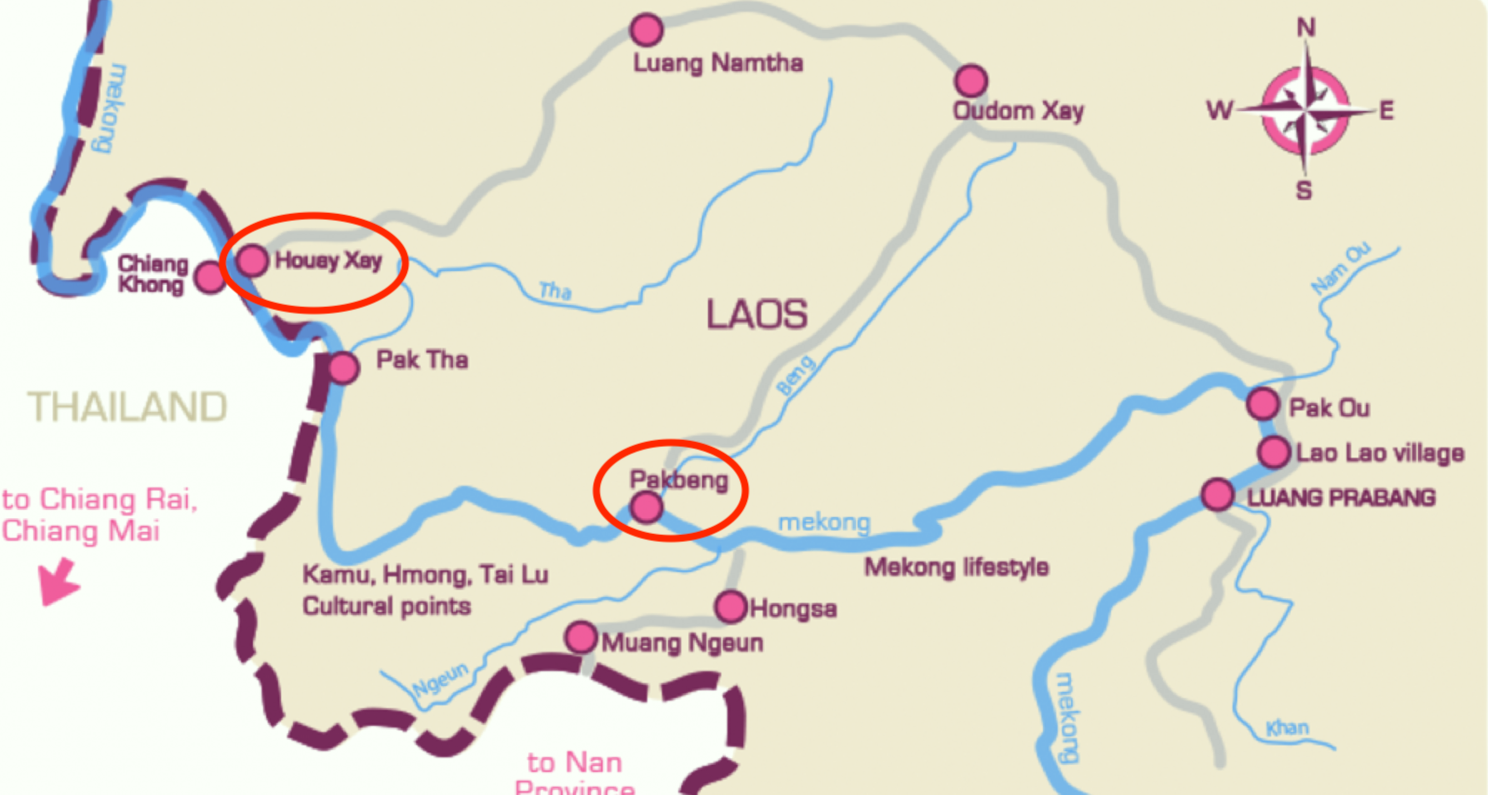
If you go from Huay Xai to Luang Prabang by slow boat, it takes 2 days to reach your destination. You need to spend the night in Pakbeng because the slow boat cannot travel with the dark. So the boat trip duration is in total 6 hours on the 1st day, and 9 hours on the 2nd day.
With the slow boat, you calmly cruise on the Mekong, which is the 12th longer river in the world (4'350 Km).
Before leaving, we collected all the useful bits of advice and prepared a to-do list in order to fully enjoy this pleasant experience :-)
1. Don't book via travel agencies
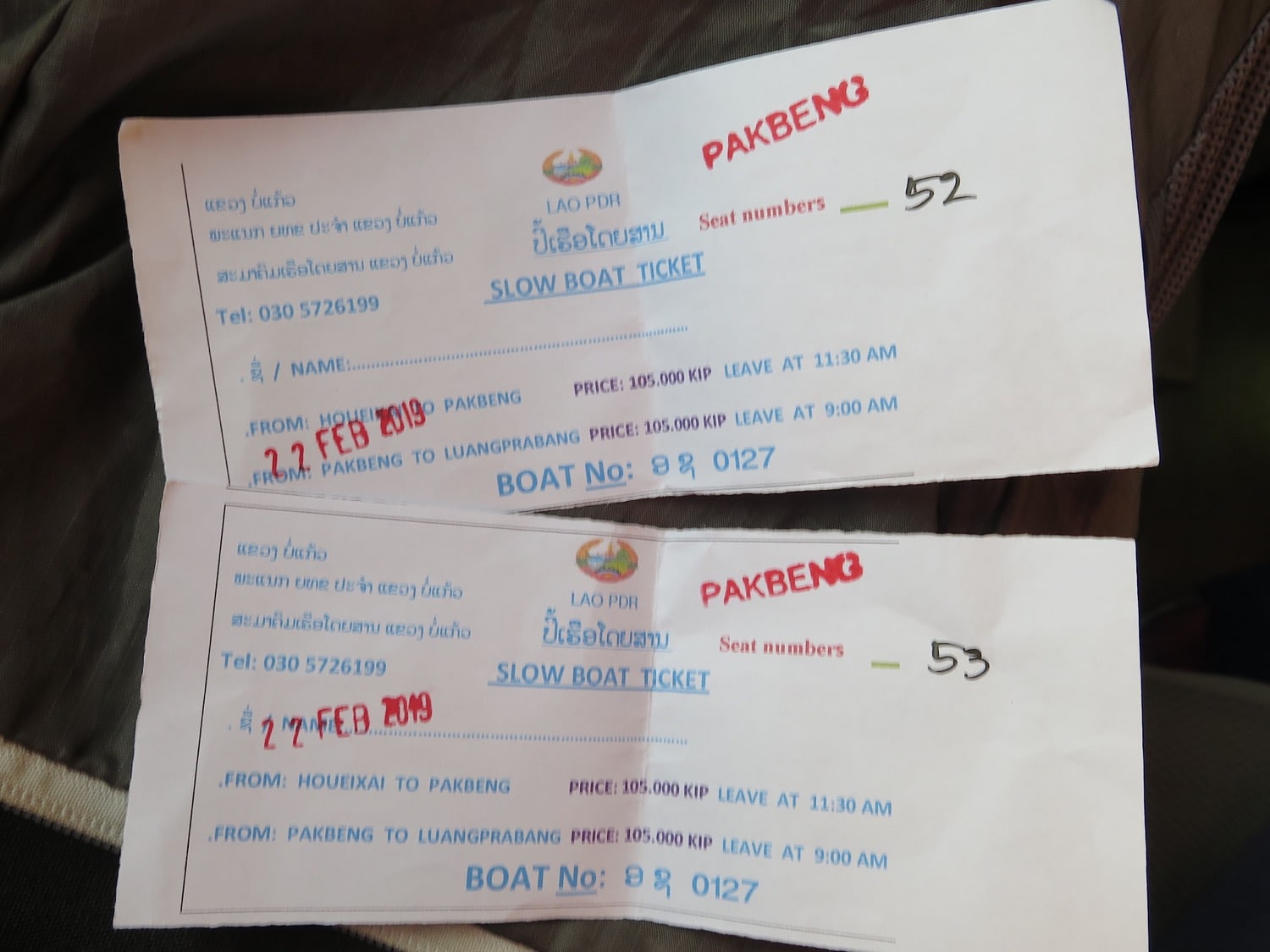
On your way from Thailand to Laos, you will find many tour agencies selling packages for the "Mekong Cruise". The cost can be quite high, around THB 1'900 ($ 52) per person. In the package, there are few extra services included: hotel pick up/drop off, lunch, drinks on board, and so on. In addition to that, you still need to pay for dinner and overnight in Pakbeng and the boat is exactly the same we got.
We arranged everything by ourselves, by buying the tickets directly at the slow boat ticket office next to the pier, on the same day. We paid LAK 105'000 ($ 12) per person, till Pakbeng. The total cost to Luang Prabang would have been LAK 210'000 ($ 24). We saved half of the money!
On the boat, you have assigned seats, both if you book via an agency or at the pier. The challenge is to actually find your seat on the boat...
2. Be on time!
It is advisable to first go to the ticket office (which is located a few meters from the pier), buy the ticket and make sure that you can get onboard. Afterwards, make sure to be on the boat at least 1 hour before departure (usually the departure time is 11h30 am) if you want to find the best seats (assigned seats are not always guaranteed) and enough space for your luggage. The boat can get super packed!
In addition to that, if you arrive earlier you can put one of the limited lifevests above your seat. In case of need, you are covered!
3. Take a day-backpack with you
Your luggage will be stored in the hull of the boat, so it will be inaccessible during the trip, namely till Pakbeng. Bring a little backpack or bag with all your valuable and necessary things with you. Do not forget a travel pillow, as the boat's seat is low and doesn't have a headrest.
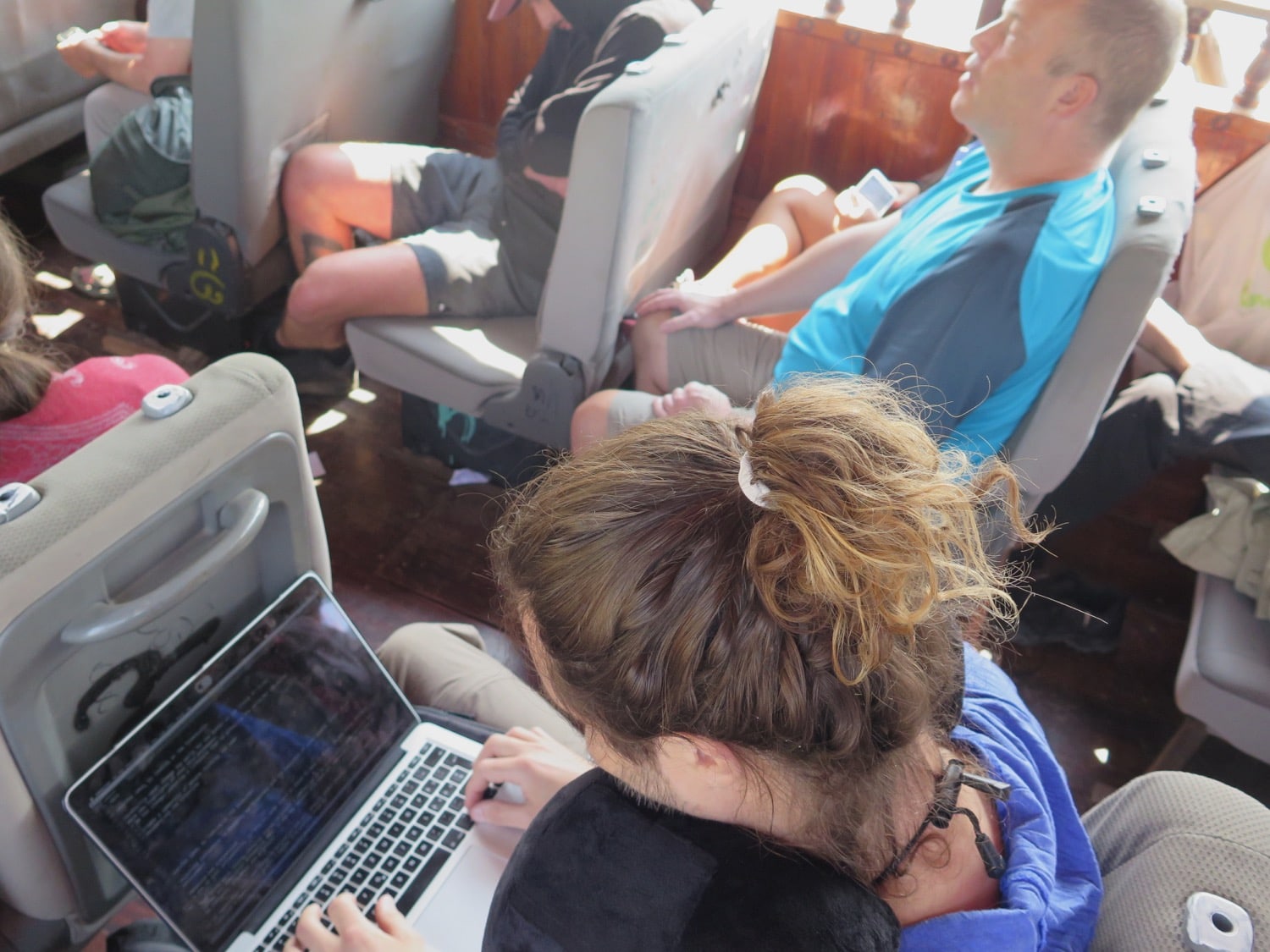
If the weather conditions are good, nothing will get wet.
4. Search your "assigned" seat
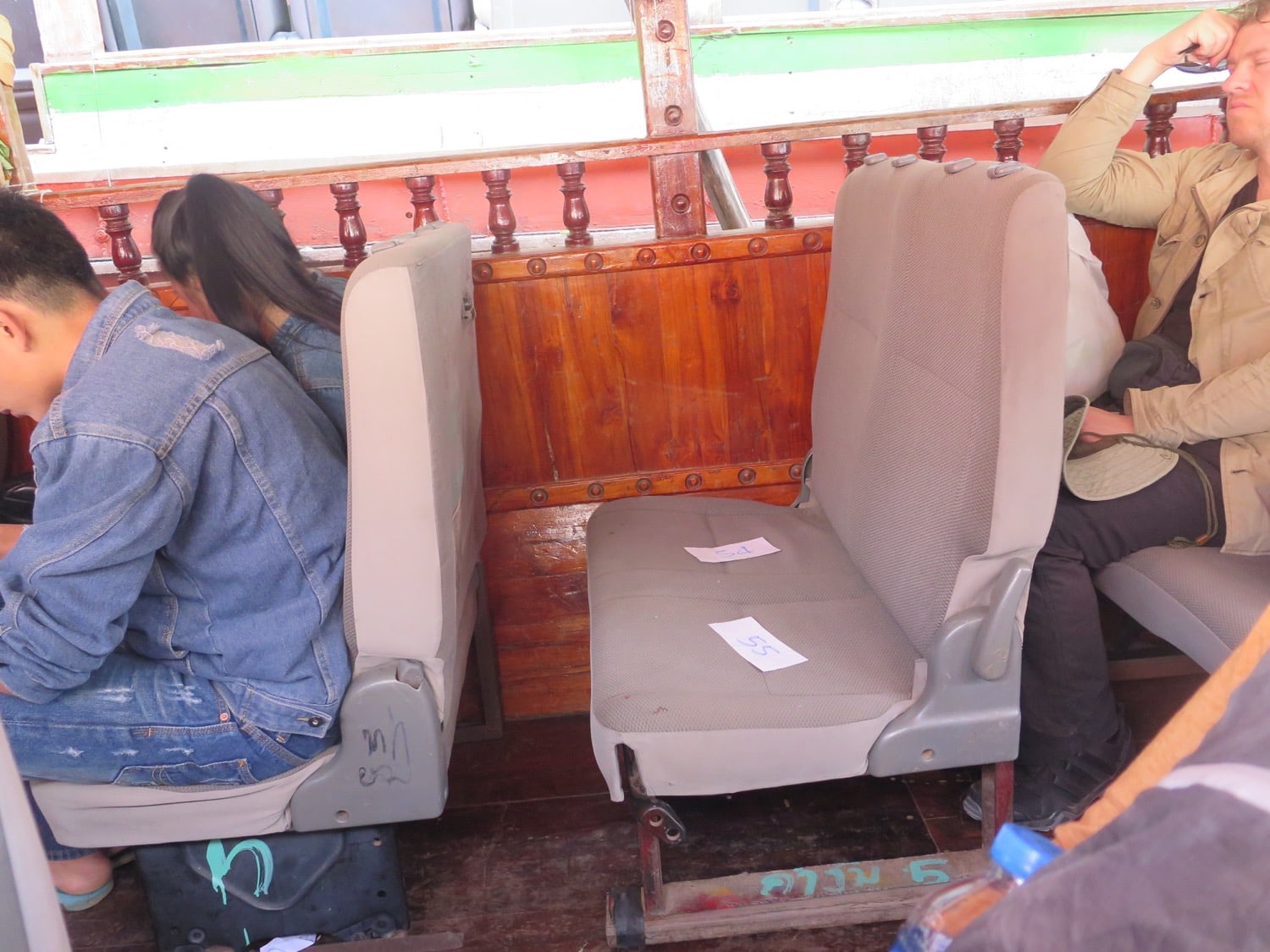
There is a piece of paper on every seat with the seat number on it. If you don't like your place, you can try to move the piece of paper on a seat that you prefer...
Keep in mind that seats are old bus-seats and are not fixed on the floor, so they will move around. If you are taller than 160 cm, adjust your seat, otherwise, your legs will not fit and you don't want to travel like a sardine in a can! However, space is very limited...
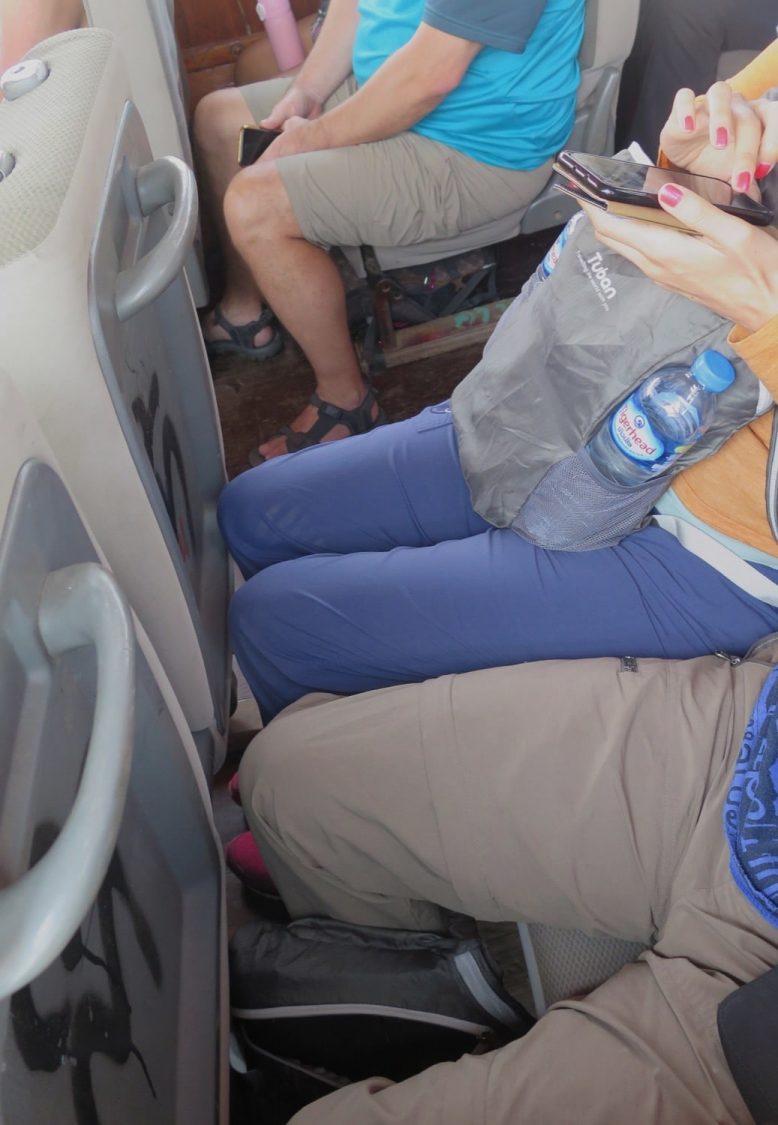
The best seats are the ones in front. Be aware that in the back of the boat there is the engine which is really very noisy and constantly smells like fuel. In addition to that, you also have the "toilet", which is 1 for the entire boat... In any case, please bring your own mask. When the boat breaks, turns or stops, you will be dipped in the petrol fumes.
5. Is your lifevest there?
Probably not! There is an average of 1 lifevest for 4-5 passengers... In case of need, bring out the best of your swimming skills and reach the shore as soon as possible.
If the boat is well balanced, everyone stays seated and doesn't move too much, the current isn't too strong, and if the captain doesn't crush against the rocks, you should be safe!
6. Bring your own food
Unless you really love chips and powdered soups, it is advisable to bring your own food. It is not expansive, but the "bar" on the boat has very limited supplies, few of them even expired.
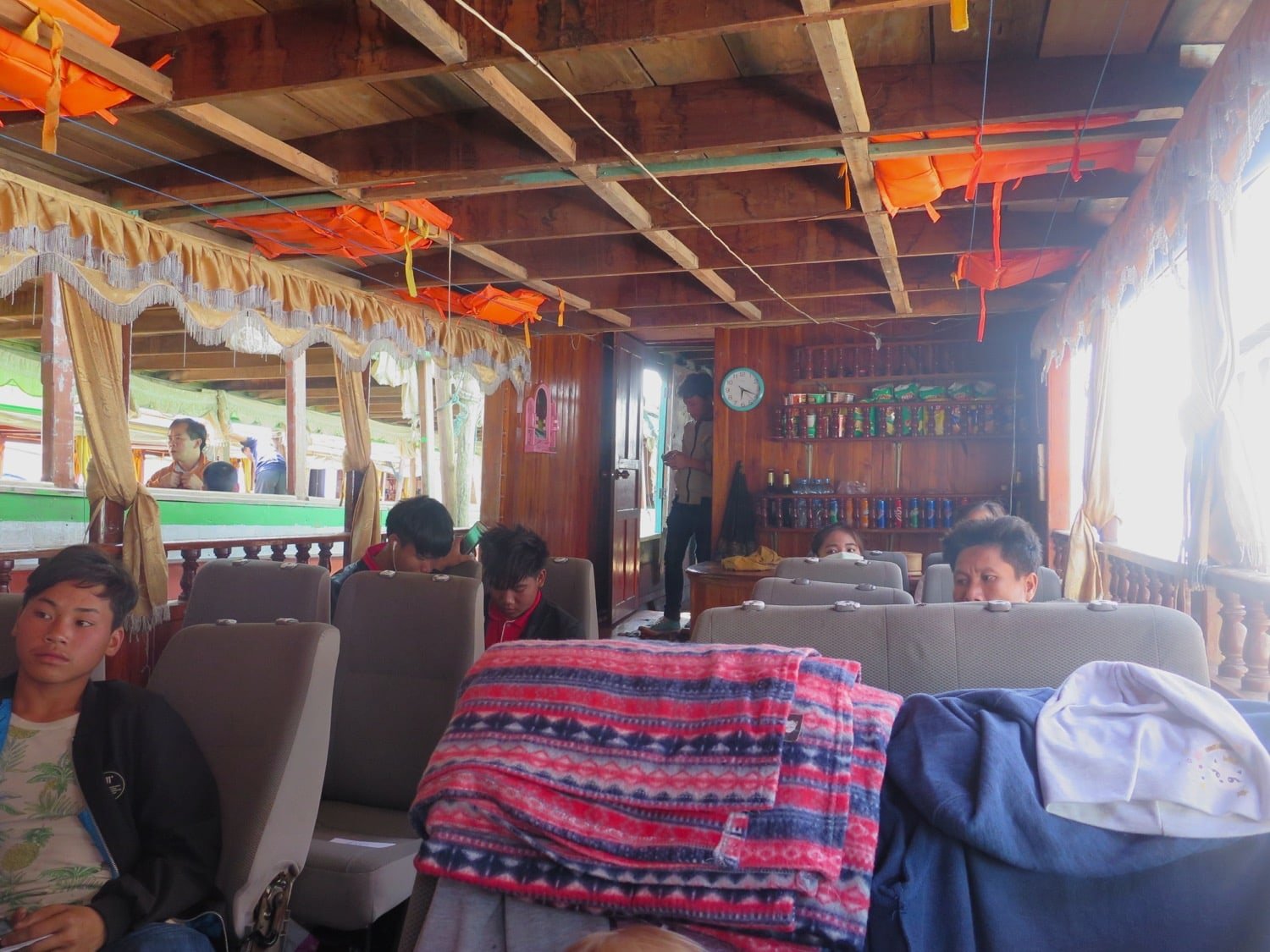
7. Reduce toilet usage...
There is one toilet for the entire boat. For men is maybe not so shocking, but for women... I suggest to do everything you need to do before going on board, and then use the toilet as less as possible. Toilet paper is surprisingly there, but it is anyway a boat's toilet.
8. Enjoy the landscape!
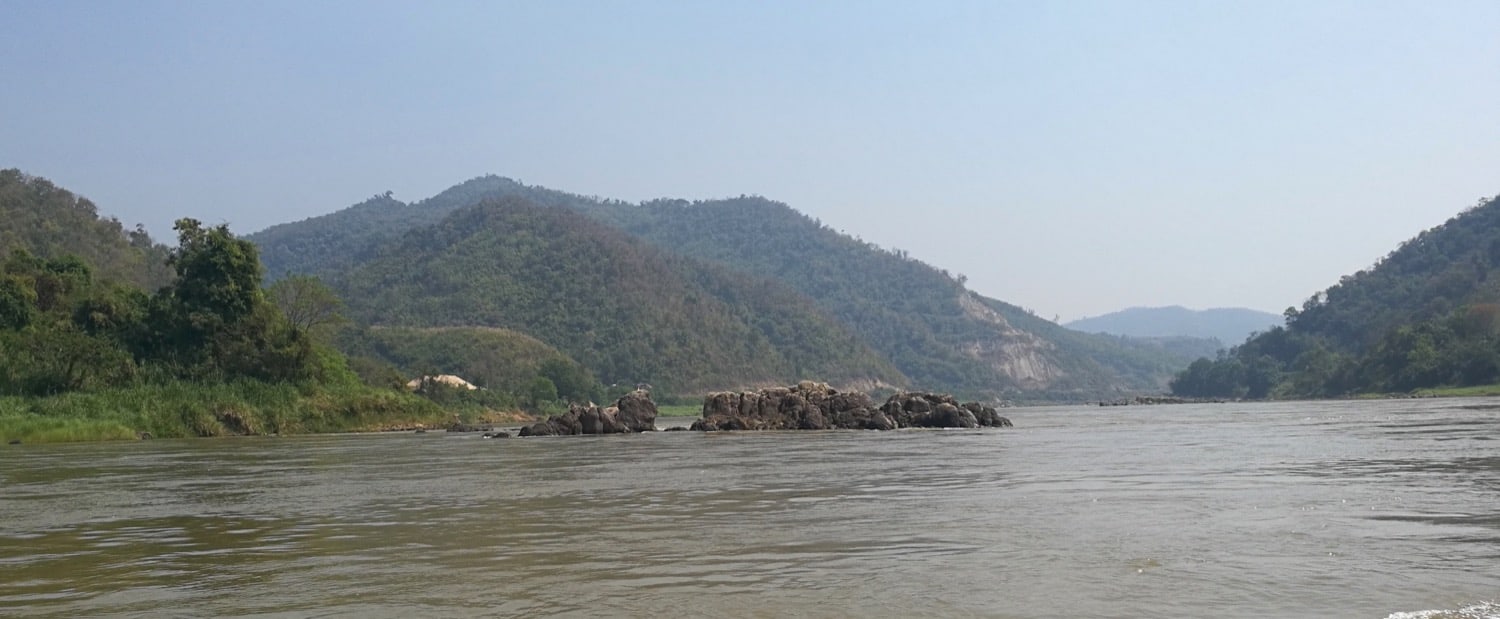
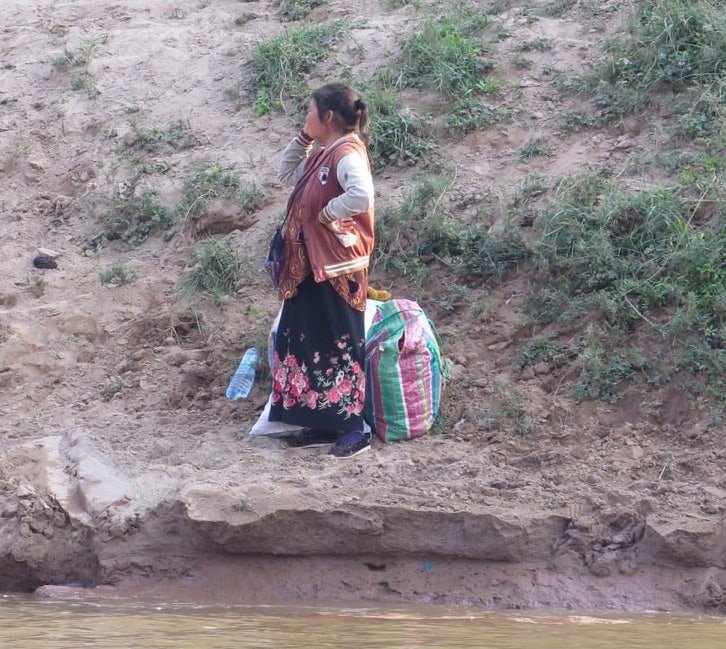
It is beautiful! The jungle, buffalos, little huts, children playing in the water, and so on.
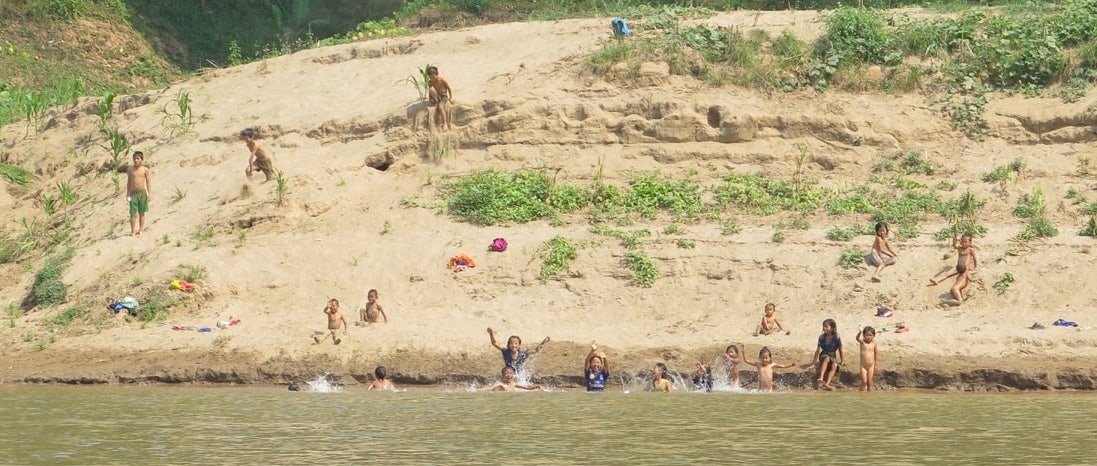
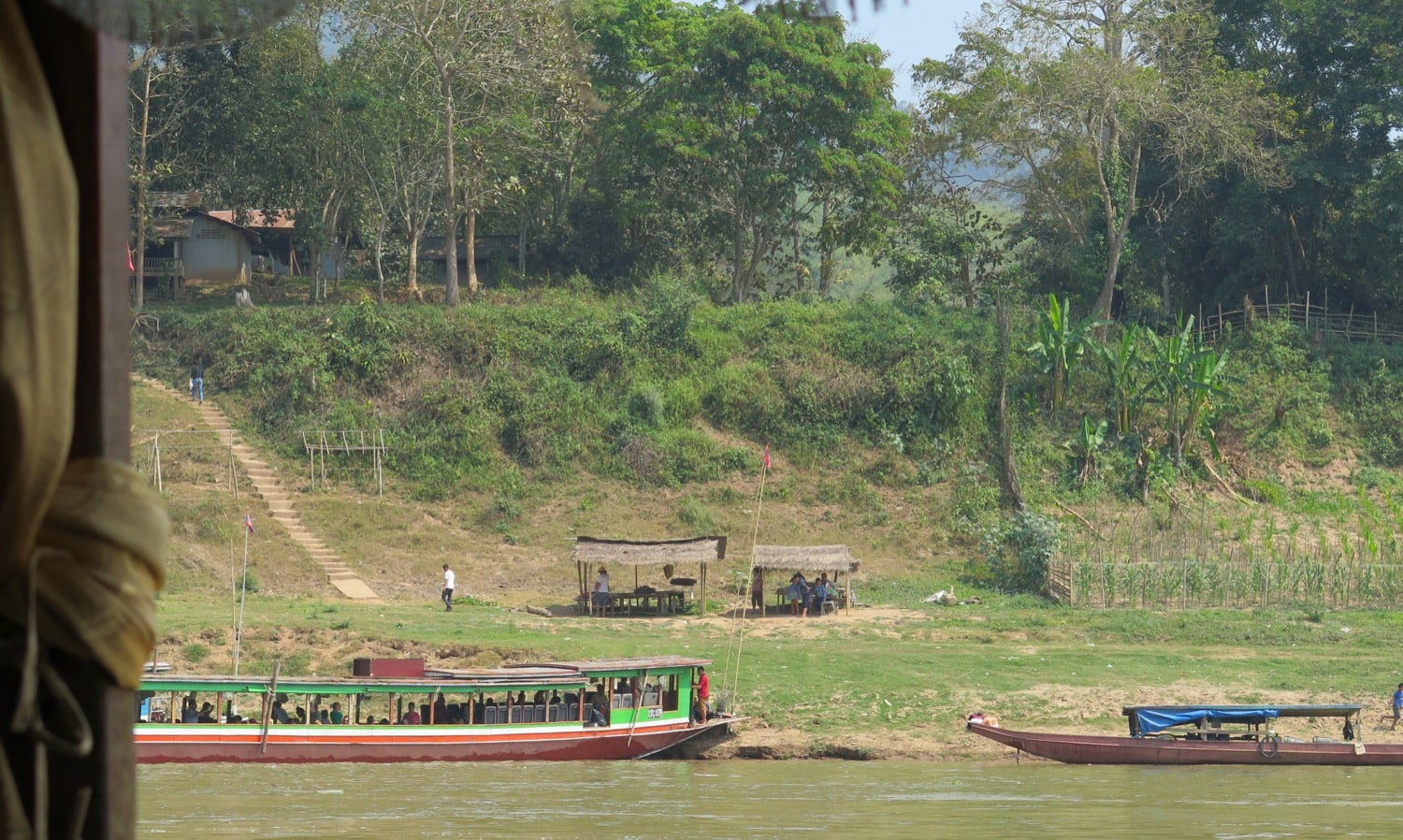
The slow boat will stop here and there at improbable piers to drop off local people to their villages. They jump out of the boat with extreme agility and run to hug their relatives or friends who are there, waiting for them.
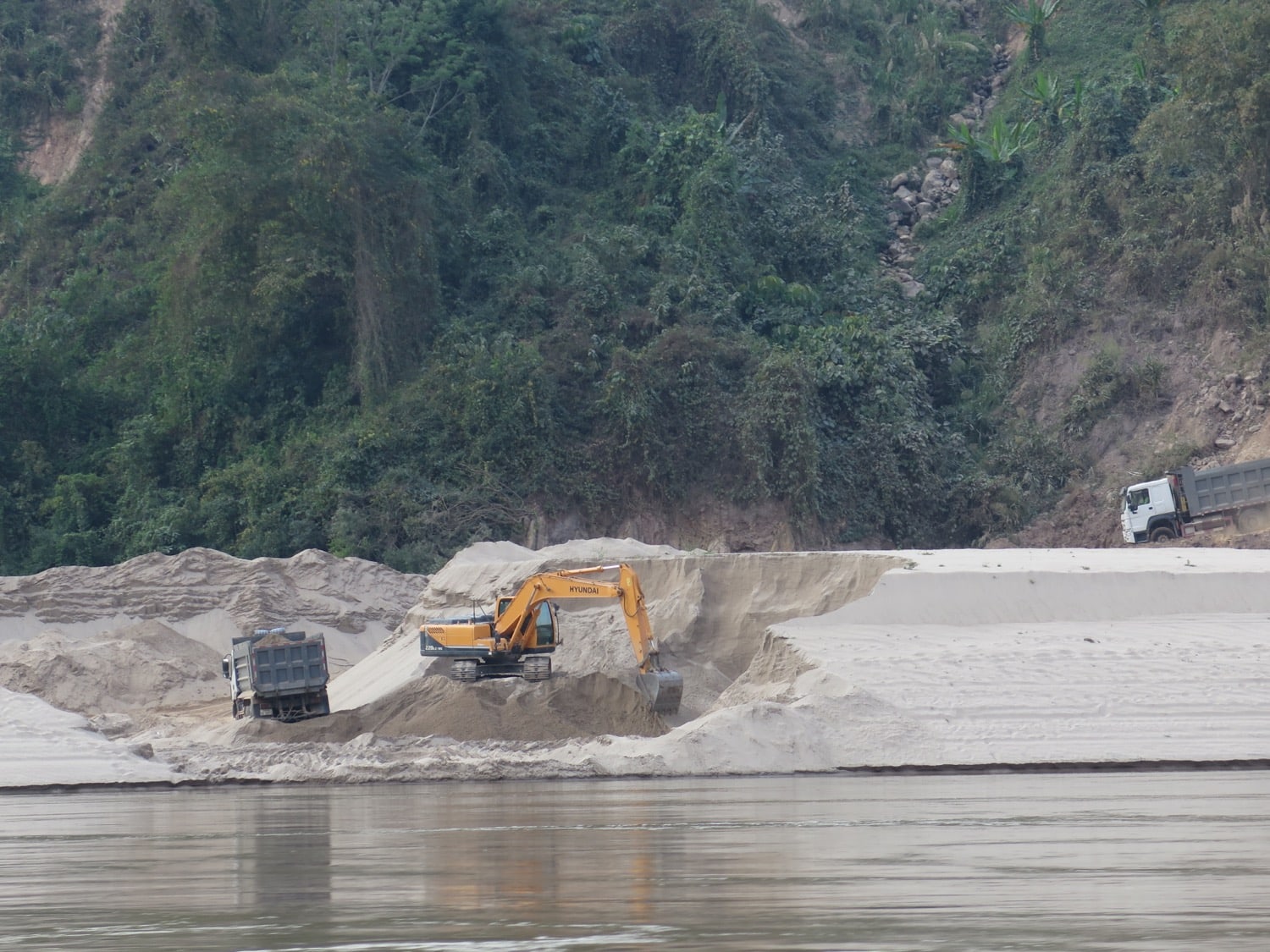
Unfortunately, there are not only nice sights, but you will also see some disrupting construction, bulldozers, and antennas... Smartphones arrived here too, in the most remote villages of Laos. It is impressing! Globalization is nowadays everywhere and is stealing people's authenticity and passion for life. Everyone is in front of the smartphone, there is almost no interaction and no human touch left.
Travelling by a slow boat is an emotional trip, impactful and needs to be done at least once in a life! But we must say that the 6-hour trip was enough for us :-)
Once disembarked, you can walk or catch the transfer to your accommodation, and the enjoy a nice evening in this cute village called Pakbeng!
Talk to you soon :-)
14 tips for an eco-friendly and responsible stay in Chiang Mai
We collected a few tips to transform a holiday in Chiang Mai into a sustainable and eco-friendly stay!
1. Be careful with TripAdvisor
This is applicable to every activity in every part of the world.
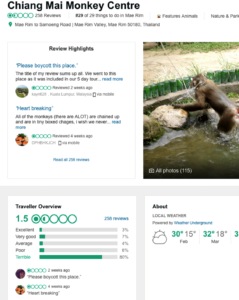
Very often you find advertised activities that look eco-friendly and amazing. Unfortunately, this is not always the case. Be careful and read a few relevant reviews. You will find out the real nature of the activity, its pros and cons, and if it is worth it or not. Of course, not all the reviews are objective or pertinent... then it is up to you to evaluate their accuracy. Just to give you an example: the Chiang Mai Monkey Centre is advertised as a fun activity with monkeys, but if you check the overall reviews, you will find out that these animals are treated in a cruel and inhuman way. It's so sad...
2. Help homeless animals
South East Asia is full of dogs, cats and chickens. There are organizations or local people who take care of them. They are not too skinny, but you can see that they don't eat enough. During the warmest hours of the day, they just lay on the ground without energies. To help them, it would be nice to bring them some left-overs or buy them some food. It is a little gesture, but with great value!
3. Don't ride elephants
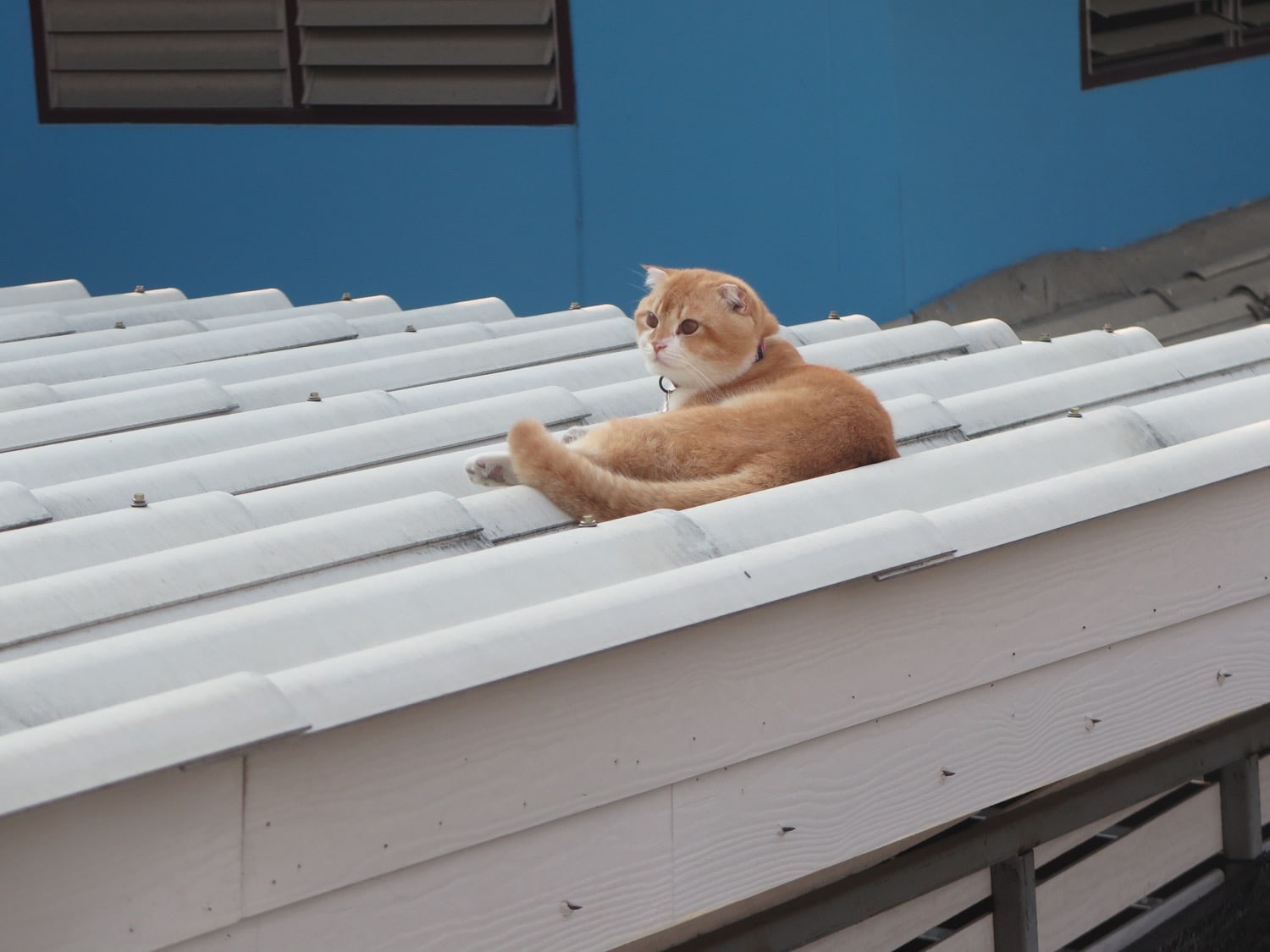
Many companies realized that riding elephants is a "cruel" activity. Poor animals! If you are looking for an experience with elephants, go to a sanctuary. There, you will interact with happy elephants, you will feed them, wash them and walk them to the river for a funny bath. It's is more ethical, a more touching experience for yourself, and they will not suffer at all.
4. Choose a cooking class in an organic farm
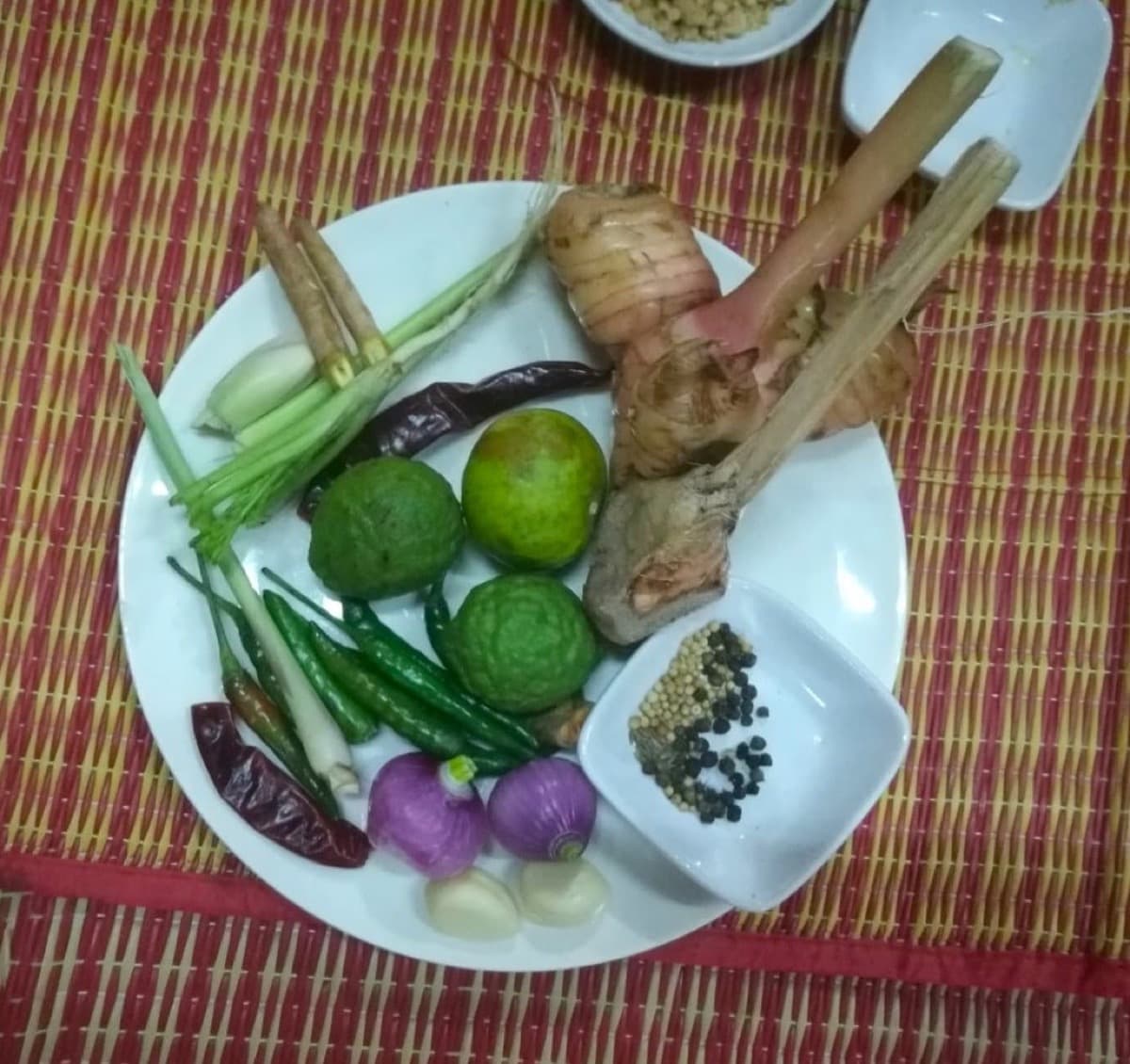
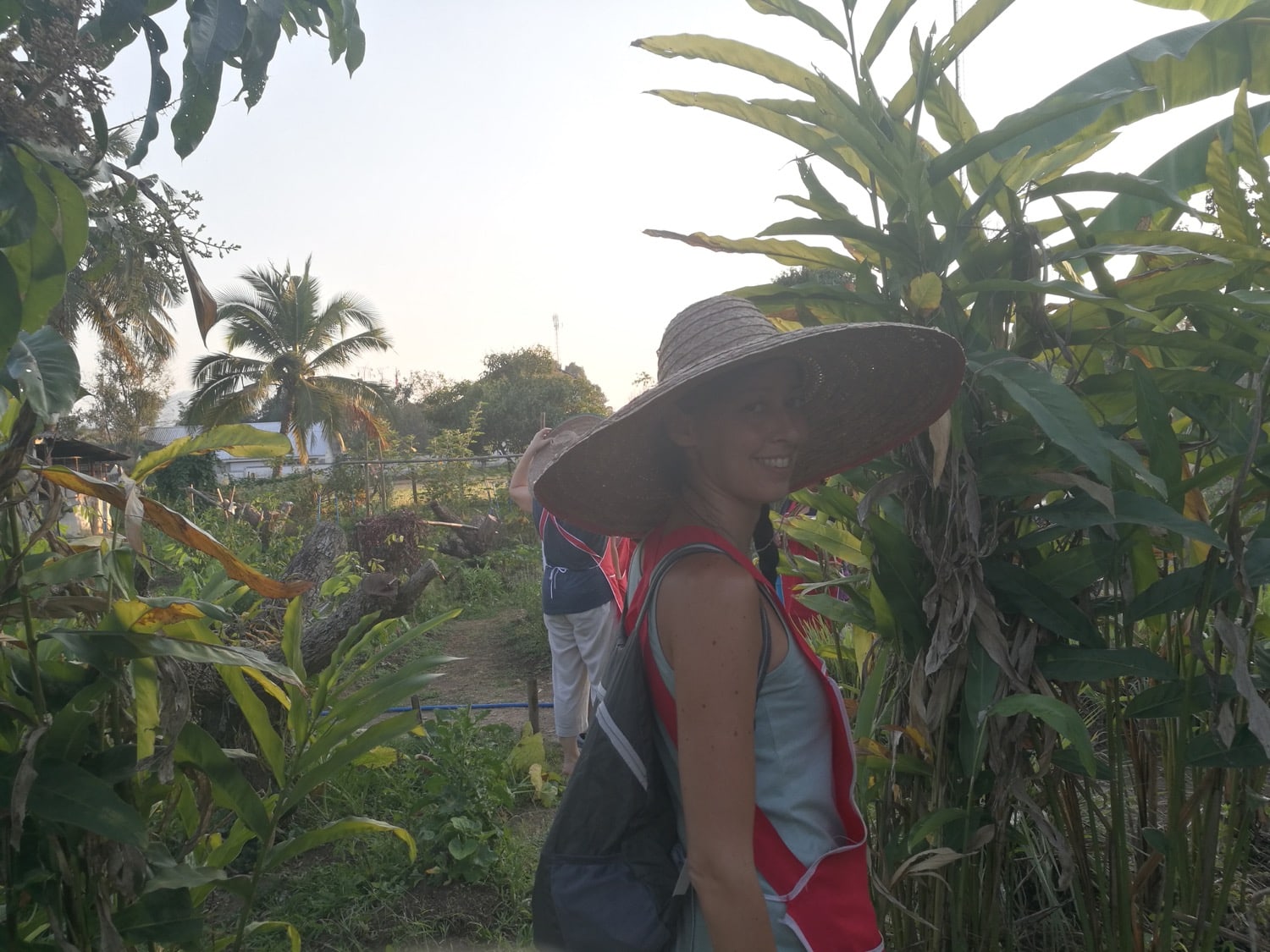
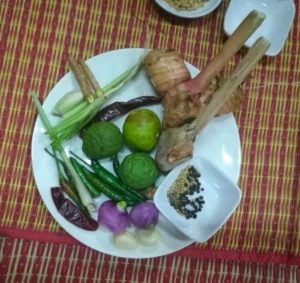
We went to the Smile Organic Farm Cooking School. It is at approximately 45 minutes from Chiang Mai, and it is located in a green countryside. They pick you up at your hotel. First, you stop at a local market then, once at the farm, you dress like a real farmer and your team-leaders will show you all the herbs, vegetables and fruits growing in their garden. Afterwards, you can choose 5 dishes you would like to cook, you will cook them and, last but not least, you will enjoy your chef-d'oeuvre! A very nice and recommended experience!
5. Have one complete meal per day
When it is so hot, you actually don't feel like eating a lot. If you eat fruit in the morning, a natural and organic snack for lunch and then you have a high-energy meal in the evening, your body will be restored and you will feel more lively. This is a good way to safeguard yourself and your body, the environment (low food consumption) and... your wallet!
6. DIY activities
There are hundreds of tour agencies organizing all the same activities for an extremely high price. They maybe offer you transportation to/from the activity, but still, they make up their margin and earn easy money. Try to arrange the activities by yourself, it can be challenging but it is worth it to try. Again, your wallet will be happy! In addition to that, you can select new and eco-sustainable experiences (planting a tree, biking, etc.), or volunteering (in sanctuaries, etc.), or give priority to non-mass tourism's activities.
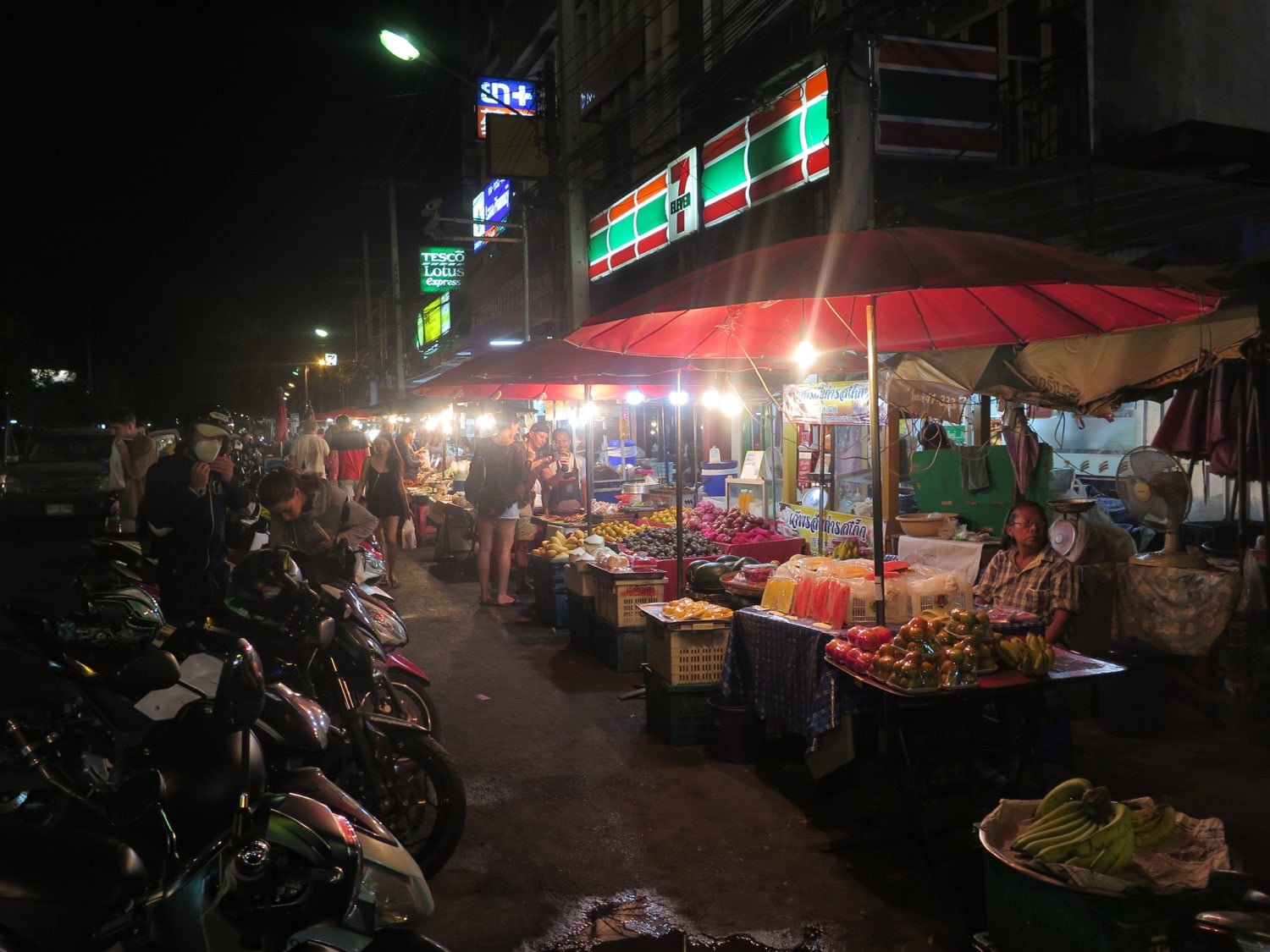
7. Buy at local markets
Thailand is full of 7eleven shops which, in turn, are full of imported products. The result is that the Thai economy and culture is suffering and feeling chocked. Buy at local markets in order to support this country, to discover traditional products and authentic tastes.
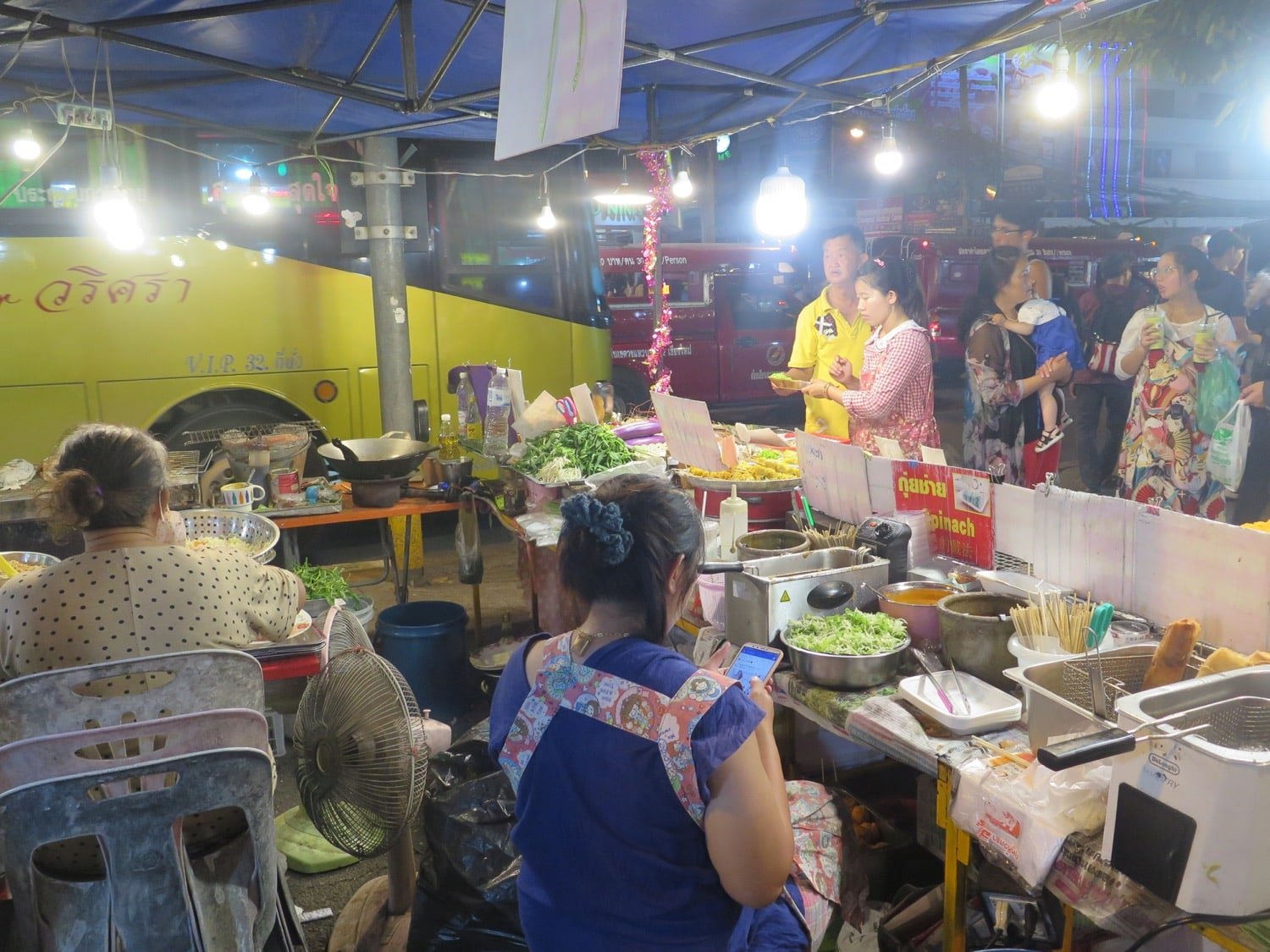
While waiting for your food, you can also have a bit of fun :-)
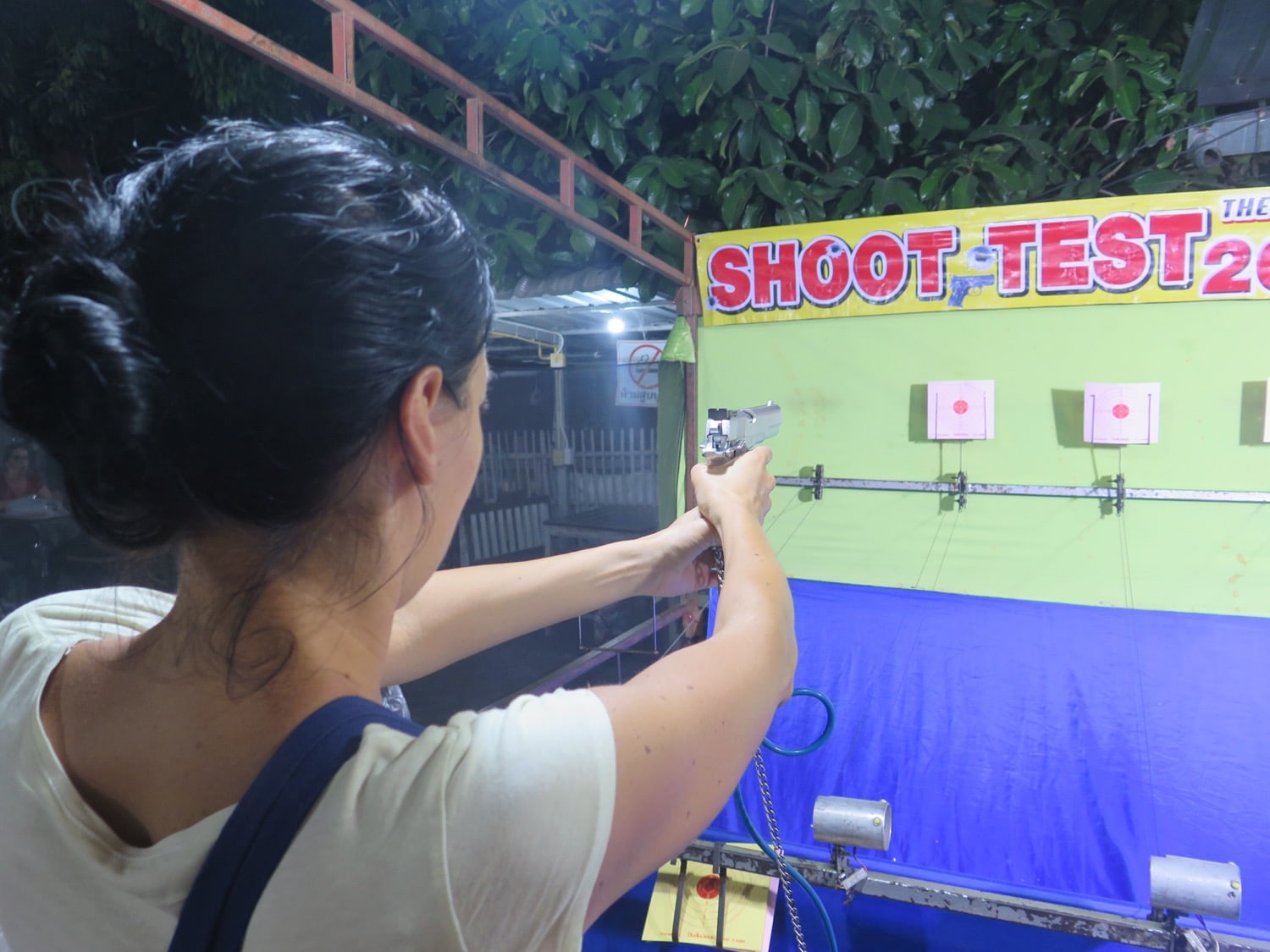
8. Carefully check bottled water
Tap water is not drinkable, so you inevitably have to buy bottled water. Check carefully the ingredients, as some waters' taste is as you would be drinking directly from a swimming pool! They are rich in fluorine and chlorine, which are very bad for your health! Carefully select the most natural water, possibly local...
9. Avoid glass bottles
Recycling is not really popular in this part of the world, therefore all the garbage is collected and somehow eliminated. Glass, when not recycled, has a degradation time of 4000 years! When possible, it is better to avoid glass bottles...
10. Discourage globalization
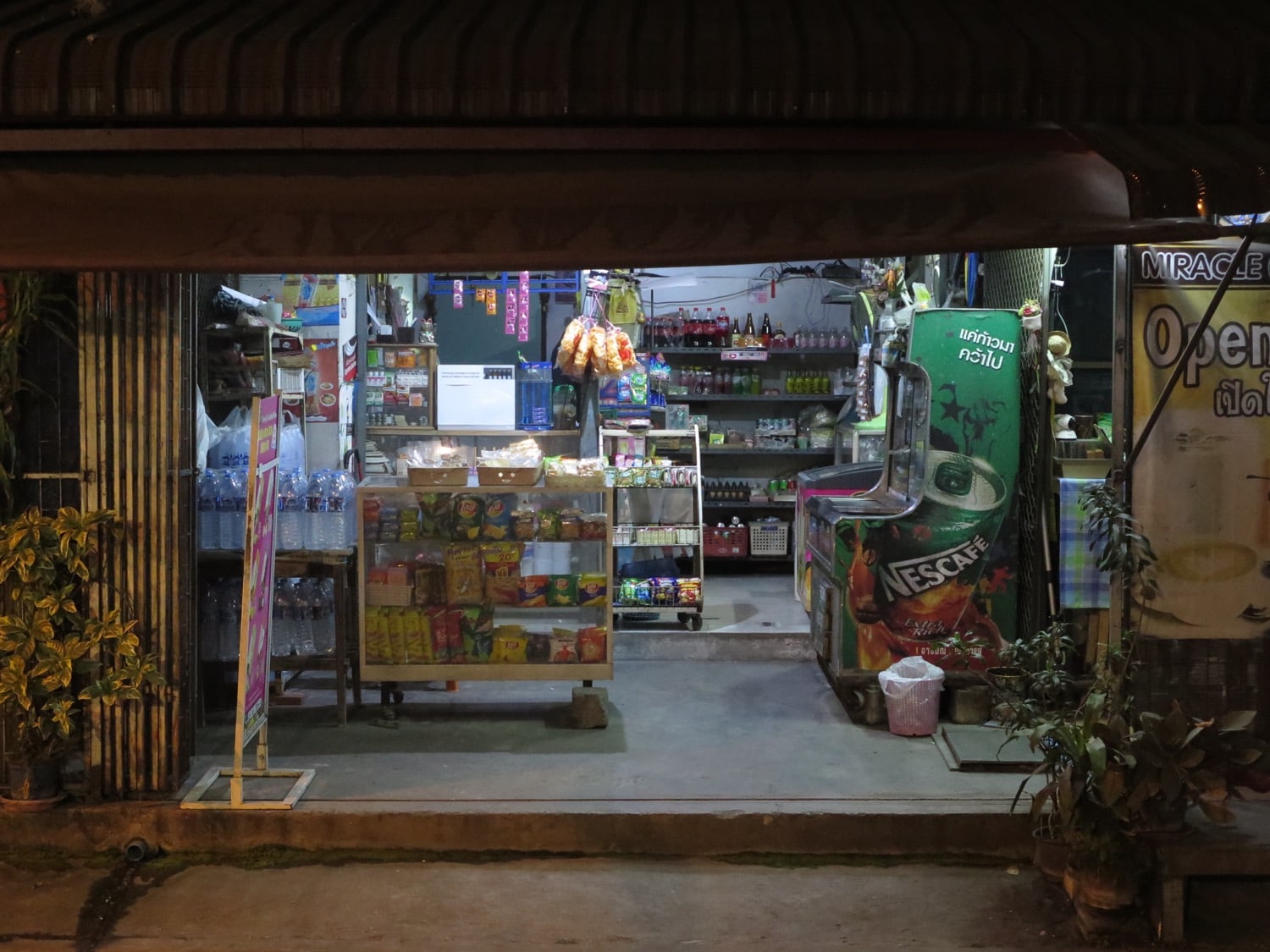
When you see imported products in local shops, don't buy them. Give priority to homemade goods! If you don't do so, Thailand will lose its authenticity, its culture and culinary traditions. This would be such a shame!
11. Eat vegetarian or vegan
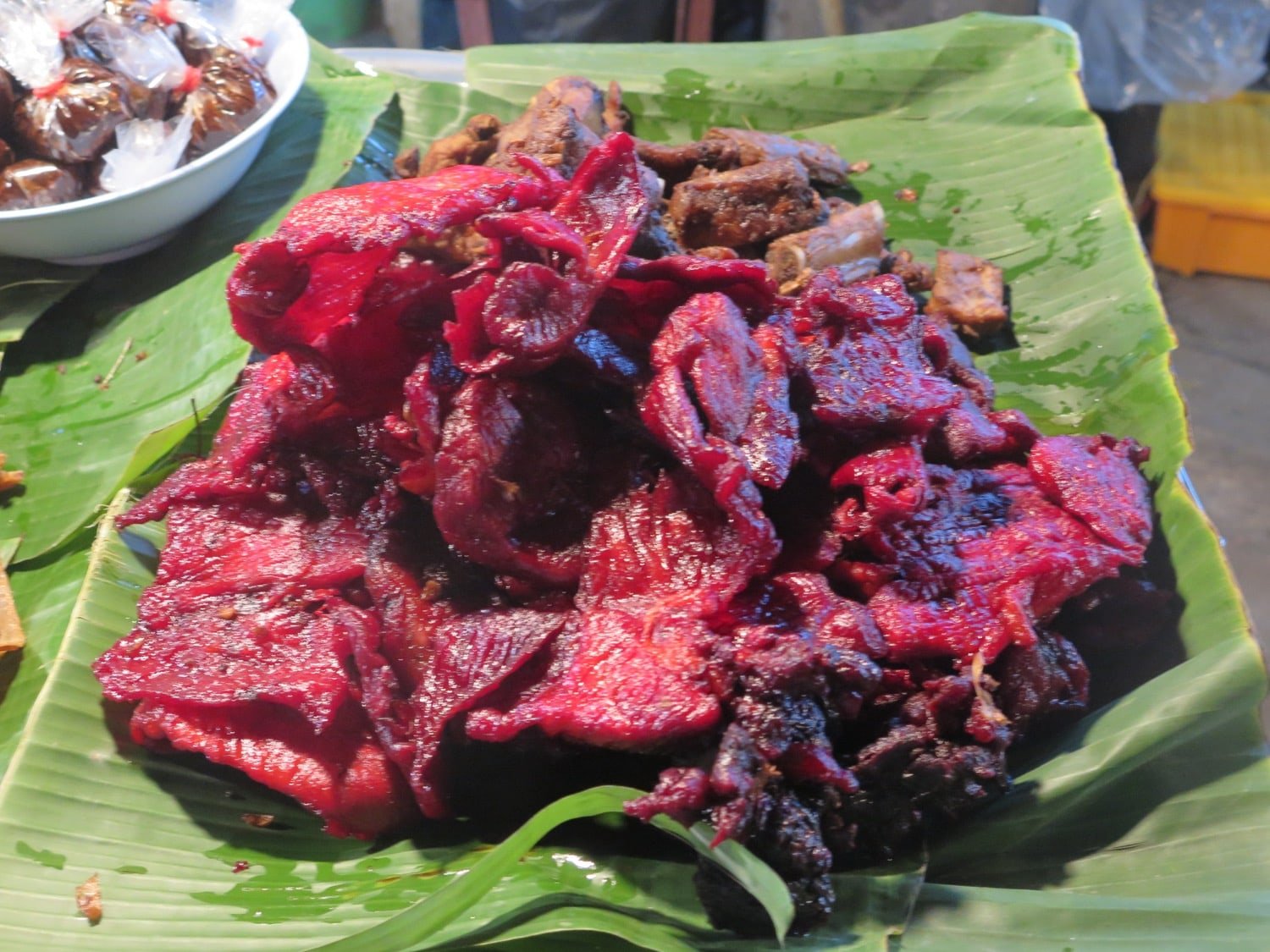
It is not advisable to eat meat in developing countries. The main reason is that those poor animals live on the road, and very often eat and drink from the garbage or in a dump. That means that, in a way, you will "eat" what they eat.
In addition to that, you cannot always understand what kind of meat is on the BBQ: it has weird shapes and colours...
The environmental impact of meat production in the world is scary, you can read here some facts.
If you eat cooked vegetables, you are safe!
12. Walk... instead of grabbing a tuk-tuk
If you can walk, just do it! You will discover much more in every corner, and you will assist at wonderful scenes that you would have missed when going by tuk-tuk or by car. It is healthier, you help the environment and you develop your sense of direction. If necessary, use the offline app maps.me, so you don't get lost. Bring your mask...
13. Tuk-tuk strategy
If you need to go outside the city centre, it is better if you walk. A tuk-tuk will try to charge you more because it has to drive away from the centre and the main attractions. On the contrary, when you are outside and you need to go back to the centre, a tuk-tuk will be cheaper as it has anyway to go back in that direction. Keep it in mind!
14. DIY laundry
Asia is full of women doing the laundry for you, it takes 24 hours but you get back your clothes scented and ironed. These ladies charge you a fee per kilo of washed clothes.
You can also find public laundries with several washing machines and you do the laundry by yourself. Very often, in these places, there is a free WIFI connection and some comfortable seats, where you can work while you wait.
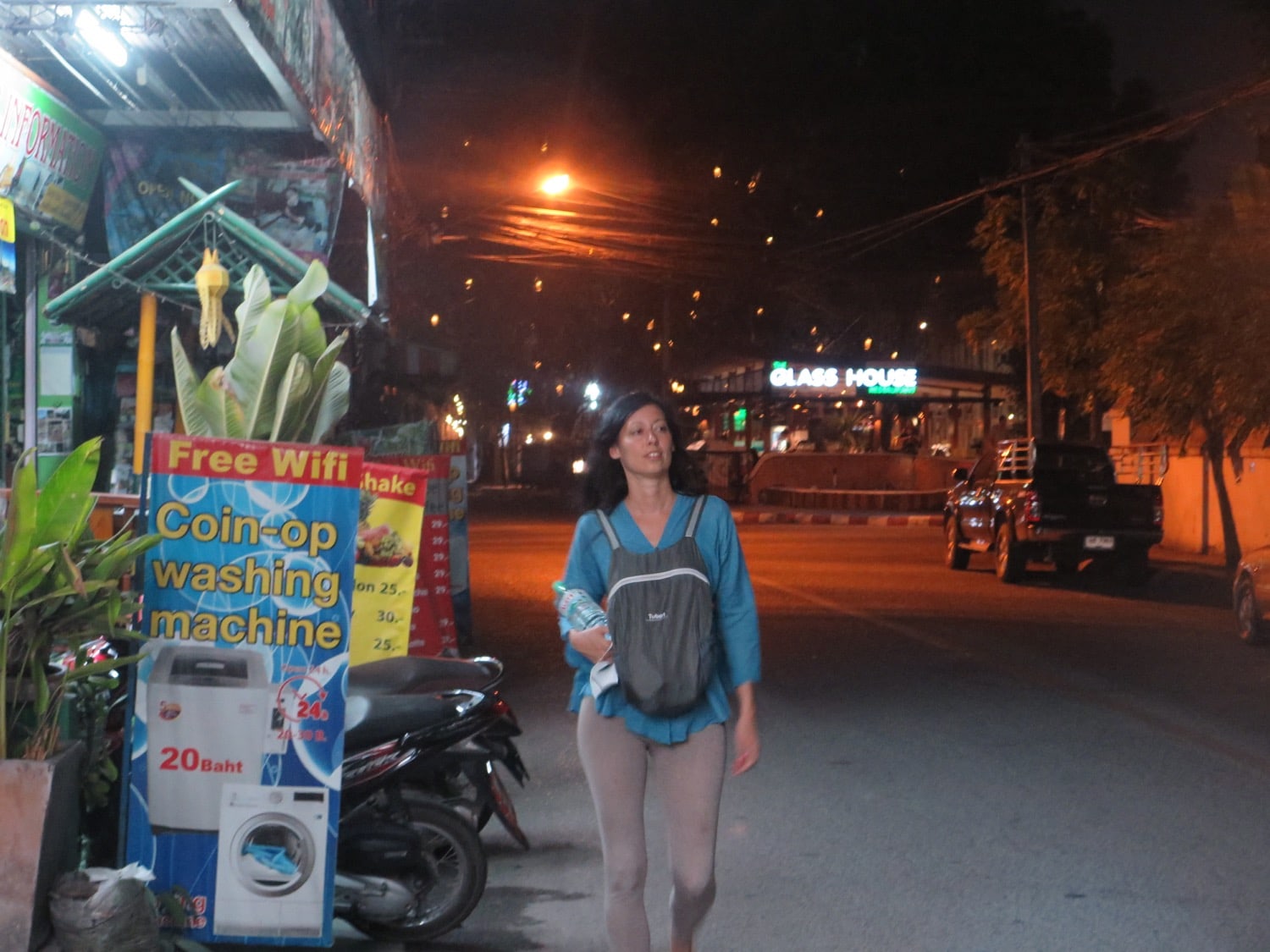
Save time and money, safeguard the environment, yourself and the others. Even if you find yourself in a mass destination, you can still make the difference and give a good example to everyone!
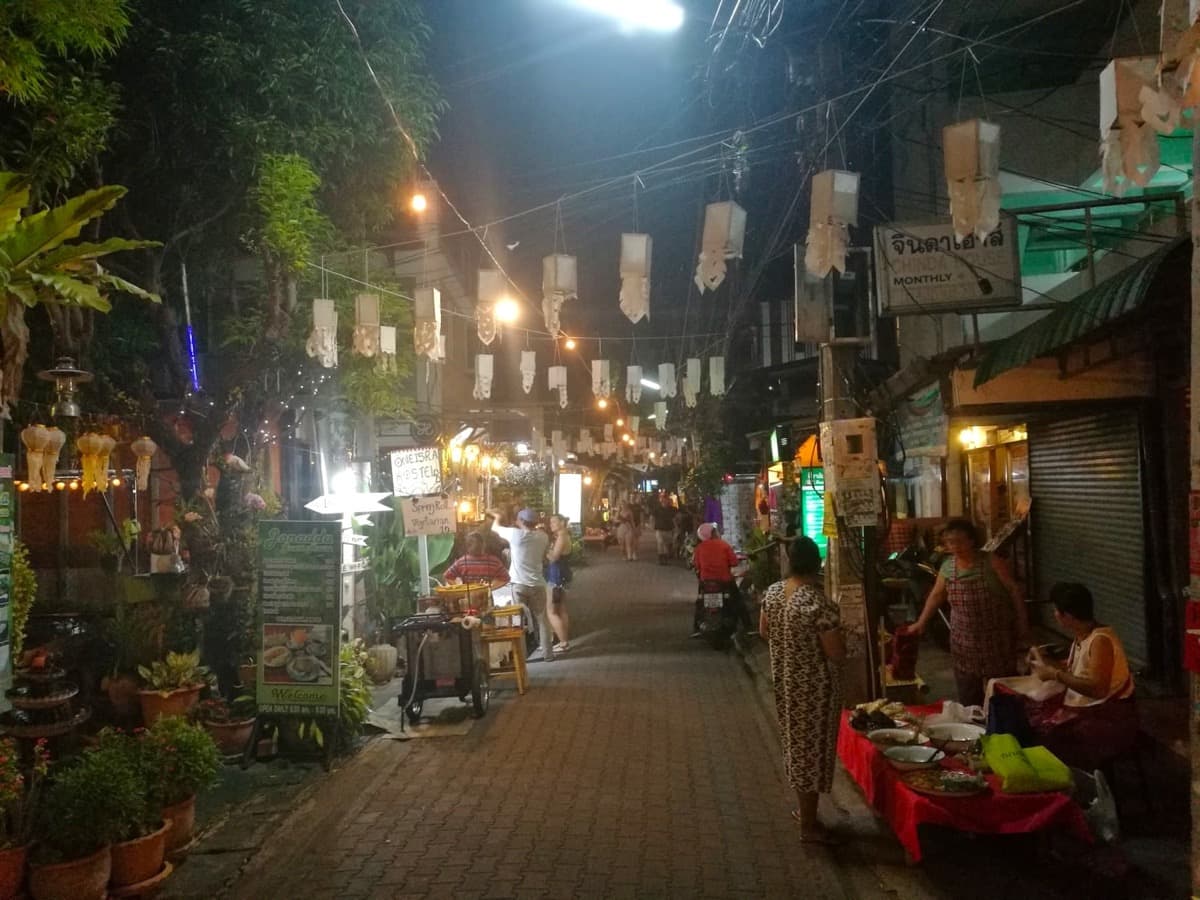
Chiang Mai for Digital Nomads
After a pleasant 2-hour flight from Krabi, we landed in Chiang Mai around 10 pm.
Several digital nomads choose this city as their temporary home. You can find many blogs about that on the web, everyone has his/her own opinion, but it is true that the majority thinks that Chiang Mai rocks if you are a digital nomad. Here below our personal experience.
Accommodation
Our host Pim, a very nice and friendly Thai lady, picked us up at the airport and brought us directly at the hostel In the City, where we spent our 8-day stay.
She is the owner and founder of this hostel specifically arranged for digital nomads. There, you have the right working environment and setting, it is very quiet and you have all the needed facilities.
The hostel offers both dorms and private rooms. There are shared bathrooms and showers, which are located on every floor. You will get towels and sheets, and in the bathroom, there are shampoo and soap.
Co-working space
The co-working space is an open space with enough tables, comfortable chairs and plugs. The room has A/C so you are able to work also during the warmest hours of the day. If you need it, there is even a printer.
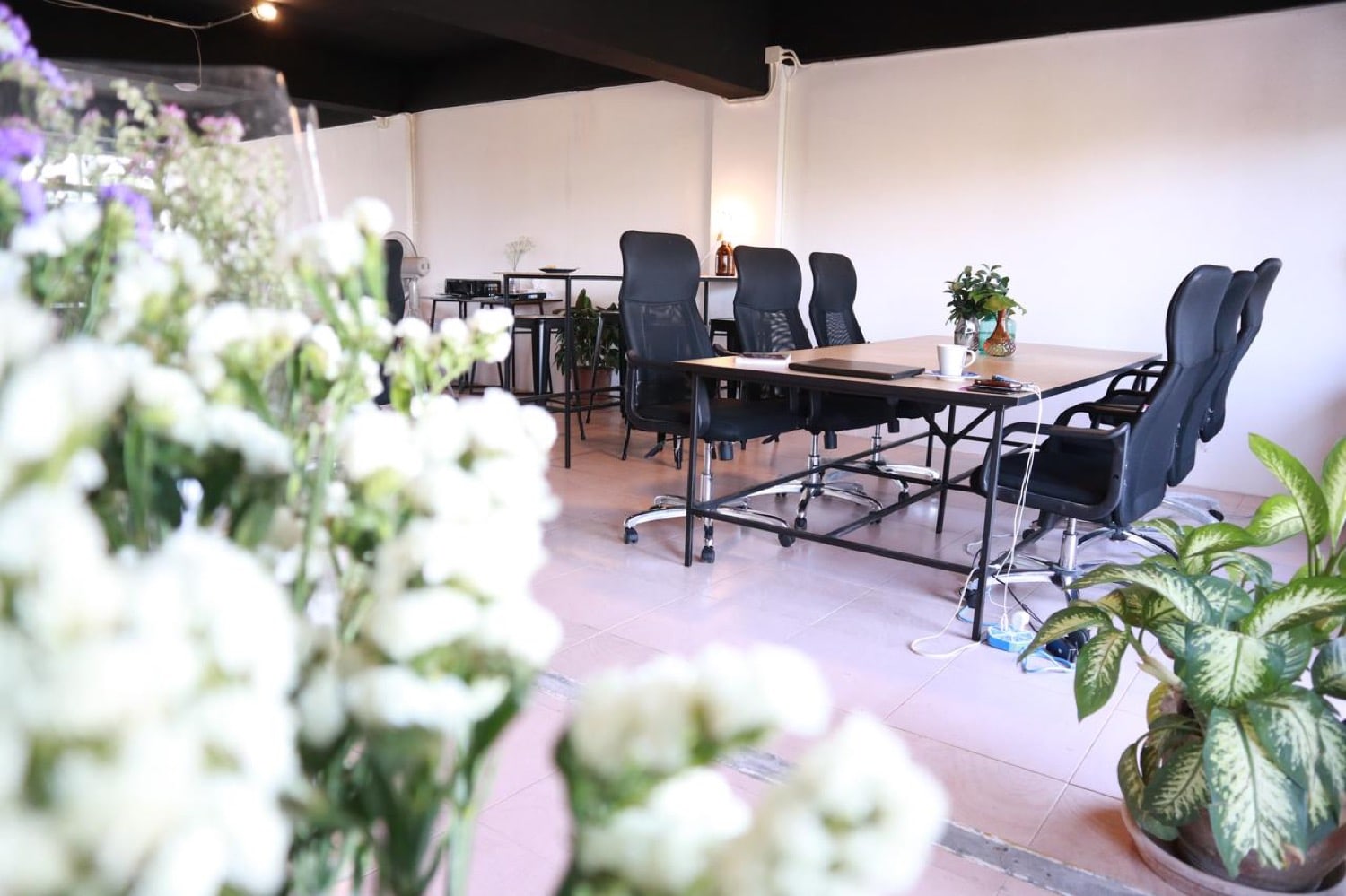
In addition to that, there are 2 Skype rooms well insulated, and everything is accessible 24 hours a day.
Meals
Every morning, Pim’s colleague prepares a delicious Thai meal for everyone, which is included in the price of your stay. If you are vegetarian, you will always receive your meal with tofu instead of meat or fish, and this is really appreciated. In addition to that, you have fresh fruit, coffee and tea, water and some snacks for free, during day and night.
Rhythm of life
To have a healthy lifestyle, you need to balance work and leisure. This co-working hostel is really perfect when you need to work, and Chiang Mai is really perfect if you want to enjoy the city or some cool activities.
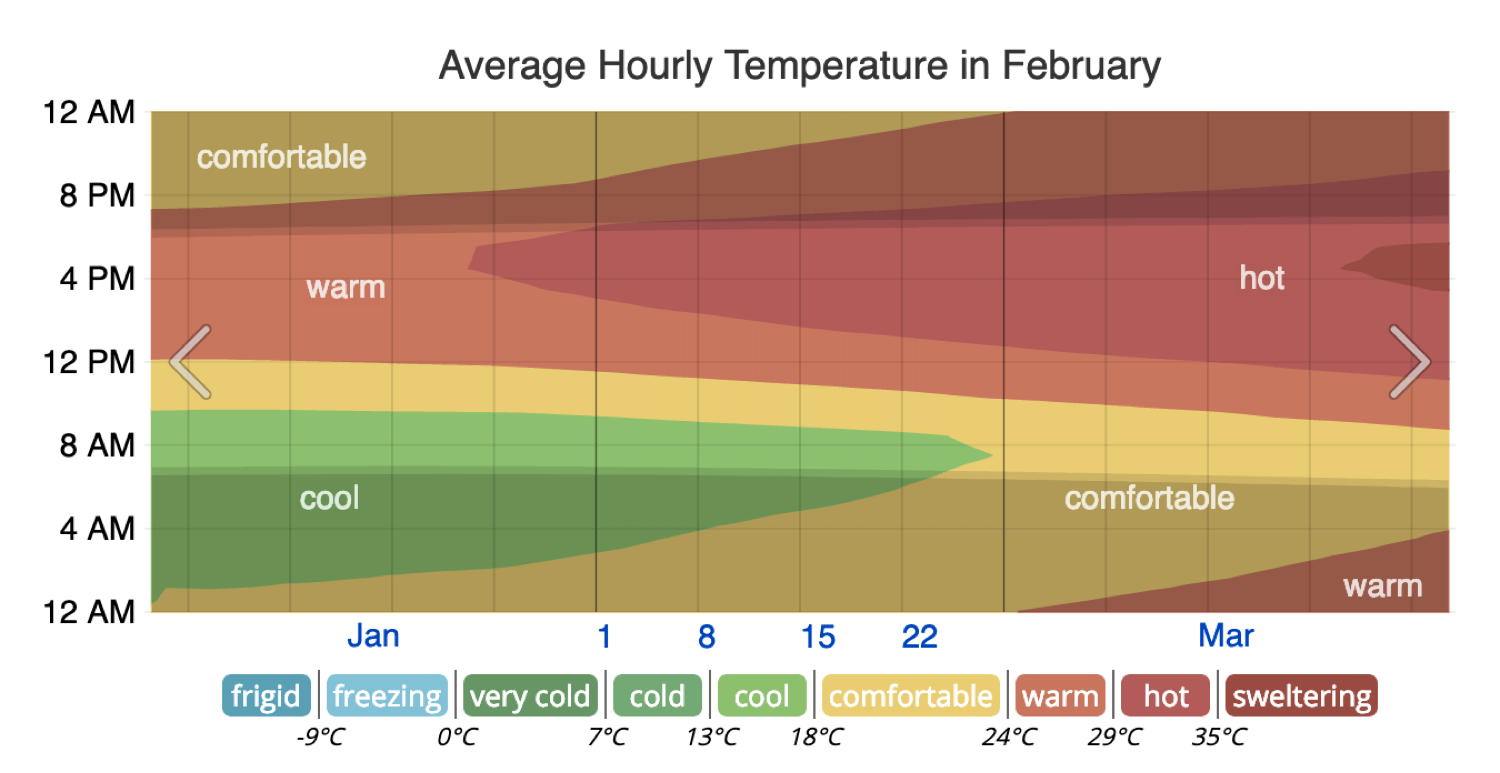
We stayed in Chiang Mai in February, and we can say that it was quite hot! So we highly recommend to stay inside and concentrate on your production between 11 am and 3.30 pm. At that time the heat is really killing! Early in the morning and later in the afternoon, you can enjoy the city and its surroundings.
There is a lot to do in Chiang Mai, you can check all kind of to-do lists online and you will find thousands of flyers everywhere.
Money saving
It is possible to save money in several ways. These are some of our strategies:
Food
We ate some complimentary fresh fruit for breakfast and the included meal for lunch. So we had only 1 meal per day to cover. Chiang Mai is actually not too expansive if you go to the right restaurants!
At the restaurant
We always note down what we order and the price, as we noticed that you can get fooled by waiters' mental arithmetics... Do your calculations in advance, so you know exactly what you need to pay. It takes a few minutes and it will save a lot of time when you update your travel accounting!
Drinks
Drinks at the restaurant might cost as one dish, above all fruit's shakes. If we want to drink, we usually order one bottle of water, that we can take away in case we don't finish it... I admit that once in a while, I enjoy a cold beer :-)
Activities
There are often promotions for activities, for example during Valentine's day, or on other occasions. Keep on eye on that!
It happened to us that we wanted to go to visit the museum Art in Paradise. Walking to the museum, we crossed an agency selling tickets with a 20% discount. We stopped by and asked for more information. The trick was: we paid the discounted price in advance at the agency, the lady drove to the museum to buy the tickets (at student fare) for us. When we reached the museum, she was there in front of the door with the 2 tickets, waiting for us.


Accommodation and facilities
The longest your stay, the cheapest will get the price. Keep that in mind!
Moreover, try to choose an accommodation that offers some extras included in the price. For example, we had free laundry service, free meal once per day, free drinks (coffee, tea and water), free fruits, free airport pickup and several other services (booking transportation, etc) thanks to our lovely owner :-)
Transportation
If you choose accommodation with good WIFI, breakfast and other facilities included, you don't have to go around too much!
Wander in the city
We don't like smartphones so, when we walk around, we use alternative tools. In addition to that, as a digital nomad, you are always in front of your monitor. It is cool to take a break from technology sometimes!
Chiang Mai city centre (old town) is well structured: it is basically a square surrounded by walls and a river. If you have a compass, you can always know where is the North and you don't get lost.
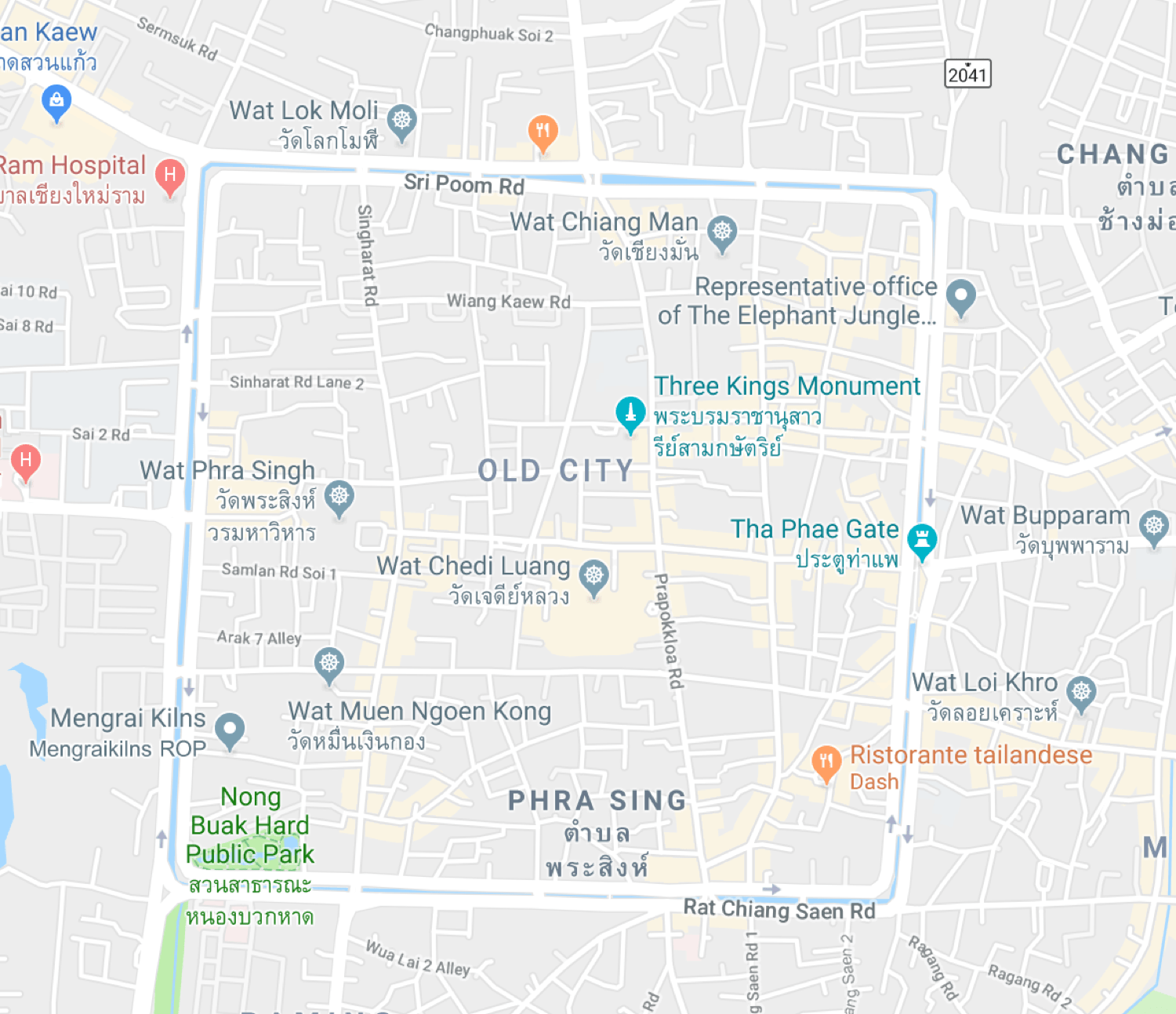
If you really cannot survive without technology, we can suggest downloading this app called maps.me, which works perfectly offline and drives you wherever you want.
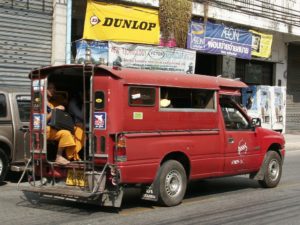
In the city centre, everything is at walking distance and if you don't want to walk, you can take a red car which is more convenient compared to a tuk-tuk. It is advisable to wear a mask as the main roads are quite polluted...
There are some hidden and cool places in Chiang Mai, you can ask at your reception for a piece of advice. We discovered an entire area full of vegetarian-hippie-style restaurants, cheap massages, cool little bars, ...
markets, ...
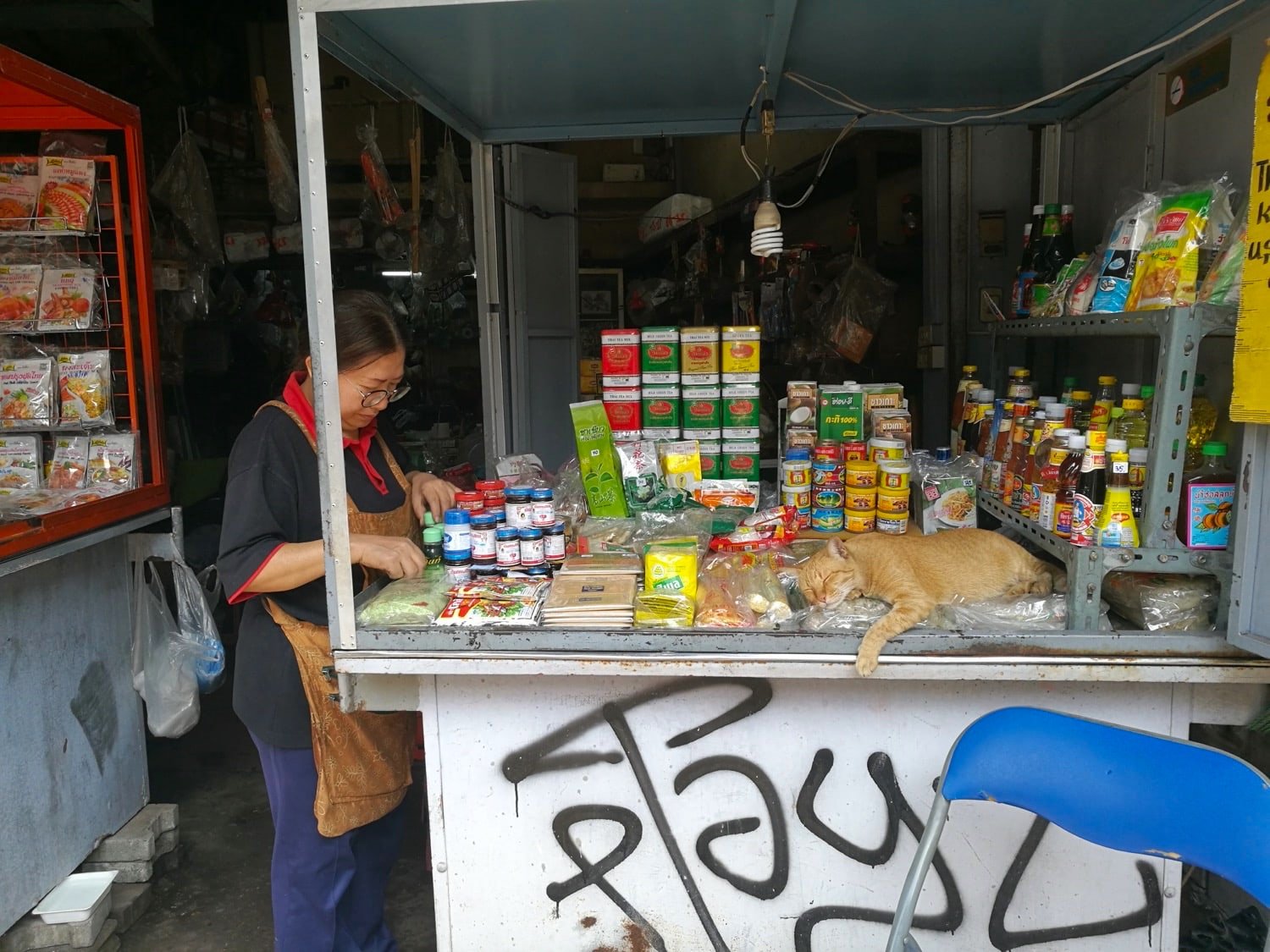
and bakeries preparing vegan breakfasts.

WIFI connection
Chiang Mai is one of the main destinations for digital nomads, as it offers a good lifestyle, it is relatively cheap and qualitative. WIFI connection is really good, not like in other SE Asian countries. In our hostel, we even had a fibre connection.
It is advisable to always use a VPN to protect your data and privacy. You can read more on our post about security.
You will find out more about Chiang Mai in our next post!
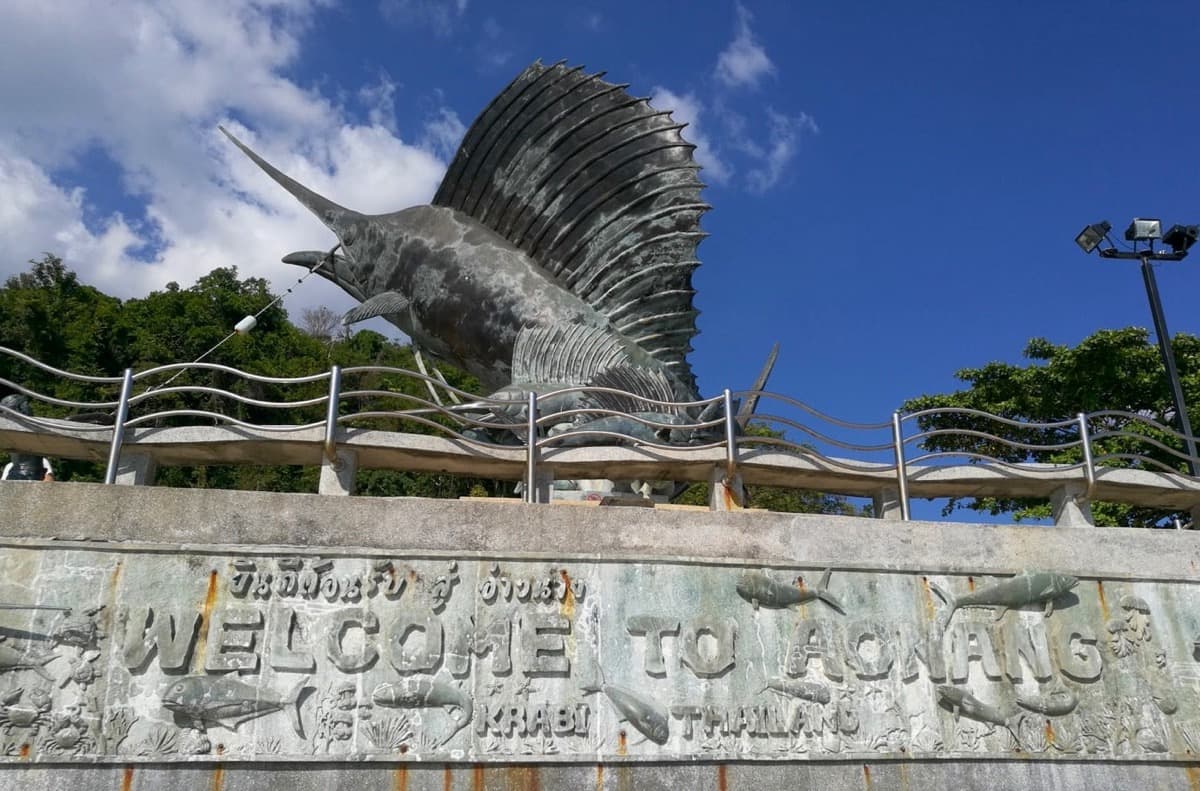
7 things to cope with when you stay in Ao Nang
Ao Nang Beach is one of the top destinations in the Krabi province.
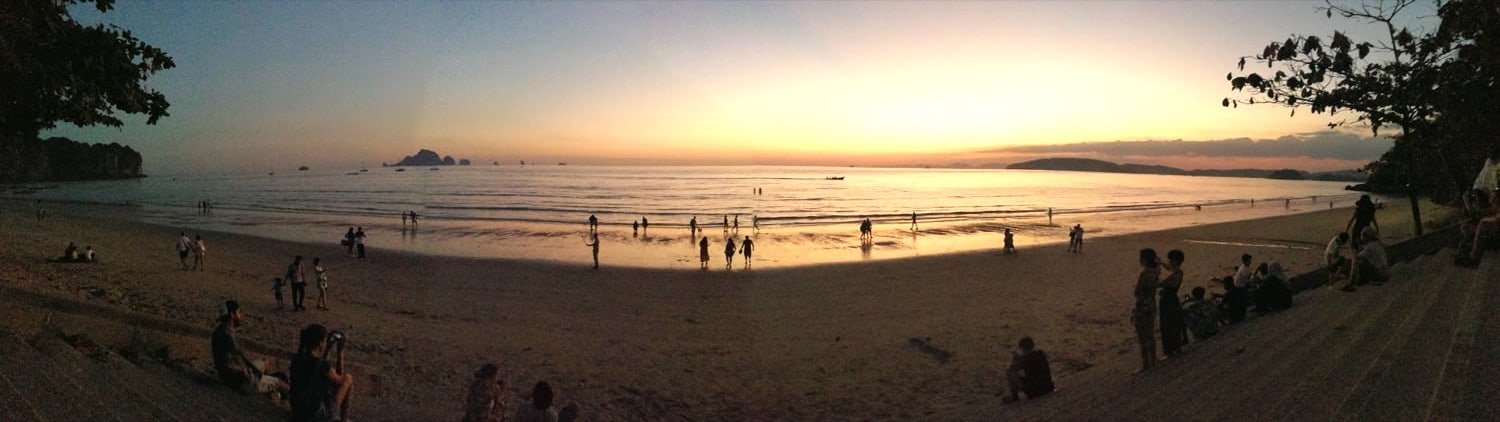
It offers a vast range of accommodations and every service that a person may want to find on holidays. There are unexpectedly lots of pharmacies, emergencies and tour organizers.
It is a perfect relaxing holiday location. But if you want something more traditional and authentic... hey, you are in the wrong place!
Here below you will find a (personal) list of things you cope with when you are staying in Ao Nang Beach but, in reality, you were looking for a more "alternative" holiday.
Accommodation
It can be quite challenging when you arrive in a new location and:
- you don't have any hotel reservation
- it rains hard
- it is 36°C in the shade
- you carry your 7-kg backpack since hours
- you have a limited budget
- there is the Chinese New Year going on
We started our Ao Nang accommodation's research from the inland, as we thought it was easier to find an affordable room. Nope!
Due to the peak season, there was no availability in budget hotels, no availability in hostels and even not in luxury hotels. We finally found 1 room available in a hotel located along the main road: a very small room without any comfort, quite old and without breakfast, for 1600 THB (approx US$ 51) per night. We asked for a discount but the receptionist said: "no can not". We then decided to let it go, and continue our search.
Slowly we reached the beach. When the hope was almost lost, we walked in front of a beautiful resort called "L resort", with a luxurious reception. We asked the staff: "you don't have rooms available, do you?". Surprisingly, they said, "yes we do"! They offered us the last non-renovated bungalow which wasn't advertised online, for a good price (approx. US$ 60 per night), including all the facilities (2 swimming pools, gym, complimentary tea and coffee in the room, toiletries, etc) and including buffet breakfast. Wow!
What a relief to take a bath in that swimming pool:
- on that day
- during the night
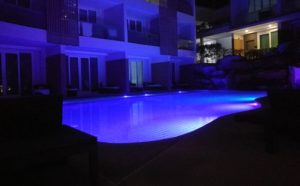
Never give up and follow your instinct! In case of doubts, follow the instructions listed in our other post...
Beaches
Compared to Koh Samui, Ao Nang Beach is much cleaner. The sea is warm and calm.
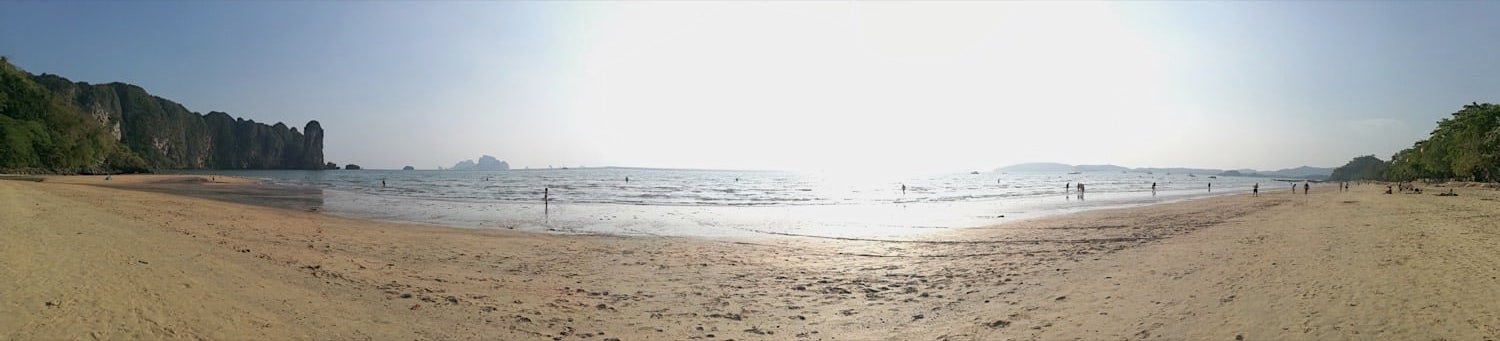
On the second day in Ao Nang, I really wanted to take a bath in the sea. We looked for a not crowded spot, we were actually by ourselves. I entered the sea and felt a pain in my feet... I ran out of the water, I checked and found 5-6 black spines in it: I stepped on a sea urchin!
Back in the room, we prepared the "surgery kit": 1 needle (from the hotel's sewing kit), 1 tweezer and some disinfectant. It took a while, but we could manage to take out all spines.
Despite this event, we enjoyed daily walks on the beach trying to understand who creates those cute little sand-balls.
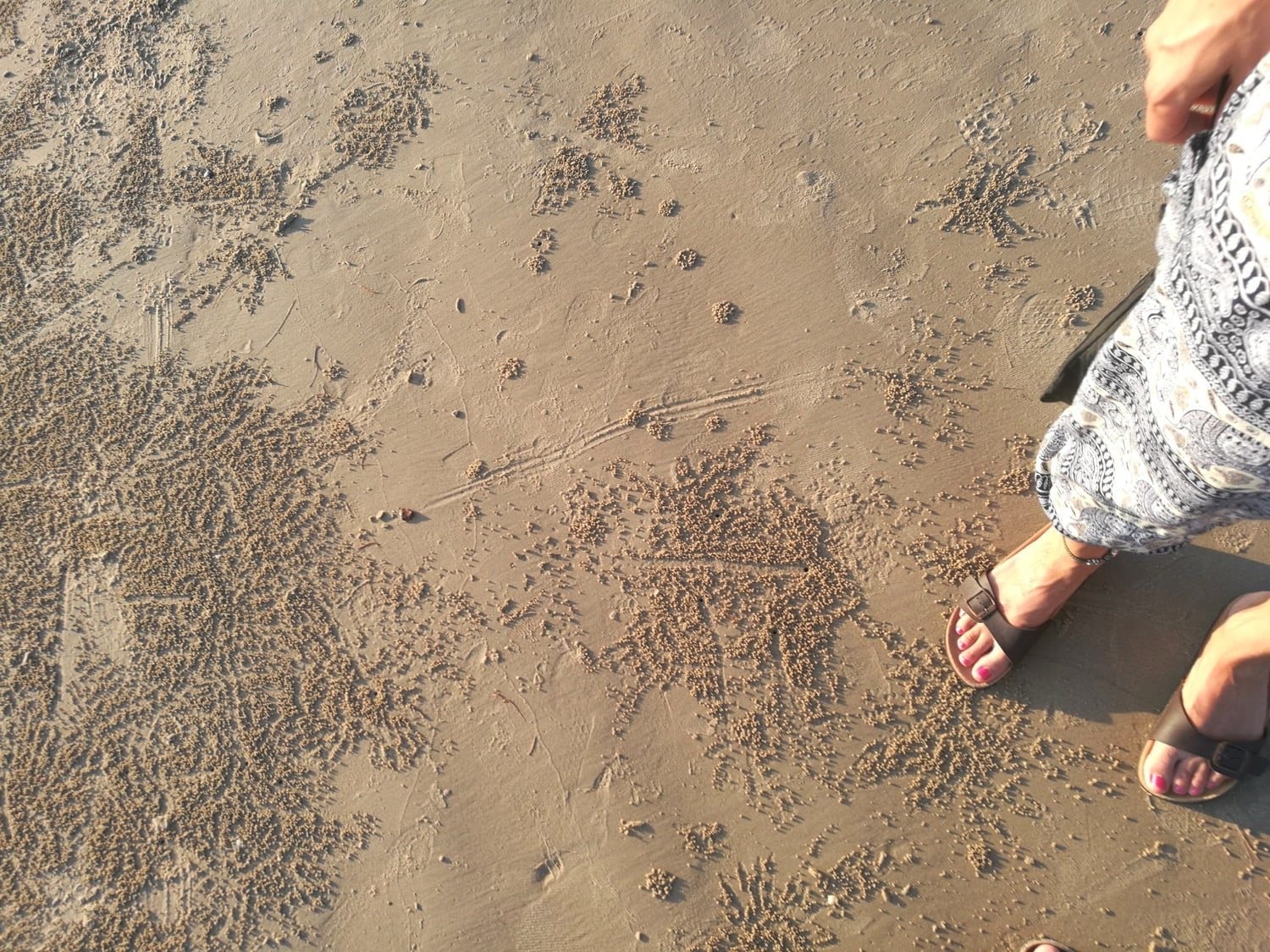
We found out that it is the "sand bubbler crab".
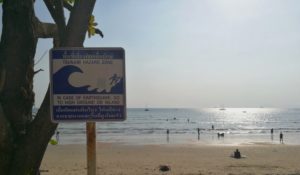
Last but not least, it is important to remember the terrible Tsunami that hit (among other countries) this side of Thailand in 2004. One of the involved areas was Ao Nang. I tried to imagine myself sitting on the beach, on a calm day, and see this huge wave coming towards the land, so powerful, so strong. Unbelievable.
Fortunately, now they are better organized in case of alarm. And along the beach, there are signs explaining what to do in case of a Tsunami emergency.
Food
I don't have to say that in this area, in this period, restaurants' prices are sky-high. You can anyway find family owned little spots where you eat well and you don't over-pay.
A must-see place is the Street Food Market. It's an area filled with fully equipped and colourful booths, selling tasty and cheap meals. Mainly, it is about barbequed fish and other Thai specialities. But you don't want to see kitchens or how dishes and cutlery are washed...
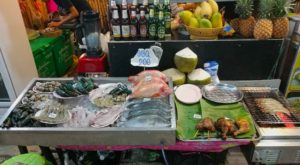
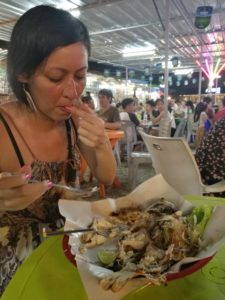
But it is really worth it!
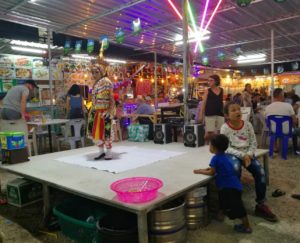
It is colourful, there is a nice and authentic atmosphere. Full of smoke, exotic scents and happy people. While you are having dinner, you can even enjoy a kids' traditional dance spectacle.
A couple of times we went to a Hare Krishna restaurant, offering a 100% vegetarian menu. You need to leave your shoes outside and walk around bare feet, they have a choice of buffet or à la carte meals. Not too bad as an alternative to Thai food. The atmosphere is lovely and gives positive vibes.
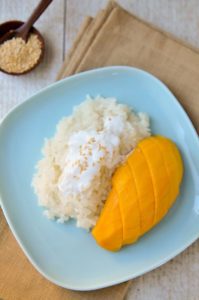
After a good dinner, you want to eat a good dessert... which is not always "sticky rice with mango".
We discovered these fantastic booths preparing ice cream rolls! You can choose the flavour, and the guy will create it for you on his frozen plate. First, he puts all the ingredients (melted ice cream and the chosen flavour/fruit) on the frozen plate. Then he chops them with 2 spatulas, with really fast movements. When everything is well mixed, the magic happens and you get your ice cream rolls!
https://www.youtube.com/watch?v=Ybb57frsdKk
Transportation
The area is full of local travel agencies arranging mainly the same tours: to the closest islands, to the Cobra shows, diving, hiking and much more. They also offer transportation to Krabi airport. We noticed that the charged price was always the same: 600 THB for a taxi, 150 THB for a shared van, 150 THB for a bus. We have been told that the government established the price, so no one can change it and it is non-negotiable.
Despite all, Ao Nang is full of tuk tuk and songthaews (red cars). If you don't need to go too far you can travel with them for a negotiable good price. Just stop them on the road, explain where you have to go, negotiate the price, and jump in!
Railay Beach
The only way to reach Railay Beach is by longtail boat.
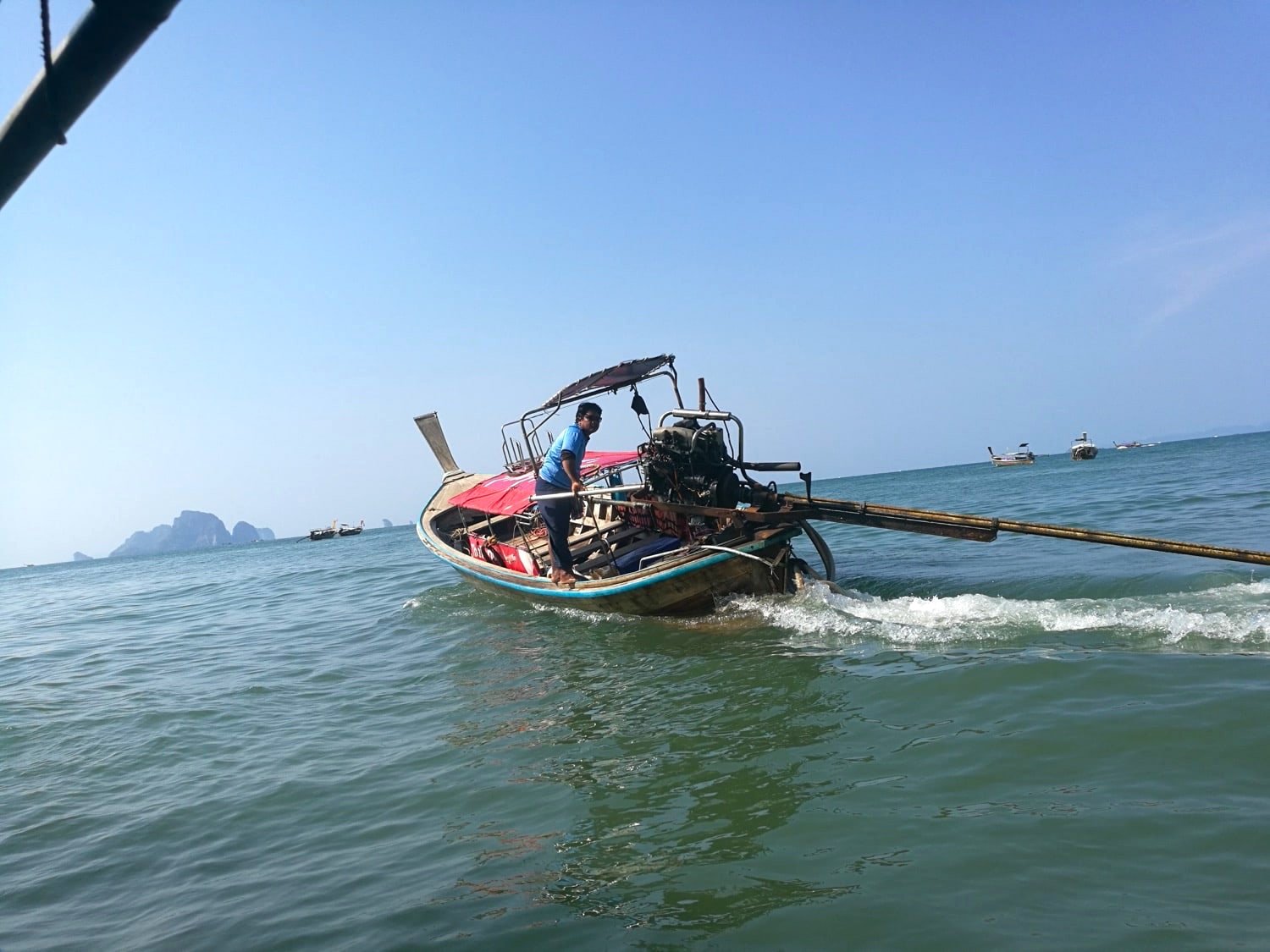
There is no time schedule, each boat leaves only when there are 8 people onboard. You can easily wait for your fellow travellers on the beach. When they leave, those boats are super noisy and the engine's smell is strong. But it is a nice experience and sometimes it becomes a kind of competition with other longtail boats: which one will arrive first? The drivers live on the boats, you can see their hammocks hanging on the roof and sometimes you can see them sleeping there.
The beach is beautiful in the morning but changes completely in the afternoon due to the tide. It becomes never-ending.
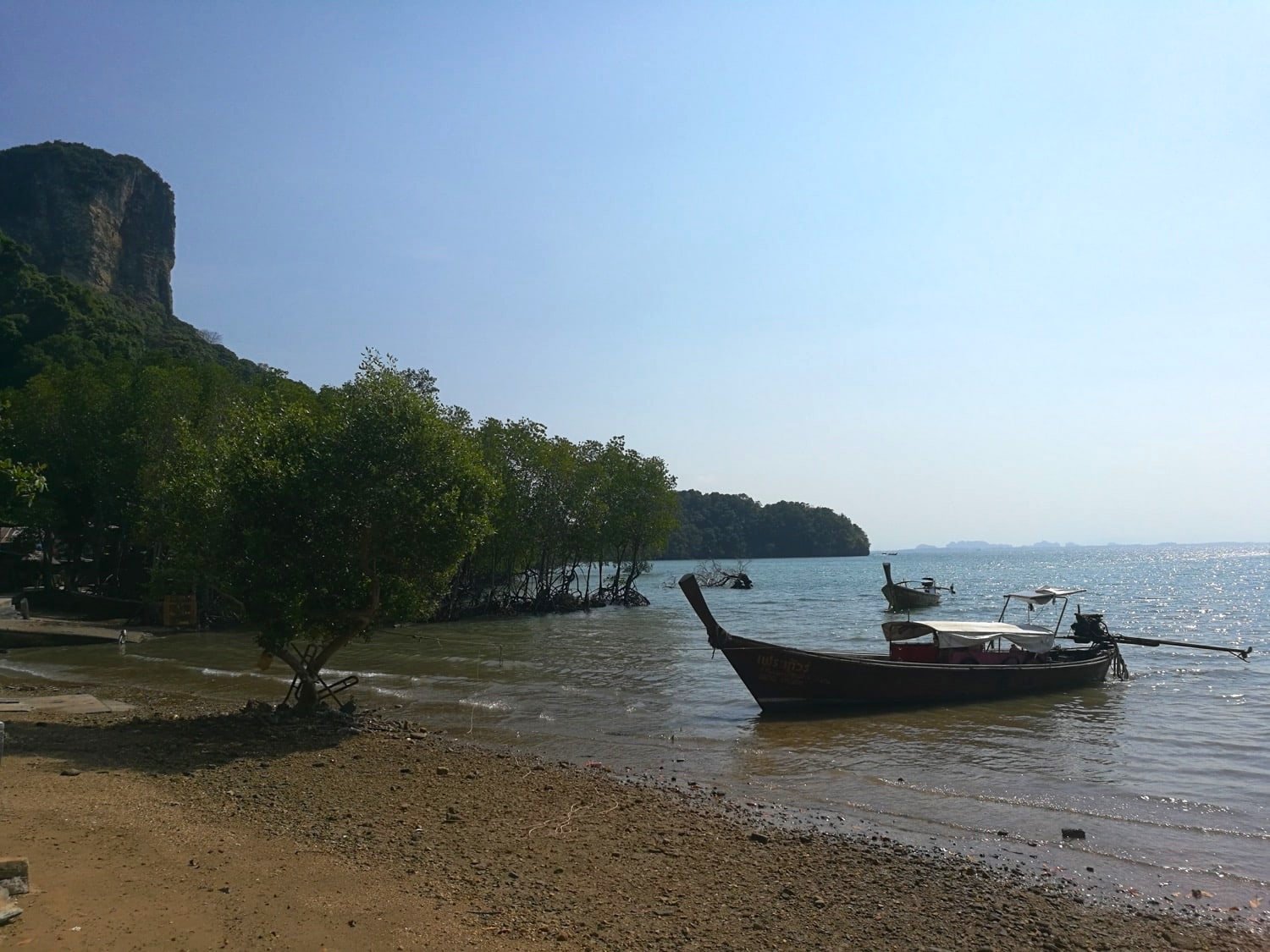
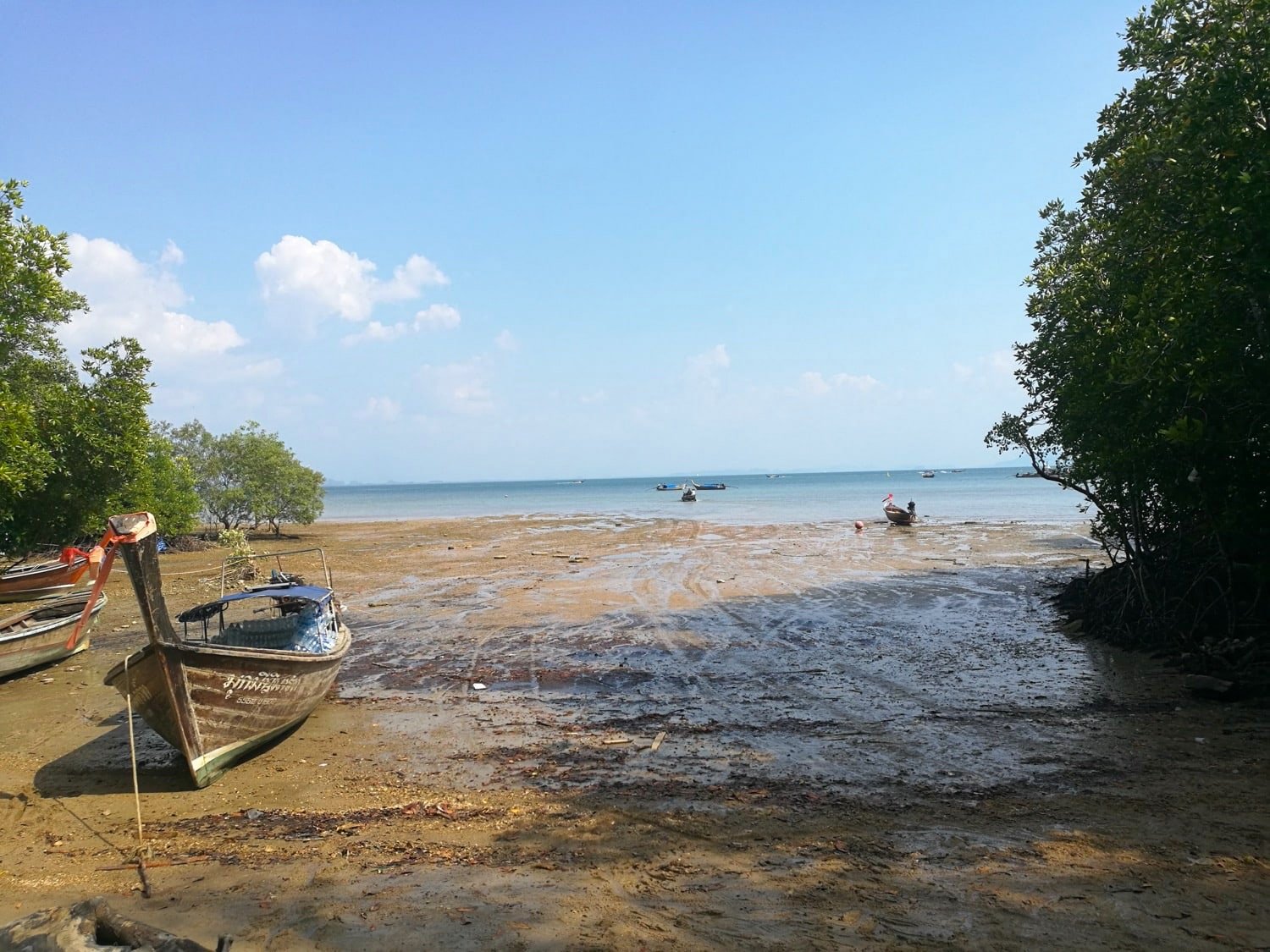
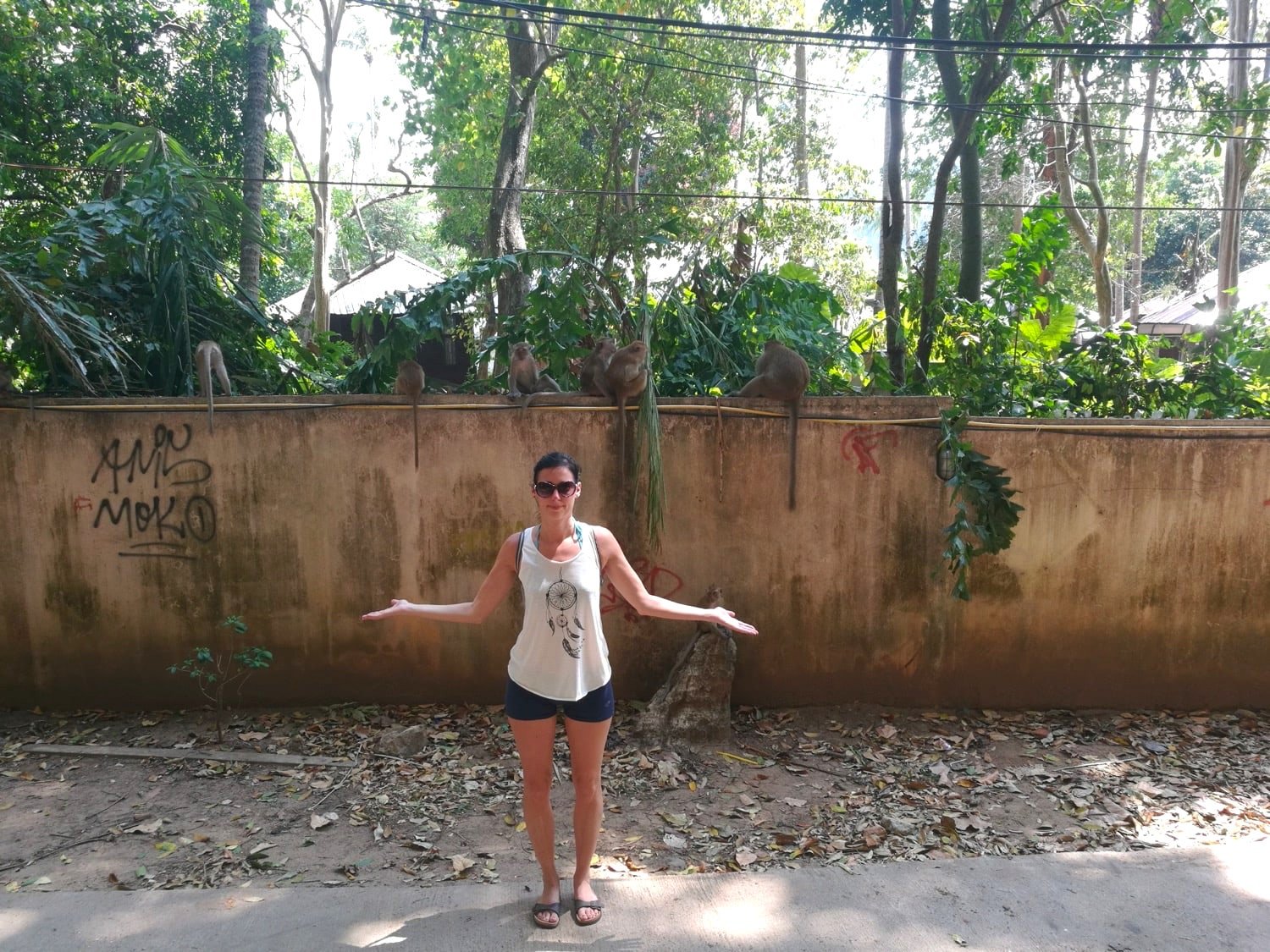
All the area is not accessible by car, you will find only a few motorbikes or tractors used for heavy transportation. You can walk around without caring too much, the air is cleaner, the atmosphere is relaxing, there are many mangroves, you can enjoy a wonderful climbing landscape, and monkeys...
It is a pity that it became so touristic. It used to be a backpacker destination, but now it offers also several luxurious accommodations.
In the morning there are hundreds of people arriving there and, at the end of the day, hundreds of people leaving (some even with suitcases...).
Back to Ao Nang... Animals
It seems that every hotel, restaurant or shop has its own cat. They are cute, well-taken care by their hosts and always looking for a cuddle.
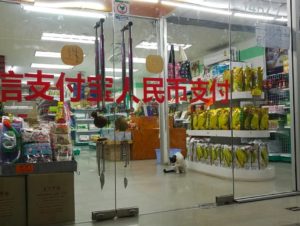
Dogs are also maintained by the population, but they don't have a real owner. They go around in groups, they are sweet, never bark and they like to sleep on the beach. It is unbelievable to see how they are careful and at attention when they have to cross the road!
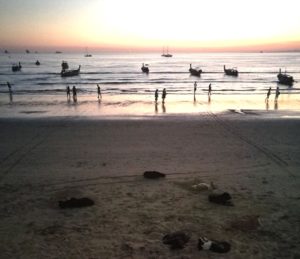
Unfortunately, after all this fluffiness, you also happen to find this 5-cm guy in your shower!

Fire show
It is really impressive and fascinating! The only downside is the smell of fuel that invades the air all around... but the ability of those guys overcomes it and makes this moment really magic.
ขอบคุณ (thank you)
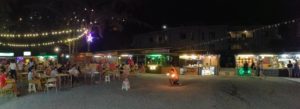
After 8 days of sun, pool, beach, flip flop and bathing suit, it's time to wear back our snickers a leave for our next destination! Talk to you soon :-)
Accommodation: 9 mistakes to avoid when booking it
Booking accommodation may take some time, above all if you have specific needs and you want to find the best deal ever!
We are every day learning new tricks to speed up this process, to avoid useless disappointments and to avoid wasting too much time. Here below we have listed 9 mistakes to avoid when booking your accommodation.

1. Book the entire stay in once
If you book online through websites like booking.com or agoda.com, it is better to book only a few nights to first "test" the hotel. What if you don't like it? It can happen that reviews are inflated, photos edited, etc. (see our experience in this post) and your expectations disappointed. We experienced that a 2-night stay is a perfect trial. On the 1st day, you check-in and verify that all your needs are satisfied (WIFI works well, beds are comfortable, toilet works properly, etc.). On the 2nd day, if you like the hotel you can extend your stay further. If you don't like it, you still have a full day to look for an alternative one.
2. Consider only online bookings
The biggest hotels, hostels, resorts and aparthotel are listed in the main hotels' metasearch engines. They have a budget to cover those websites' fees. On the other side, family-owned guest houses or smaller accommodations are not there because it is too expensive, but they anyway offer a quality stay. We learned that when you walk up and down in a location, you find good deals in "non-popular" but nice accommodations. You can also bargain the price per night, or get discounts only because you are there face-to-face.
3. Travel in peak season
Of course, "peak season" means that it is the perfect moment to visit a destination. The result is that everyone who wants to visit the destination will travel in that period. As a consequence, prices are 2-3 times higher, hotels don't have much availability and are not willing to offer discounts (even for the last available room!).
4. Trust information and pictures on the web
You can really have bad surprises sometimes. We experienced it on our skin, and now we are very careful when booking a hotel. If we have the chance, we check it online first and then we walk-in at the reception and ask to see the available room. Only in this way you are 100% sure about what you will get. Some pictures have been taken when the hotel just opened, so everything looks super new. But in reality, after years of activity, tools and furniture are old and maybe not so well maintained... Be aware of that!
If we don't have the chance to personally go to the hotel's reception, we book only 2 nights and then we decide to stay longer, or not.
5. 100% trust online guest reviews
Accommodations try their best to have a great online reputation and sell their services as much as possible. Guests' reviews are very important, but sometimes you'd better take them with a grain of salt.
For example, it happens that you find a super deal for a hotel "close" to the beach and you are excited to get it. But when you read guests' reviews you will find out that 9 out of 10 write that "close to the beach" is not at walking distance so you need to rent a motorbike or go by taxi. In this case, you can trust the reviews as it is a fact: the hotel is located there.
On the other side, if we talk about more variable topics (e.g.: WIFI, breakfast, staff, etc) it is more difficult to 100% trust guests' reviews as, in the meantime, things could have changed. The WIFI connection can be faster or slower depending on your device (fast on mobile, poor on a laptop), and depending on the time (day or night). Breakfast quality and quantity depend on everyone's habits and taste. Staff regularly rotates, so it cannot be evaluated on a long term base, but only on your own experience.

6. Think that there are several single hotel metasearch engines and aggregators
Some metasearch engines belong to the same company so the competition is not as high as expected. This means that it has no sense to look for accommodation in all of them, but choose one or two and use them.
Here below you will find the 2 main companies operating in the travel industry, and the companies that belong to them:
Booking Holdings: Booking.com, Agoda.com, Kayak.com, Cheapflights, Rentalcars.com, Momondo, and OpenTable.
Expedia Group: Expedia.com, HomeAway, Hotels.com, Hotwire.com, Orbitz, Travelocity, trivago, and Venere.com.
This means that, if you check availability in booking.com and in agoda.com, you will possibly find the same deal. The only difference could be in the fees applied by the website itself.
7. Accept the price given at the reception
Create room for negotiation. It is well known that you will always get a high price first because they want to earn as much as possible in one go. Our strategy is to:
- check the prices online and possibly find a discounted rate
- go to the hotel's reception and initially ask the last price for 1 night; if it is a good deal, we ask if we can get a discount when we stay there for 1 week or more
- when the given rate is higher than the online one, we show the website to the receptionist and negotiate to have that same rate
- if this is not possible, we just walk away and try with the next one.
8. Accept everything even if online things look different
As already mentioned, some hotels still publish online their best pictures (super furnished rooms, new equipment, the best side of the swimming pool,...). If there is something missing in your room or something that doesn't match with the published pictures, just inform the reception and ask for what you paid for. For them, it is maybe not so important. But for you it is! Then insist, and obtain what you should already have. Just to make an example: we saw online that the hotel had a kettle and complimentary tea in every room. We arrived in the room, and the kettle was not there. Then we asked for it at the reception, and they said that they never had kettles in their rooms. We showed them the online pictures and the magic happened: on the same day, we found a kettle in our room :-)
9. Walk around randomly searching for your accommodation
In some warm places like Thailand, the temperature is really high and you don't want to walk too much around, randomly. Then, before going out, do a list with all your top needs and criteria. Establish the priorities and then check online all the accommodations with the mentioned criteria, in your desired location. Plan an itinerary and then start your search. This doesn't mean that, if on your way you see another hotel, you cannot stop there and ask. Don't miss opportunities, you never know!
Good luck with finding your next accommodation in a smart way!
Koh Samui: difference from what you find online and reality
After a few days in the polluted big city, we decided to move to the beaches :-)
It is well known that the best Thai beaches are on the islands. But, which one is really the best? Several of them are heavenly, small and not so touristic but... during the Chinese New Year, it is impossible to find an affordable accommodation there because the number of hotels is limited and the number of tourists is huge! The only availability is in dorms or super luxury resorts, and this is not what we want now.
We wanted an island with both beaches and activities to do, therefore we decided for Koh Samui which is a bit bigger than the others.
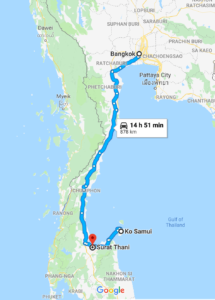
It took us 20 hours to go by public transportation from Bangkok to Koh Samui:
14 hours with the sleeper train (Bankok - Surat Thani)
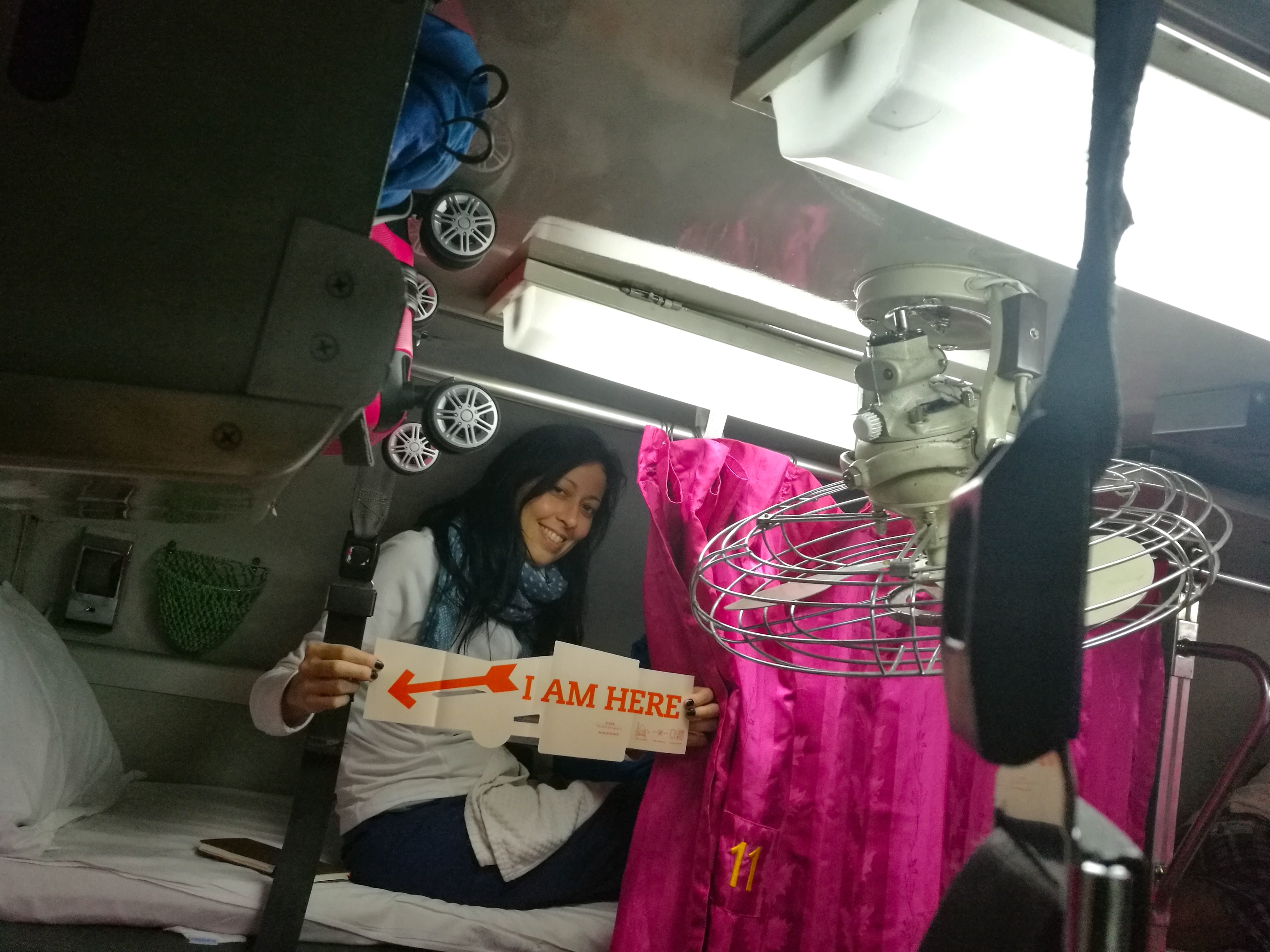
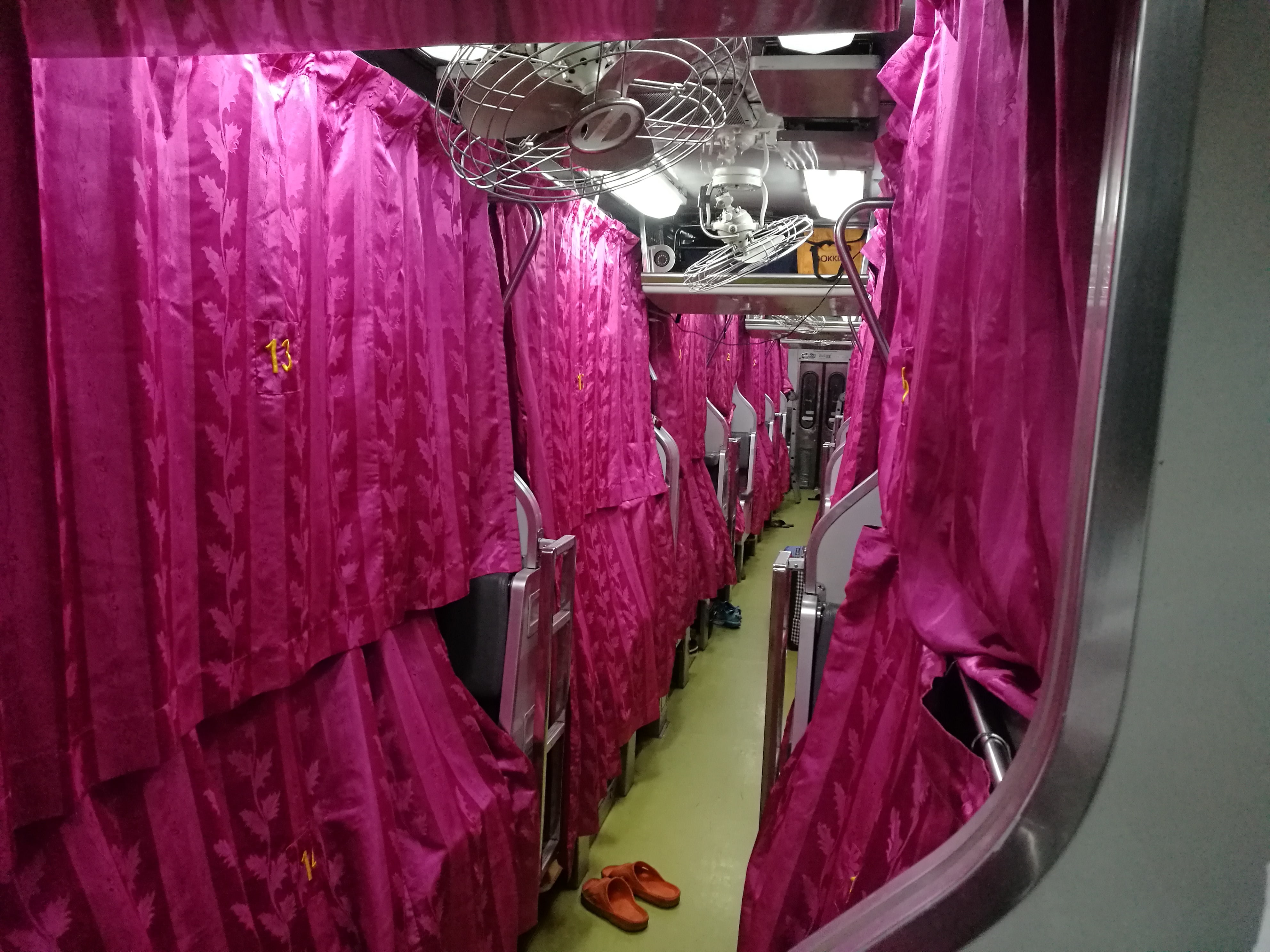
waiting time...
1 hour by bus (Surat Thani - pier)
waiting time...
1.5 hours by boat (pier - Koh Samui)
waiting time...
1 hour by taxi (Koh Samui - hotel in Lamai beach)
And finally, we arrived on the beach after more than 1 year! White sand, clear water...
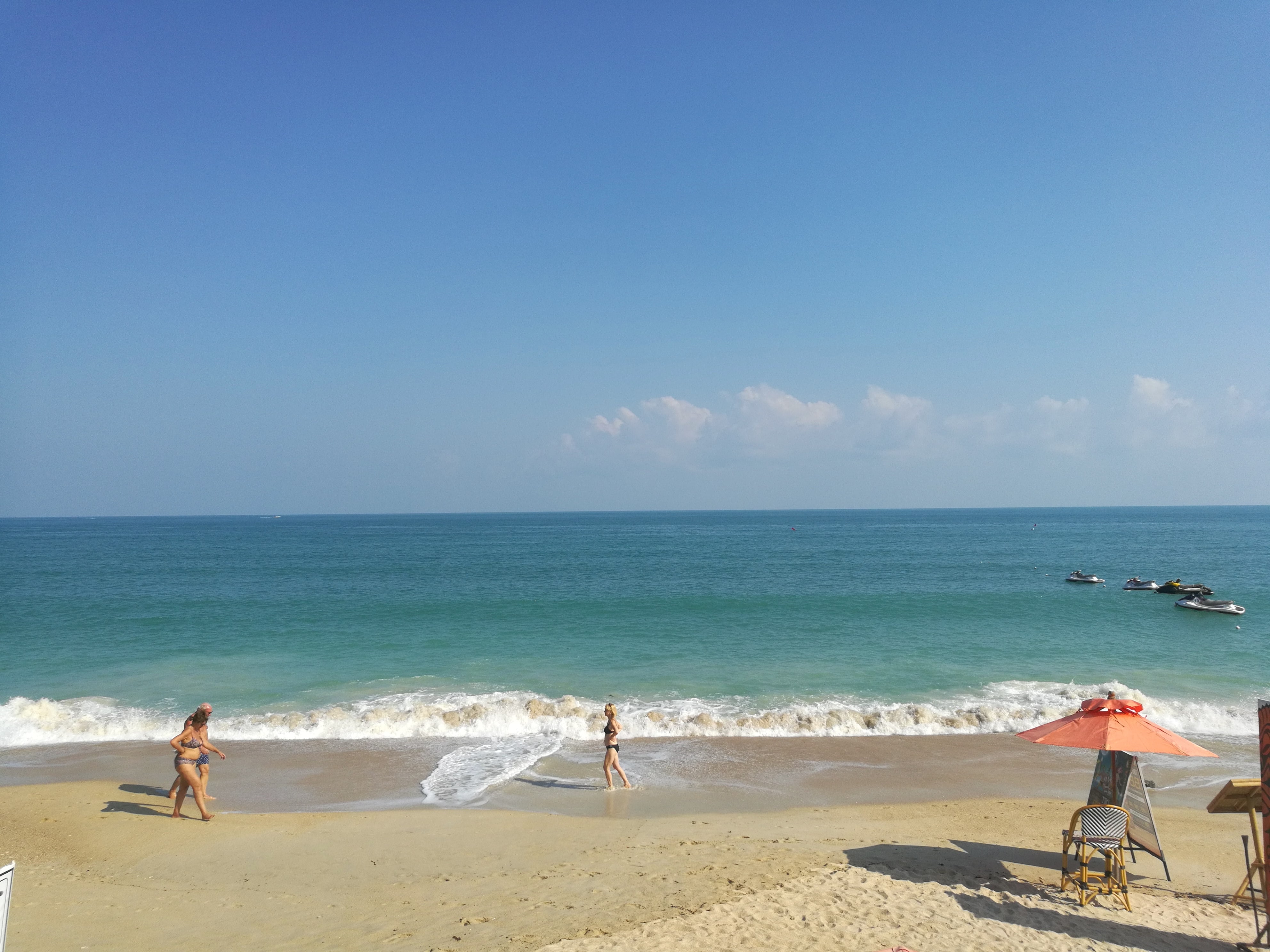
But... (there is always a "but").
We noticed that Thailand is becoming expensive and super touristic. It seems that they only want to earn as much as possible, it is a business created for lazy tourists who don't care about this beautiful country. Unfortunately, it is now a mass destination and you really notice it. Local people are not so friendly and smiley as they were in the past, and mass tourism is damaging and polluting the environment. Above all, this happens in peak periods.
Shortly I will analyze a few misleading points, one by one.
We were in Lamai beach, which is considered to be one of the best and longest beaches in Koh Samui. It is not so vibrant and party-style as Chaweng, so you go there when you want a more "relaxing" holiday. Due to this characteristic, on the web you will read that this destination is also cheaper than others in Koh Samui.
But, is everything we read online reality? Mh...
Accommodation
For low budget accommodations (hostel - 2* hotels) you can expect to pay around THB 800/night (approx US$ 26), which is way too high for Thailand and for the offered services. Buildings are mainly old and with a few or no comforts (fan instead of A/C, cold shower only, poor WIFI, no room cleaning, etc.).
We had a terrible experience at the Rich Resort Beachfront. If you check the description of this hotel on booking.com, you see that it has a private beach with sun-beds, a cool pool and nice rooms. In reality, the beach and the pool belong to a close by bar, which has a partnership with this hotel. The hotel is located on the other side of the street, and not in front of the beach. Our room was terribly old and dirty, you don't really want to stay there! The staff is not friendly and in the room you find a paper mentioning the costs you have to pay in case you damage something in the room (but everything is already damaged!). Fortunately, we stayed there only 2 nights, the time to find another accommodation.
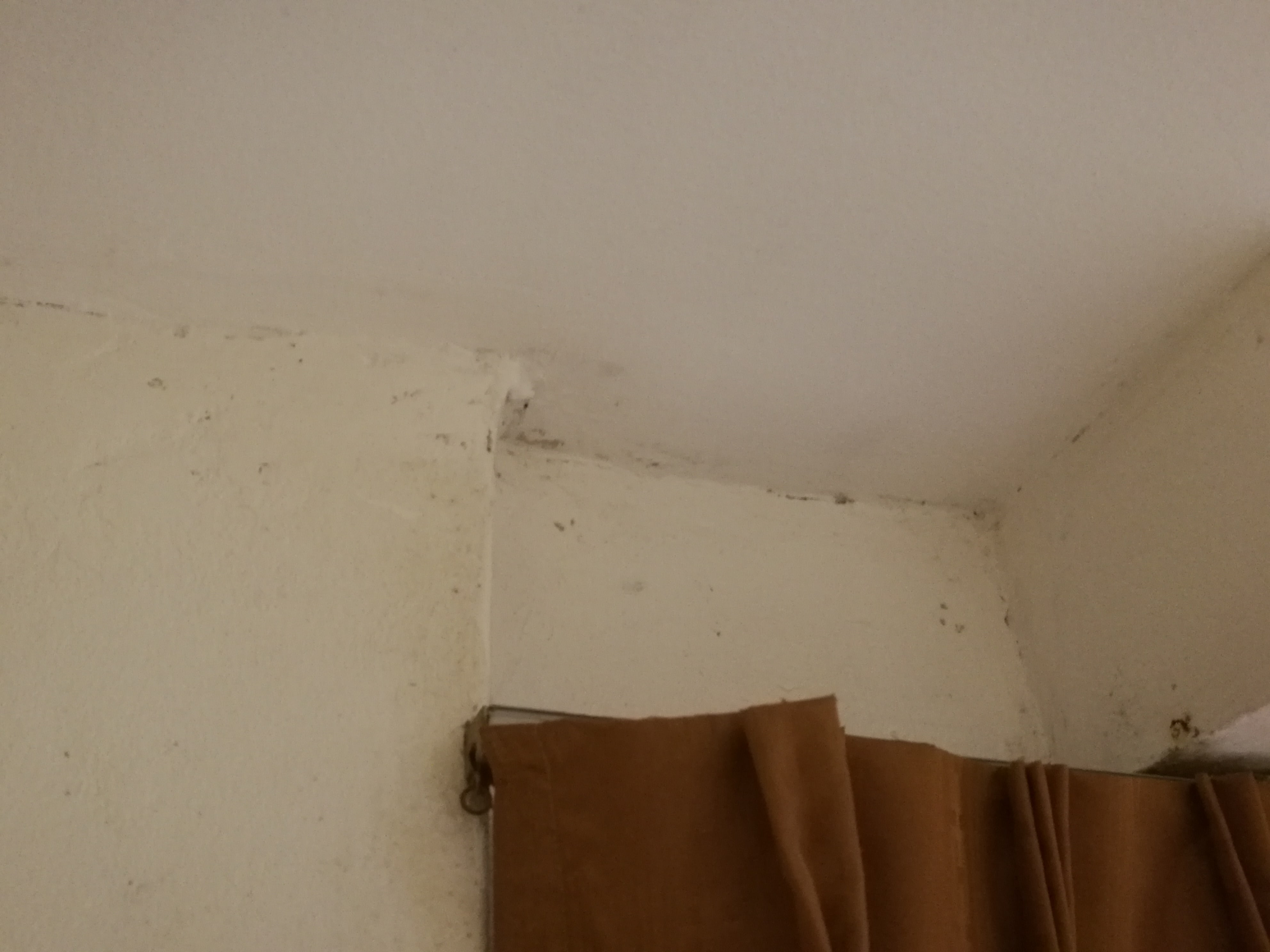
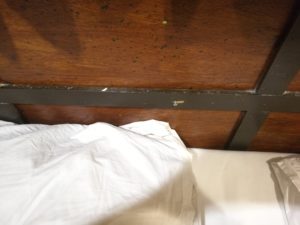
For a standard accommodation (3*) you can expect to pay around THB 1700/night (approx US$ 55), which is still too high compared to Thai standards. Comforts are a bit better: you get 2 bottles of water every day, daily room cleaning, A/C, complimentary tea and coffee, towels for the beach, good WIFI connection, etc. We stayed at the Coconut Beach Resort, a nice experience and a good balance in quality/price.
Luxury accommodations were out of our budget, therefore I will not mention them here.
Food
In Koh Samui you will find many cuisines: Thai, Indian, European (mainly French, Swiss and Italian cuisine), street food, BBQ, and much more. The costs sometimes are extremely high but mainly they vary depending on the restaurant's location: along the main road, it is way more expensive than in hidden spots. You need to explore a bit the area in order to find affordable restaurants offering good quality food.
TIP:
[su_note note_color="#f2f2f2" text_color=“#000000” radius="3" class="p_tip"] Select one dish and use it as a meter to understand if the restaurant charges too much or not. [/su_note]
Our meter was the Pad Thai's price, which is on average around THB 60-80 (approx US$ 2-3). Along the main road, a Pad Thai costs THB 150 (approx US$ 5). In hidden restaurants, it costs THB 60 (approx US$ 2).
The same rule is applicable to Thai curry meals (THB 220 = 7 US$), breakfasts on the beach (THB 180 = 5.5 US$) and to local beers (THB 80 = 3 US$).
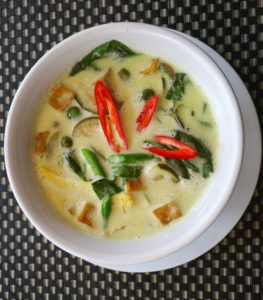
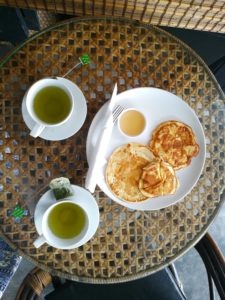
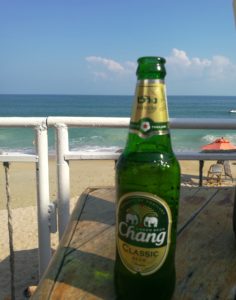
Almost every restaurant has a menu with pictures showing the dishes so that it is easier to understand what's inside. It can happen that the picture shows different ingredients...
Talking about shops or supermarkets: Thailand, in general, is full of "7 Eleven" supermarkets, where you find all kind of imported products (there are even Lindt chocolates), and almost nothing local. They are literally at every corner, this is the result of globalization. As a consequence, it is very difficult to find a local supermarket with Thai products.
Beaches
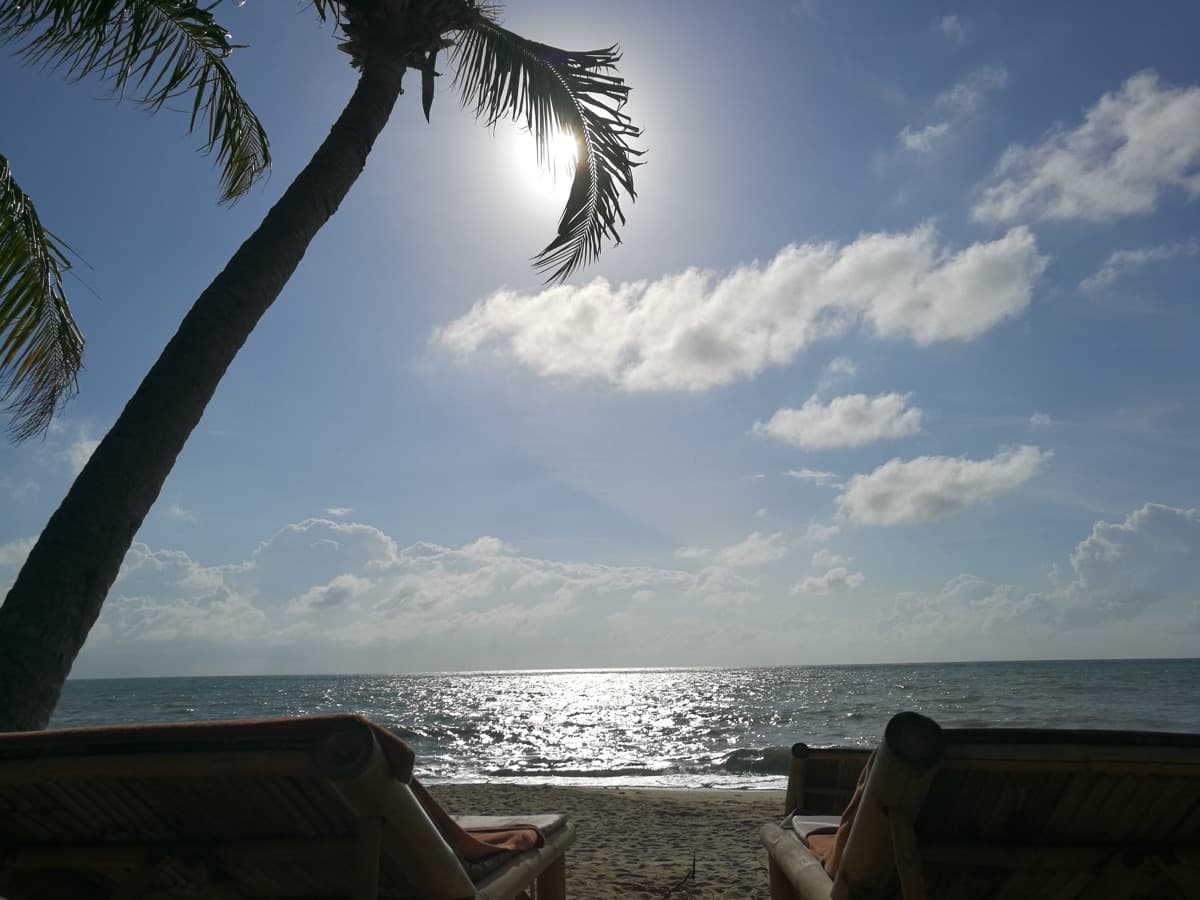
This is the main and real disappointing point of the whole story. As mentioned, Lamai beach is well known as one of the best beaches in this area. If you google it, you will find this:
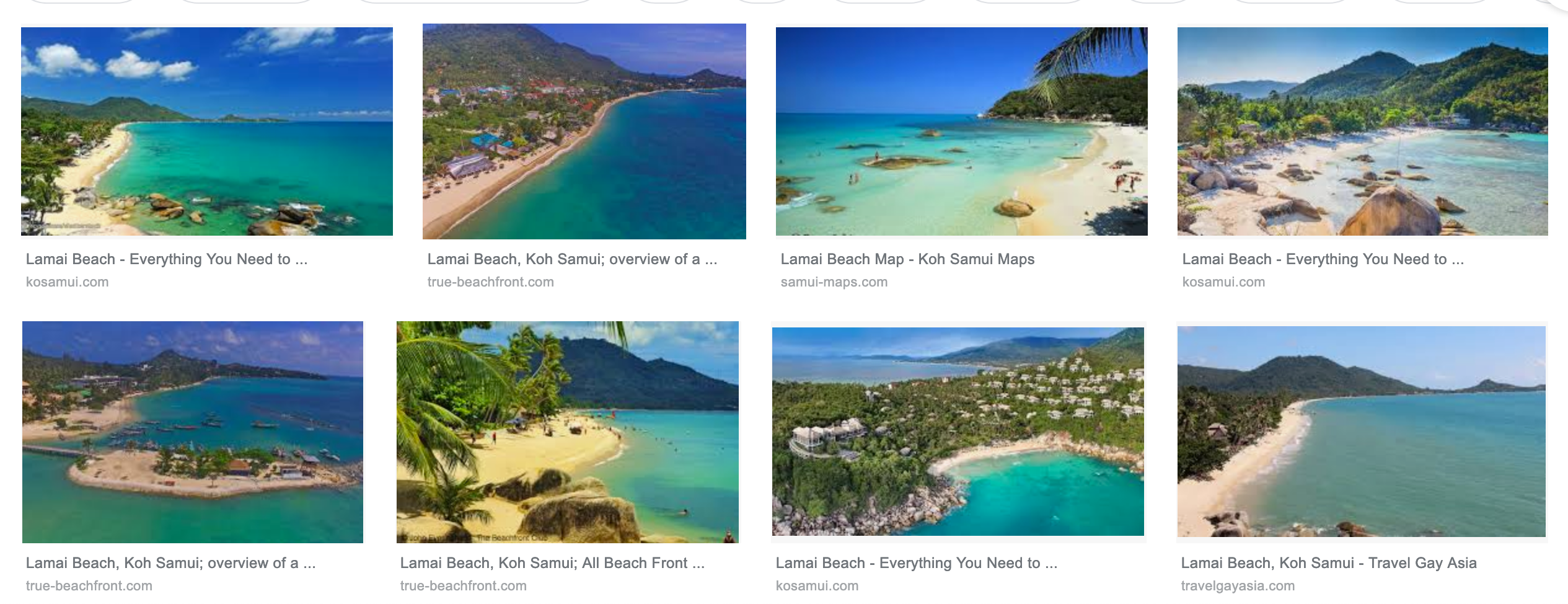
In reality, this is what you see here and there, along the beach:
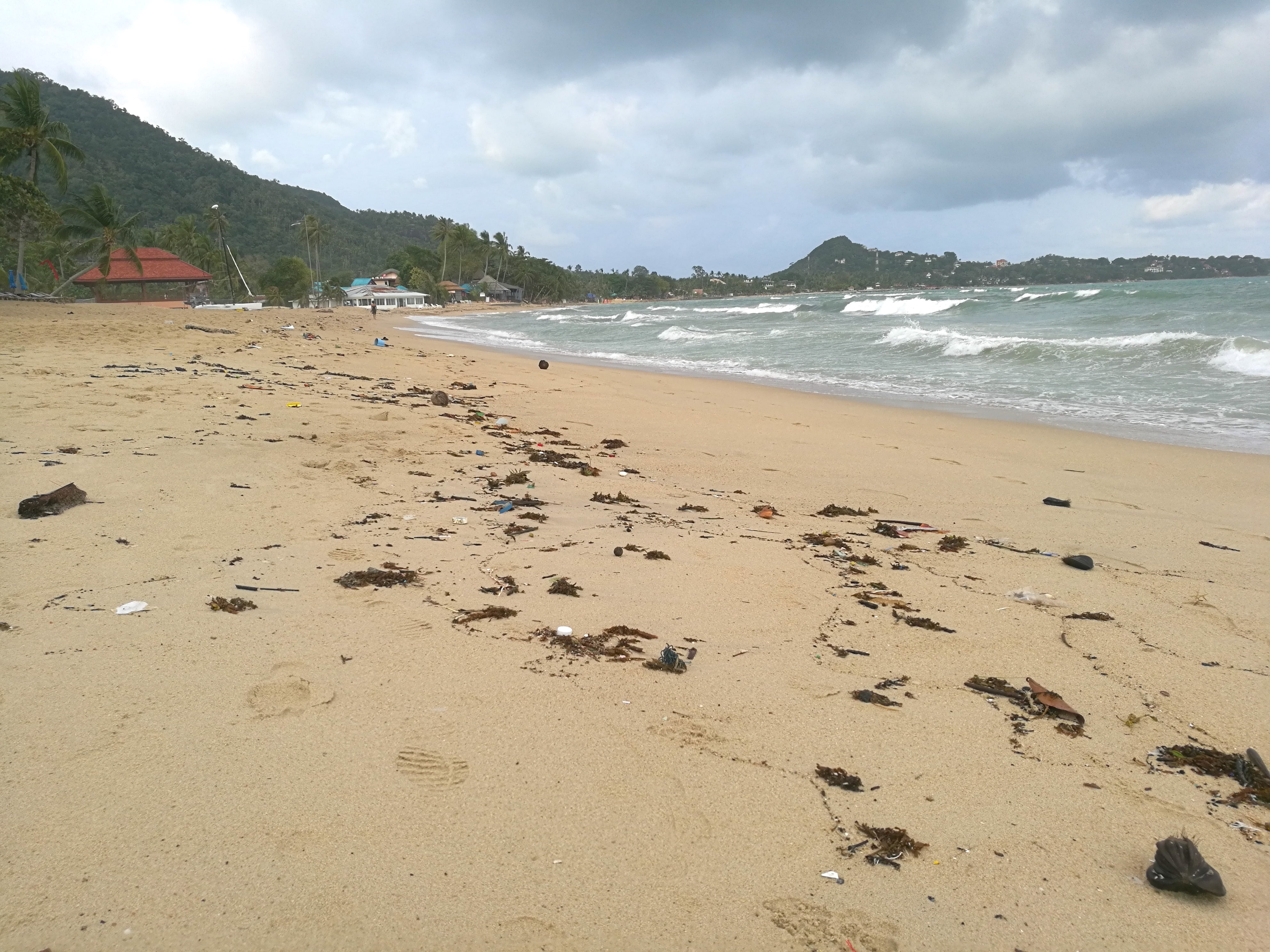
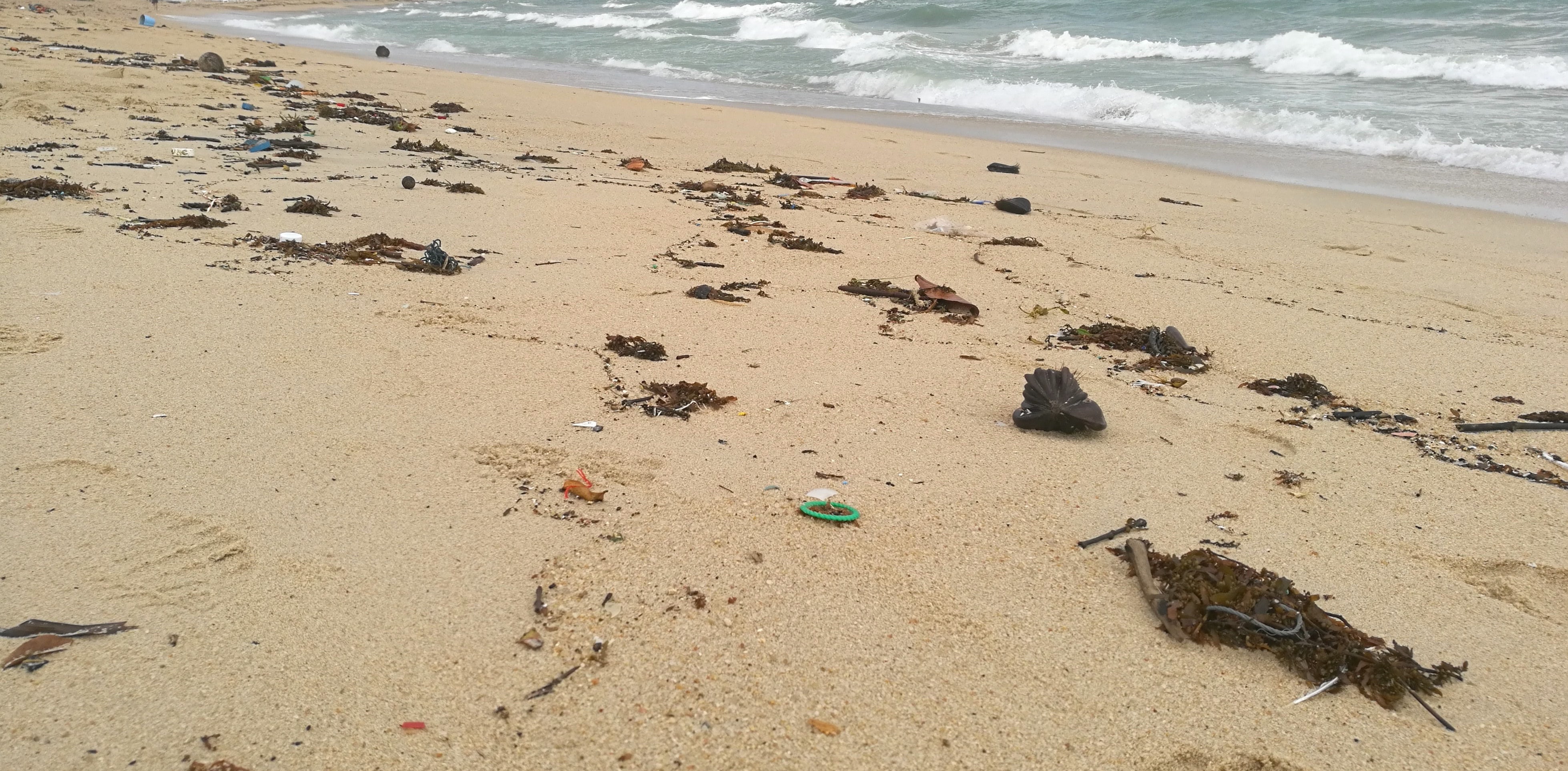
I must say that on this side of Koh Samui it is quite windy and there is often heavy sea. As a consequence, the sea brings all the garbage on the beach... and this is the result!
Fortunately, to defuse this disappointment, in the late afternoon, you can admire Thai laughing girls who collect shells on the shore. They will use them to create bracelets and necklaces.
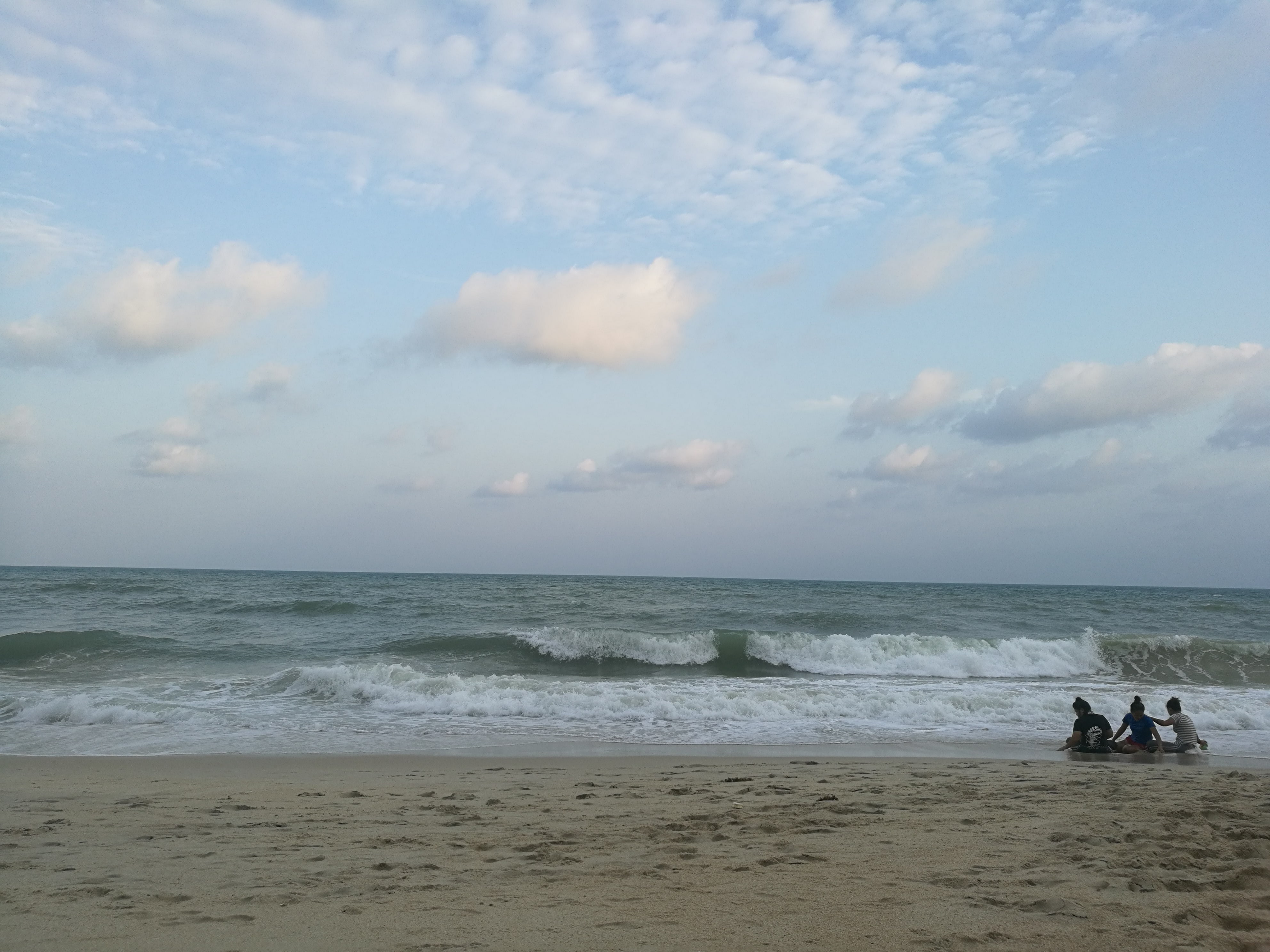
Despite all, we had a good time here!
It is the quietest part of the island, where we could relax and enjoy at the same time.
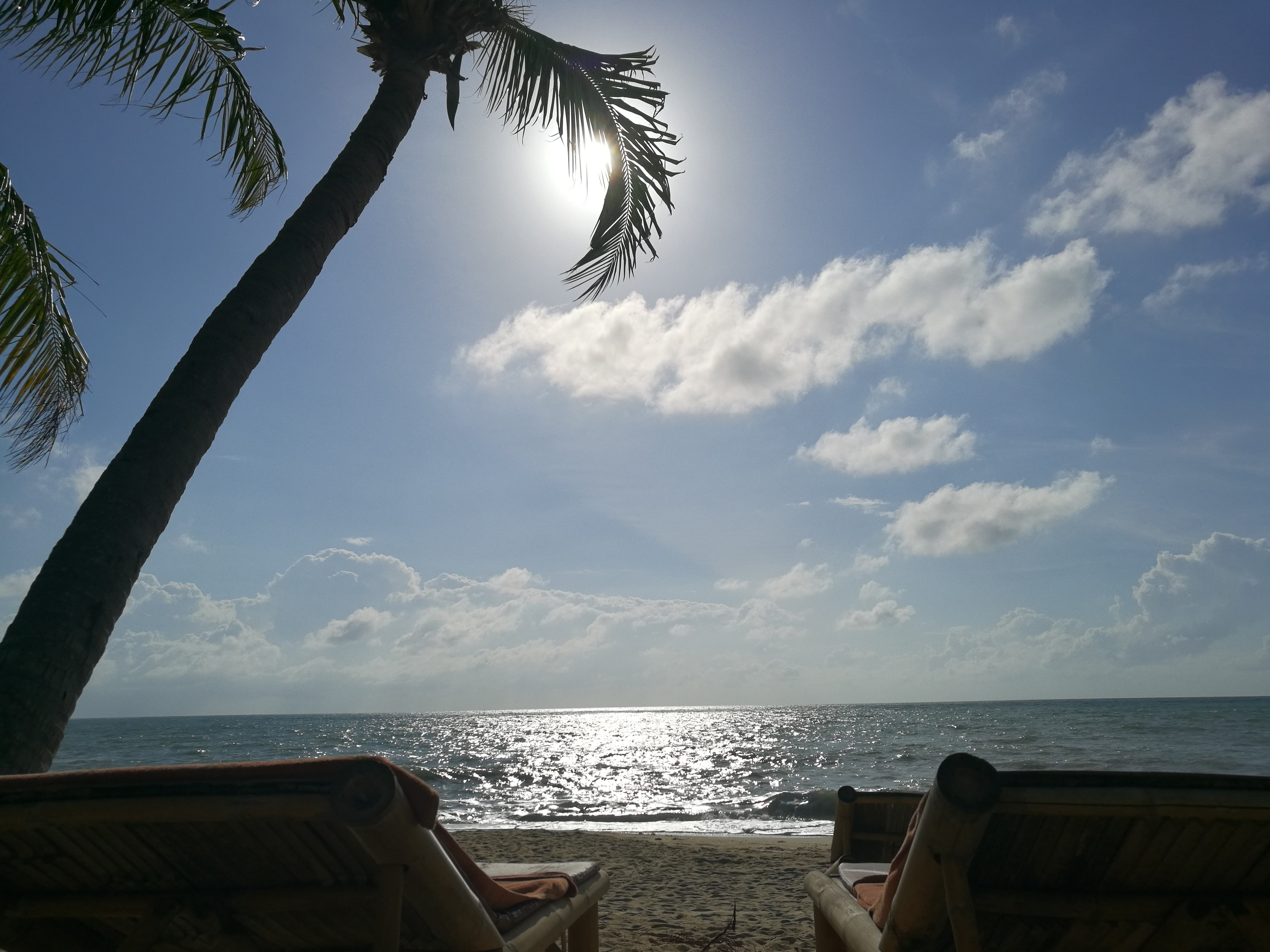
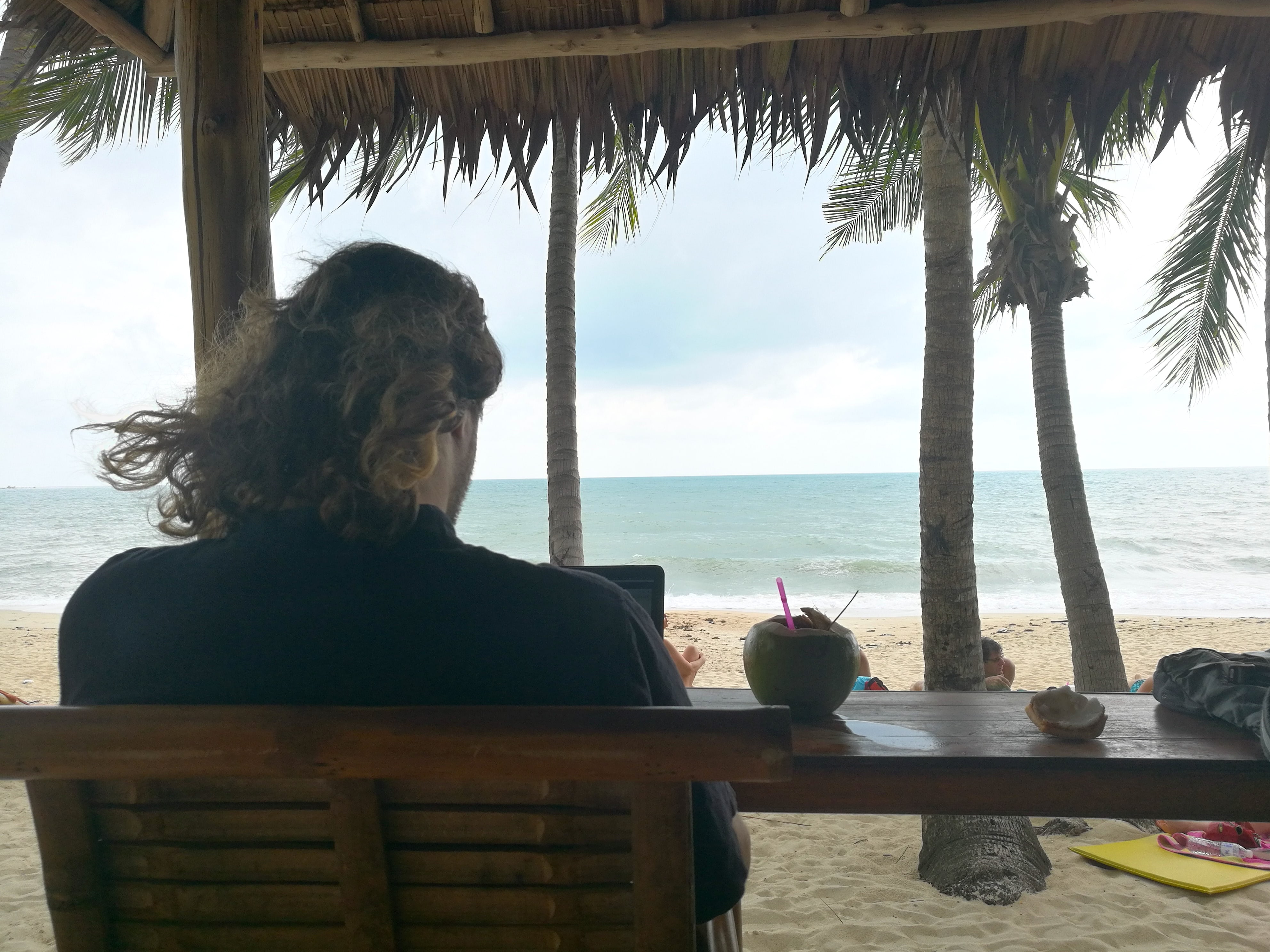
The WIFI connection, despite the negative reviews found on the web, was not so bad. So we could work directly on the beach, enjoying a fresh coconut :-)
After 6 days in Koh Samui, we are ready to move to our next destination! Talk to you soon :-)
11 Security and Safety tricks before leaving for a long travel
Most of the travel security and safety tricks that will follow may seem paranoic or useless to you.
The thing about negative or catastrophic events that may happen is that we always tend to think that those will happen to other people and not to you!!
Also, remember that in such situation most people are panicking and tend to lose lucidity (included memory recovering), those small forward thinking and preparation tricks will surely help you.
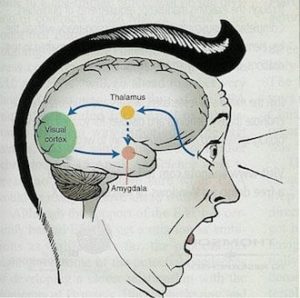
I found myself involved in dramatic situations many times in my life, unfortunately. My forward thinking abilities and preparation always helped me or literally saved my ass. E.g. I had to run for my life from after a Tsunami alarm. Scanning the territory when just arrived on the island participated in saving my life and run to the right place.
Maybe you are right, statistics may be on your side... but what if not? What is the price to pay? And, above all, what does it take to reduce the likelihood that those negative events happen to you?
I tell you this.
It's important to "live your trip" and go with the flow, but with an eye on the environment, you will be more covered. Spending a few your cognitive efforts on individuating threads, exit ways, possible scenarios to save your life, sometimes can make the difference between life and death. We are talking about your life and your death.
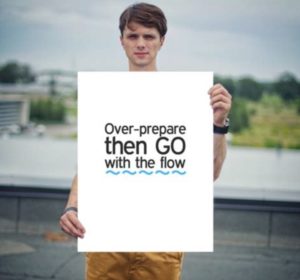
It's the same thing with carefully preparing your travel before leaving. What it takes is just a few boxes spent to buy the right equipment and a bit of time spent preparing your stuff.
That's it.
So, just do it and chances are that you will be covered for your entire stay :)
1) Bring with you a watch with the basic functions
I know, most people would argue that smartphones have nowadays most of the functionalities that a normal wrist watch have.
Nevertheless, for the following reasons, I advise you to bring an old-style wrist watch (iWatch not included :)).
- the basic things are set/done faster with the push of a button
- it’s always on your wrist, anything you need is immediately there, without having to look for an object in your pockets
- it’s cheaper
- it doesn’t break or get stolen
- battery basically last forever
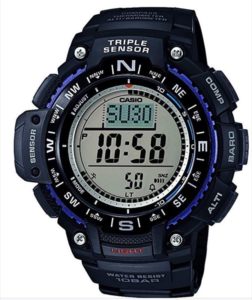
- Basic functions I recommend: hour & calendar (date, day), alarm clock, compass, rain forecast (pressure), altitude, night illumination, waterproof, anti-scratch screen, (timer).
I found that this Casio model completely fulfil my needs and it’s not so expensive.
2) Carry with you one or more hidden wallets
Of course, you can hide your money on your underwear or on your socks :)… but nowadays there are better and more efficient ways to do that!
It’s practical to have a neck hidden wallet like this one (RFID blocking) or even an under-armpit one like this model from Tatonka.
This should be your main wallet, holding about 70-80% of your cash, the major CCs you brought with you and your passport. This way it’s always touching your body and under control.
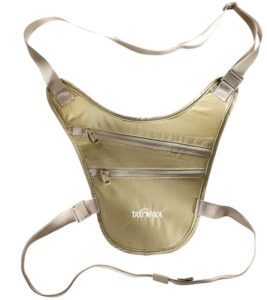
I also bring with me a hidden wallet on my belt, where I can store a few dollars in case I would need them.
Also, don’t forget to bring a low-quality wallet for your needed daily money. So, if you are robbed you can easily give that away without losing anything valuable.
All of that represents the solution when you are on the go. Better to store most of the cash, CC and passport inside the hotel or hostel safe. So, you just go around with one CC, a few daily cash and your passport’s photocopy within your low-quality wallet.
3) Cover your passport
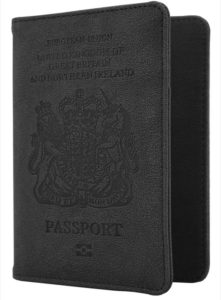
From the cover of your passport, it's easy to get your nationality. I advise you to purchase this standard cover to hide personal info. I personally don't put any card on it, but you can do so without any problems if you want as it's equipped with RFID blocking material.
4) Subscribe yourself to natural-disaster alerting authorities
Subscribe yourself by email to an automatic earthquake notification system. It's free and very practical. Almost in real time, you get an email with the earthquake magnitude and location, so you can act on time if involve the region where you are currently living.
5) Subscribe yourself to your national foreign affair department
This is to be able for them to know that you are in such country in the case a natural disaster happens. This would allow them to search for you and possibly send someone picking you up (depending on how much your government care about you :)).
Maybe it’s a completely useless task… but it’s free and very easy to do. Luckily, I live in a country where this is happening :)
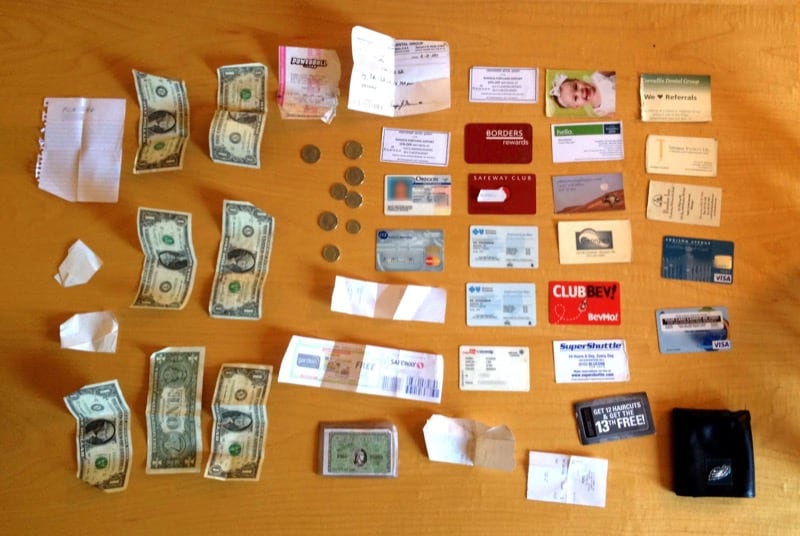
6) Take a photo of your wallet's content
This is in the case you lose your wallet or it gets stolen, you will know exactly its content and you will be able to act (e.g. you immediately know which cards to block).
Depending on where the photo will be stored, you may obscure personal info of the picture you have taken with Photoshop or similar (e.g. CC numbers, info on documents,...).
Quick important advice: store this photo in your online-accessible encrypted storage. Read this article I wrote if you wanna read more about digital privacy protecting tricks when you travel click here.
7) Save your most important phone numbers
Save all of the needed local numbers (police, ambulance, tourist police...) and personal numbers (your insurance, your bank, your CC provider,...) in the memory of your phone already. So, in case of need, you just have to push one button to reach out to them. Remember: the more you prepare before a possible dramatic event happen, the easier your life will be after it happens :)
Also, I advise you to write down those numbers in a small sheet (5 cm x 10 cm) that you always carry with you in your wallet. So that info is in a second place that is not your phone (e.g. not dependent on your phone battery). Don't forget to coat that sheet with plastic, so to make it waterproof.
8) Make a sheet with your CC providers' fees
If you are like me, you don't trust your bank and CC institution. In the last decades, they demonstrated being institutions that want to rule individuals and walk over them rather than offering a service and really care about their clients' money. So, chances are that you have many banks and CC providers or institutions.
So, probably you have many CC that you carry with you on your long-term travel (and it's better for you that you do so). You will have then different fees and % that they charge you for different actions with your CC (e.g. charging them, purchase online, withdrawal from ATM, etc).
I advise you to write all of those fees on a small sheet that you will then coat and make waterproof. I do this on the back of the just above-mentioned point's sheet. This way you will be covered when you need to face the decision (and if you travel long term this is likely to happen) if exchange your currency, withdrawal from a specific ATM or from a specific card. The difference may be small or even big (e.g. some cards may charge you even 5% if you withdraw from specific ATM or in a specific currency. Better to be aware of this rather than having wrong surprises.
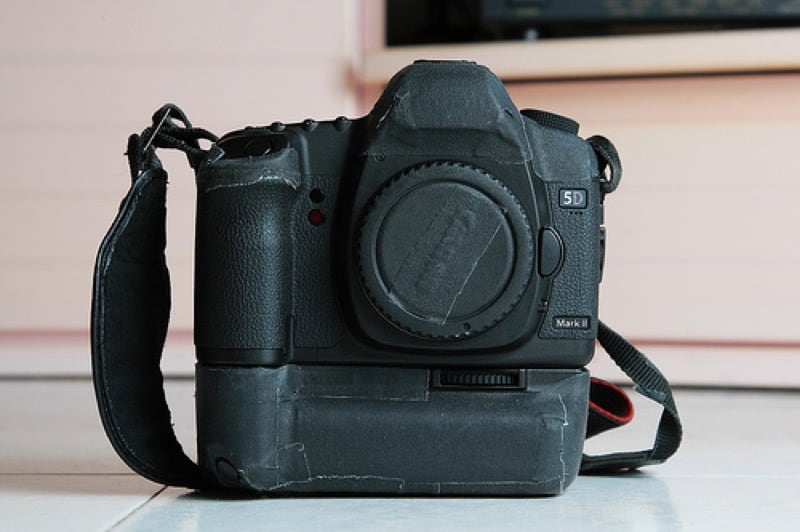
9) Cover your expensive brands' logos
Nobody thinks about that... if you carry with you an expensive Nikon or your MAC laptop, maybe it's better for you to cover them.
Those apparels are normally super expensive. People with bad intentions around the world (and home) may be just looking for tourists with such apparels to rob. Better to leave them with doubt and abandon the plan instead of inviting them to rob you and sell your valuable equipment.
I normally use a piece of normal black electrician tape to cover Nikon's logos on my camera. For my 13 inches MAC laptop I use such leather PU hard shell.
10) Bring with you an emergency kit
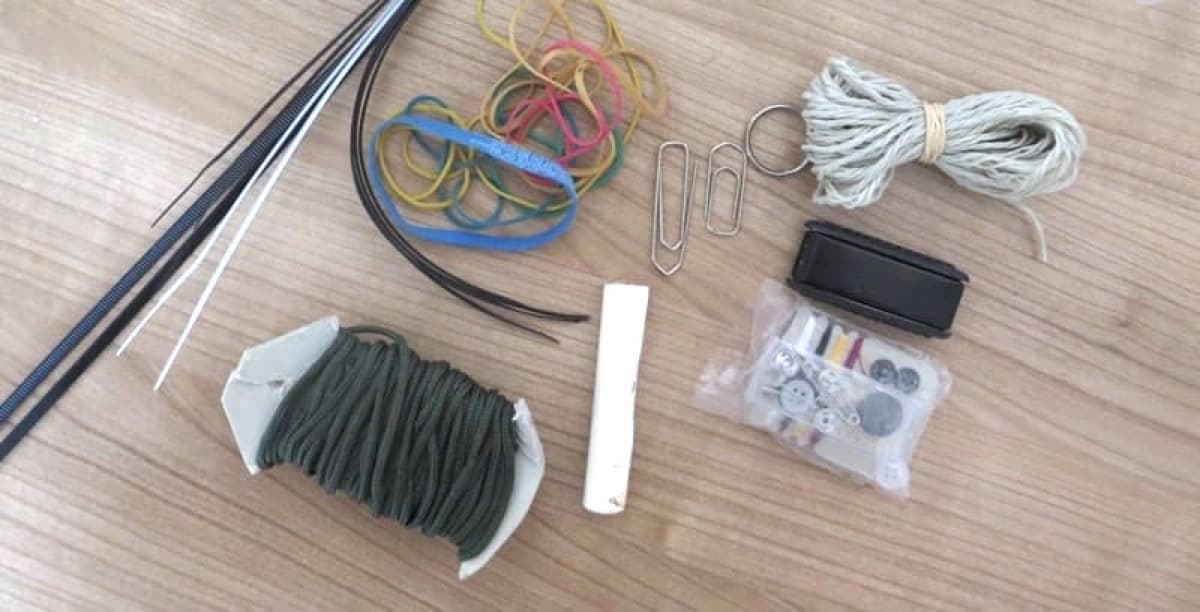
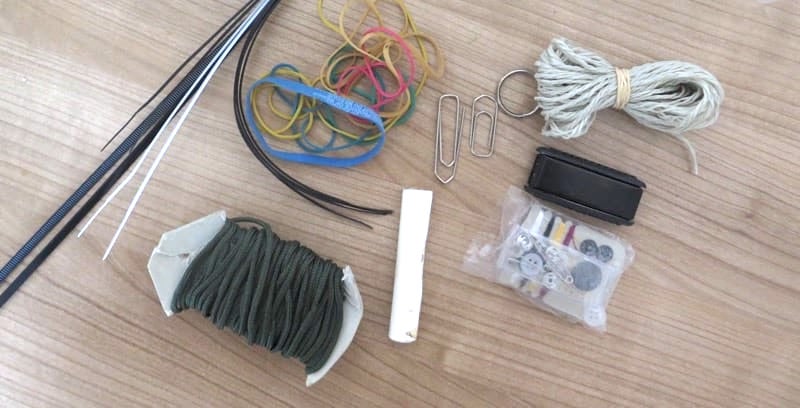
The kit can be contained in one of those travel transparent plastic pockets. I personally inserted the following content but it may vary depending on your trip:
- Spare batteries AAA and AA (tape those to avoid poles contact)
- A cheap mini torch like this one
- Tiny screwdrivers set (e.g. to quickly fix something inside your notebook on the go)
- mini sewing kit that you can buy here, build yourself or take from a 1-night stay in a luxury hotel :))
- 10 meters rolled string (e.g. to hang your clothes to dry)
- a fire starter (lighter won't pass airport security checks)
- a Lifestraw, which, trust me, is probably one of the most important objects that you can carry with you, regardless of the kind of trip you are heading to :)
- some rubber bands
- some paper clips
- some plastic bands
11) Don't put your personal info on luggage labels
Ok, if you check your luggage (ie. hold baggage), then you probably need to put your info on it. I am more referring to your carry on luggage (ie. hand baggage). Considering that that baggage is always with you, putting a label doesn't make any sense. Also, after you pick your baggage from the carousel at the airport, you don't need that label anymore and it's better for you to destroy it.
This is because some very personal information sits on it and can be read by anyone passing by. You don't want every person throwing a gaze to your backpack to know your surname and address isn't?
I hope this list helped you in some way. Talk to you soon :)